


FLASH NEWS
Boycotts and controversy, will Eurovision survive its biggest crisis?
Mark Savage dhe Ian Youngs – BBC
Organic molecules found on one of Saturn's moons

2025-10-05 10:55:50 / MISTERE&KURIOZITETE
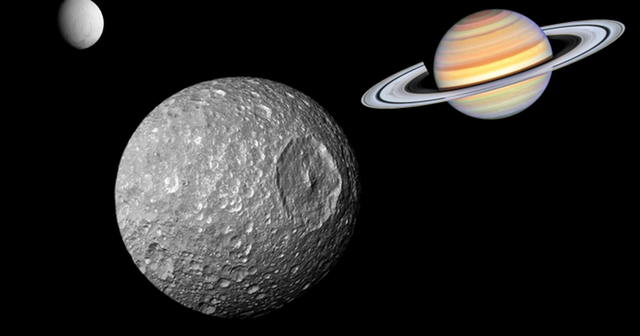
The large organic molecules that form the basis of life come from a mysterious ocean hidden beneath the ice of Enceladus, one of Saturn's most interesting moons.
Their traces have been identified thanks to a new analysis of data from the Cassini mission, which ended in 2017 and was carried out by NASA, the European Space Agency and the Italian Space Agency.
Published in the journal Nature Astronomy, the research was coordinated by Nozair Khawaja of the Free University of Berlin.
First observed up close in 1980 by the Voyager 2 probe, Enceladus has been at the center of scientific interest for years because its ocean hidden beneath the ice is believed to have all the necessary conditions for the emergence of life.
Over the years, this suspicion has become increasingly well-founded, thanks in part to data collected by the Cassini probe, which entered Saturn's orbit in 2004 and visited several of its moons, including Enceladus.
It was "Cassini" that first demonstrated that the surface of this moon is covered by a thick layer of ice, in which large cracks open, spewing powerful streams of dust and ice, similar to geysers.
This activity led to the hypothesis that beneath the ice lies an ocean with heat sources, such as underwater volcanoes and fumaroles, capable of keeping water in a liquid state.
Ice particles ejected into space by Enceladus' geysers had been captured and analyzed by Cassini since its arrival, providing the first evidence of the presence of complex molecules, including precursors to amino acids, essential building blocks for life.
However, there was suspicion that the molecules were produced by changes caused by cosmic radiation.
Now, new data analyses remove any doubt and confirm that these complex organic molecules come directly from Enceladus' ocean.
Previously unseen molecules were also discovered, such as aliphatic compounds, characterized by chains of carbon atoms, and other organic molecules containing nitrogen and oxygen.
"It's fantastic to see new discoveries emerging from Cassini data, nearly two decades after they were collected. It shows the long-term importance of science missions like this," said Nicolas Altobelli, Cassini scientist for ESA.
The discovery strengthens the hypothesis that Enceladus' ocean possesses all the necessary conditions to support primordial life forms and gives new impetus to the planning of a future mission capable of reaching its icy surface and searching for any traces of life.

Happening now...















Karmën nuk e ndalon dot Sali Berisha!
Nga Bato Kosova
ideas

Will Berisha take stock of the first in his second speech?
Nga Preç Zogaj

First Secretary of the Democratic Party
Nga Indrit Vokshi

"Topple" Edi Rama by lying to yourself...
Nga Patrik Sadikaj
top



Alfa recipes




TRENDING 




services
- POLICE129
- STREET POLICE126
- AMBULANCE112
- FIREFIGHTER128