


FLASH NEWS
Boycotts and controversy, will Eurovision survive its biggest crisis?
Mark Savage dhe Ian Youngs – BBC
Scientists create embryos from human skin DNA

2025-10-01 16:30:21 / MISTERE&KURIOZITETE
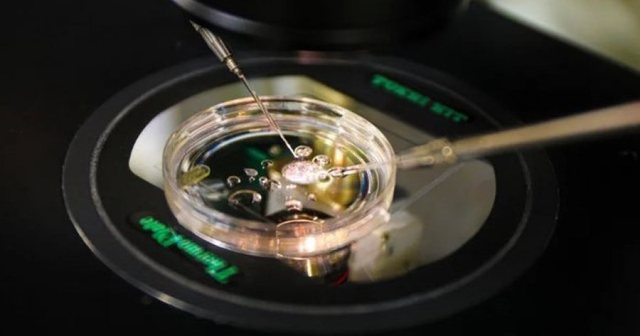
American scientists have, for the first time, created early-stage human embryos by manipulating DNA taken from human skin cells and then fertilizing it with sperm.
The technique can overcome infertility due to old age or disease, using almost every cell in the body as a starting point for life.
The method requires significant refinement, which could take a decade, before a fertility clinic can consider using it.
Experts said it was an impressive advance, but there needed to be an open discussion with the public about what science was making possible.
Reproduction used to be a simple story of a man's sperm meeting a woman's egg. They unite to form an embryo, and nine months later a baby is born.
Now scientists are changing the rules. This latest experiment starts with human skin.
The Oregon Health & Science University research team's technique takes the nucleus, which contains a copy of all the genetic code needed to build the body - from a skin cell.
This is then placed inside a donor egg that has had its genetic instructions removed.
So far, the technique is similar to that used to create Dolly the sheep, the world's first cloned mammal, born in 1996.
However, this egg is not ready to be fertilized by sperm as it already contains a complete set of chromosomes.
You inherit 23 of these DNA strands from each of your parents, for a total of 46, which the egg already has.
So the next stage is to convince the egg to shed half of its chromosomes in a process that researchers have called "mitomeiosis" (the word is a portmanteau of mitosis and meiosis, the two ways cells divide).
The study, published in the journal Nature Communications, showed that 82 functional eggs were created. These were fertilized with sperm and some progressed to the early stages of embryo development. None developed beyond the six-day stage.
"We achieved something that was thought to be impossible," said Prof Shoukhrat Mitalipov, director of the Center for Embryonic Cell and Gene Therapy at Oregon Health & Science University.
The technique is far from perfect, as the egg randomly chooses which chromosomes to shed. It should end up with one of each of the 23 types to prevent disease, but it ends up with two of some and none of others.
There is also a poor success rate (about 9%) and the chromosomes miss an important process where they rearrange their DNA, called crossover.
Prof. Mitalipov, a world-renowned pioneer in this field, told me: "We need to perfect it."
"Ultimately, I think that's where the future is going, because there are more and more patients who can't have children."
This technology is part of a growing field that aims to create sperm and eggs outside the body, known as in vitro gametogenesis.
The approach is still at the level of scientific discovery and not clinical use, but the vision is to help couples who cannot benefit from IVF (in vitro fertilization) because they do not have sperm or eggs to use.
It can help older women who no longer have viable eggs, men who don't produce enough sperm, or people whose cancer treatment has left them infertile.
This field is also rewriting the rules of parenting. The technique described today doesn't have to use a woman's skin cells - it can use a man's too.
This opens the door for same-sex couples to have children who are genetically related to both partners. For example, in a male same-sex couple, one man's skin can be used to produce the egg and the sperm of a male partner is used to fertilize it.
"In addition to offering hope to millions of people with infertility due to a lack of eggs or sperm, this method would allow the possibility for same-sex couples to have a child genetically related to both partners," said Prof. Paula Amato, from Oregon Health & Science University.
Build public trust
Roger Sturmey, professor of reproductive medicine at the University of Hull, said the science was "important" and "impressive".
He added: "At the same time, such research reinforces the importance of ongoing open dialogue with the public about new advances in reproductive research."
"Such advances remind us of the need for strong governance, to ensure accountability and build public trust."
Professor Richard Anderson, deputy director of the MRC Centre for Reproductive Health at the University of Edinburgh, said the ability to generate new eggs "would be a major breakthrough".
He said: "There will be very significant safety concerns, but this study is a step towards helping many women have their genetic children."/ BBC


Happening now...















Karmën nuk e ndalon dot Sali Berisha!
Nga Bato Kosova
ideas

Will Berisha take stock of the first in his second speech?
Nga Preç Zogaj

First Secretary of the Democratic Party
Nga Indrit Vokshi

"Topple" Edi Rama by lying to yourself...
Nga Patrik Sadikaj
top



Alfa recipes




TRENDING 




services
- POLICE129
- STREET POLICE126
- AMBULANCE112
- FIREFIGHTER128