


FLASH NEWS
Albania successful "online", but over 100 years behind the EU in education, infrastructure and governance

2025-11-10 10:03:49 / POLITIKË
The Vienna Institute for International Economic Studies, through the "Converge2eu" initiative, has collected data on the progress of 6 Western Balkan countries towards the European Union, as part of the Berlin Process.
After the suspension of EU enlargement in 2014, the Berlin Process was created as a bridge between the union and the countries of the Western Balkans, including Albania, Kosovo, North Macedonia, Montenegro, Serbia and Bosnia and Herzegovina.
For these countries, the study assessed progress towards the EU in relation to 8 areas, such as: Economy, social development, health, education, environment, governance, digitalization and infrastructure. The data from this study were presented at the 'Ignita' forum, held in Prizren, Kosovo in October this year.
The study also made recommendations regarding the future focus of the Western Balkan countries as a condition for EU membership. The Vienna Institute emphasizes that the environment, education and infrastructure should be the main focus of policymakers in the six countries. On the other hand, the study emphasizes that the only aspect where all countries have significant progress and proximity to EU standards is digitalization. In this category, the study evaluates Albania with only 9 years of difference from the European Union countries.
According to Vienna Institute economist Branimir Jovanovic, “'Converge2eu' aims to reformulate the concept of compliance with EU standards, focusing on how people in the region actually live, how this compares to the European Union, and whether these conditions are improving or not” – underlining once again the depth and importance of this study.
Ranking of the 6 Western Balkan countries
In economic terms, Albania ranks second in terms of proximity to EU standards. Serbia ranks first with 35 years away from the EU, Albania second with 53 years, followed by North Macedonia with 59 years, and Montenegro with 72 years. The study further estimates that Kosovo and Bosnia and Herzegovina are both over 100 years away from EU economic standards.
But the opposite is assessed in the social aspect, where Kosovo ranks first. According to the study, Kosovo's social support system is 19 years behind that of the European Union, while Serbia ranks second with 51 years away from the EU. The ranking then follows Montenegro with a difference of 59 years and Albania, which according to the study has a 71 year difference with the EU when it comes to social protection. At the bottom is North Macedonia with over 100 years difference from EU standards, while the Bosnian social system is judged by the Institute to be moving away from EU standards.
Kur flitet për shëndetësinë, Instituti gjykon se progresin më të ndjeshëm e ka bërë Maqedonia e Veriut, ku sistemi shëndetësor ka 7 vite diferencë nga ai i BE-së. Mali i Zi renditet i dyti me 17 vite, ndërkaq që Shqipëria renditet e treta me 39 vite diferencë nga standardi shëndetësor i BE-së. Kosova renditet e katërta me 41 vite nga BE. Raporti vë në fund të klasifikimit Bosnje-Hercegovinën me 89 vite diferencë nga BE-ja dhe Serbinë si të fundit, me mbi 100 vite diferencë nga standardet e BE-së për sistemin shëndetësor.
Arsimi, i cili u përmend në raport si pikë e veçantë tek e cila të gjitha vendet duhet të investojnë, renditet si fusha më e dobët e pothuajse të gjitha vendeve. Me përjashtim të Bosnje-Hercegovinës, sistemi arsimor i së cilës ka 18 vite diferencë me standardet e BE-së, vendet e tjera, duke përfshirë dhe Shqipërinë, vlerësohen si në largim nga standardet e BE-së.
E njëjta situatë paraqitet në aspektin e politikave mjedisore, ku të gjitha vendet paraqiten me problematika të thella. Shqipëria sipas studimit është të paktën 100 vite larg BE-së në këtë aspekt, e po ashtu dhe Kosova. Të gjitha vendet e tjera nga ana tjetër vlerësohen si në largim nga standardet e Bashkimit Evropian.
Cilësia e qeverisjes për të gjashta vendet ishte gjithashtu objekt studimi. Kosova vlerësohet si me qeverisje më afër Unionit në raport me vendet e tjera, 26 vite larg standardit të BE-së. Renditja vijon me Maqedoninë e Veriut me cilësi qeverisjeje 40 vite larg BE-së, të ndjekura nga Mali i Zi me një diferencë prej 57 vitesh, e Shqipëria që ndodhet 64 vite larg BE-së në qeverisje. Serbia renditet e parafundit me mbi 100 vite diferencë në qeverisje nga standardi i BE-së, ndërkaq që Bosnje-Hercegovina është i vetmi vend i renditur si në largim nga standardet e BE-së në fushën e qeverisjes.
Raporti i Institutit vëren arritje nga Ballkani Perëndimor në digjitalizim, ku në Serbi është 4 vite larg atij të BE-së, ndërkaq që në Shqipëri diferenca me BE-në është 9 vite. Serbia e Shqipëria ndiqen nga Maqedonia e Veriut me 16 vite larg nga niveli i digjitalizimit të Unionit, e nga Mali i Zi me 63 vite. Bosnje-Hercegovina vlerësohet si në largim nga standardet e BE-së.
Infrastruktura e vendeve të Ballkanit Perëndimor lë për të dëshiruar në raport me standardet e BE-së. Kjo konfirmohet edhe nga studimi që vlerëson se infrastruktura e Shqipërisë, Serbisë, Maqedonisë së Veriut, Malit të Zi e Bosnje-Hercegovinës është mbi 100 vite larg BE-së, me Kosovën që renditet edhe më ulët, me cilësi infrastrukture në largim nga standardet e BE-së.
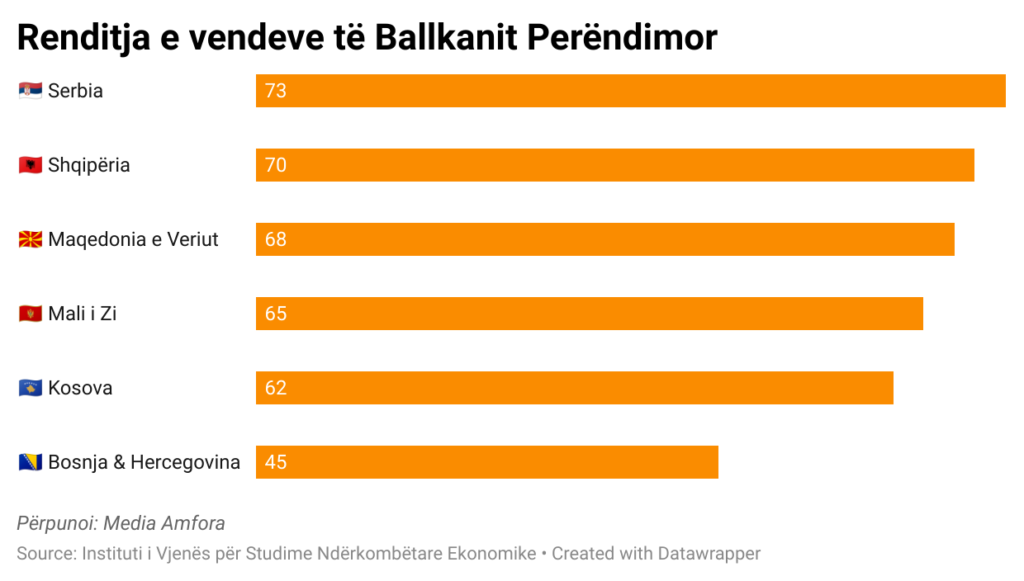
Ekipi i Amforës përpunoi renditjen e përgjithshëm të vendeve në një tabelë të pikëzuar, e cila ka për qëllim të tregojë afërsinë dhe largësinë e vendeve të Ballkanit Perëindor në raport me standardet e BE-së.
Si metodologji është përdorur një rankim sasior e cilësor i të gjitha kategorive. Rankimi cilësor i ponderuar 60% për nga rëndësia, ndërkaq që rankimi sasior 40%. Për rankimin sasior, kategori të ndryshme largësish nga standardi i BE-së pikëzohen si më poshtë: 0–10 vjet → 5 pikë, 11–30 vjet → 4 pikë, 31–60 vjet → 3 pikë, 61–100 vjet → 2 pikë, mbi 100 vjet → 1 pikë, “Diverging” (duke u larguar) → 0 pikë.
Në total, maksimalja që Amfora i jep një shteti të Ballkanit Perëndimor është 40 pikë e minimalja zero. Ndërkaq metoda cilësore vë si më të rëndësishme digjitalizimin, ekonominë, qeverisjen e mjedisin, duke bërë një rankim në bazë të këtyre kritereve. Të dyja metodat e përmbledhura japin grafikën e mëposhtme.
Metodologjia e studimit të Institutit të Vjenës
Për secilën nga 8 fushat e përzgjedhura të studimit – ekonomia, shëndetësia, arsimi, mbrojtja sociale, digjitalizimi, mjedisi, qeverisja e infrastruktura – studiuesit e Institutit të Vjenës kanë përzgjedhur disa kategori që janë përdorur për t’i vlerësuar këto fusha. Për ekonominë, studimi ka përdorur kategori si prodhimi për frymë, të ardhurat mesatare bruto, paga minimale, pensionet mesatare dhe produktiviteti për punëtor.
Për shembull, paga minimale në Shqipëri është 385 euro, e cila sipas studimit është 40 vite larg pagës minimale të BE-së. Në Serbi, paga minimale është 544 euro, të cilën studimi e vlerëson si 25 vite larg pagës minimale të BE-së. Ky krahasim është bërë për të gjashta vendet, në tetë fushat objekt të këtij studimi, duke përdorur nënkategoritë e mësipërme për të nxjerrë konkluzionet.
Në aspektin social, studimi ka përdorur metrika si papunësia, punësimi, varfëria, pabarazia dhe pabarazia gjinore në punësim. Për shëndetësinë, janë përdorur si indikatorë shpenzimi publik për shëndetësinë, jetëgjatësia, vdekshmëria e të vegjëlve, numri i krevateve të spitaleve dhe numri i mjekëve. Niveli i arsimit është vlerësuar në gjashtë vendet duke përdorur fusha studimi si shpenzimet publike për arsimin, pikët në PISA, regjistrimi e diplomimi në dhe nga shkolla e lartë, fuqia punëtore me arsim të lartë dhe norma NEET (individët që nuk janë as në punë, as në shkollë e as nuk po trajnohen).
Cilësia mjedisore në gjashtë vendet bazohet në tregues si vdekja e parakohshme, përqindja e energjisë së rinovueshme në treg, intensiteti energjetik, intensiteti i përdorimit të karbonit dhe ripërdorimi i mbetjeve.
Governance, a very important aspect for any country, is measured by the study using metrics such as voice and accountability, political stability, government efficiency, regulatory quality, legal order and corruption. The study measures the degree of digitalization of countries through the number of households with internet access, use of online government services, businesses with websites, exports of ICT (Information and Communication Technology) services, value added and employment in ICT. Finally, the study assesses the infrastructure of the six countries by taking into account indicators such as the length of roads, the number of railway tracks, the number of airports and the installed electricity capacity.
According to the study, there are a number of areas in which Albania is falling short of EU standards. This includes average pension, public spending on health, number of doctors, gender gap in employment, public spending on education, average PISA scores, carbon intensity, waste recovery, accountability voice, political stability, regulatory quality, exports in ICT services and number of railway tracks.
Meanwhile, Albania is over 30 years behind the EU in areas such as higher education attainment (47 years behind), premature deaths (60 years behind), energy intensity (84 years behind), control of corruption (31 years behind), value added in ICT services (56 years behind), employment in the ICT sector (44 years behind) and number of airports (33 years behind). The study also ranks Albania as over 100 years behind the EU in indicators such as the number of individuals not in education, employment or training (NEET rate), as well as in the length of roads and the capacity of electrical installations.
The study also highlights areas where Albania's standards are in line with those of the European Union. These categories include a well-educated workforce, the market share of renewable energy, the number of households with internet access, and the use of digital government services.
Finally, it seems that Albania has made progress in a number of areas, but there are significant shortcomings in education, environment, infrastructure and governance. Substantial institutional and social reforms remain key to achieving EU standards in these areas as well./ Ruel Domi, Amfora.al
Happening now...




Boycotts and controversy, will Eurovision survive its biggest crisis?
Mark Savage dhe Ian Youngs – BBC






Karmën nuk e ndalon dot Sali Berisha!
Nga Bato Kosova
ideas

Will Berisha take stock of the first in his second speech?
Nga Preç Zogaj

First Secretary of the Democratic Party
Nga Indrit Vokshi

"Topple" Edi Rama by lying to yourself...
Nga Patrik Sadikaj
top



Alfa recipes




TRENDING 




services
- POLICE129
- STREET POLICE126
- AMBULANCE112
- FIREFIGHTER128