


FLASH NEWS
The Warsaw Treaty as a union of communists/ Albania's role and the great decline

2024-07-14 13:27:53 / JETË
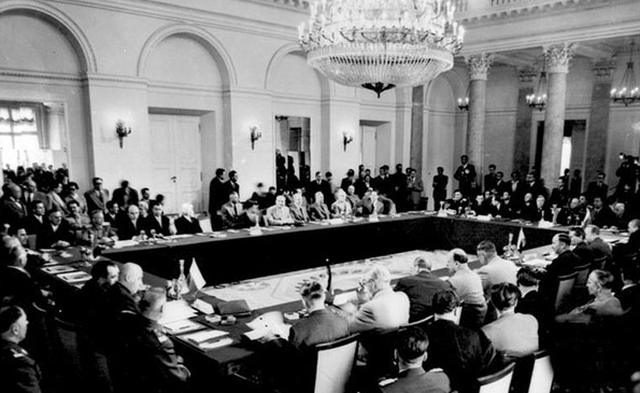
On May 14, 1955, Albania, Bulgaria, Czechoslovakia, East Germany, Hungary, Poland, Romania and the Soviet Union signed the Warsaw Pact, with the aim of mutual protection of the signatories of the treaty.
The Warsaw Pact was a League of Communist States of Europe, led by the Union of Soviet Socialist Republics, signed on May 14, 1955 in Warsaw, for the purpose of friendship, cooperation and mutual assistance between Albania, Bulgaria, the German Democratic Republic , Poland, Romania, the Union of Soviet Socialist Republics, the Socialist Republic of Czechoslovakia and Hungary.
The pact committed its members to consultations on matters of common interest and to immediate military assistance in the event of an attack in Europe on one or more members of the pact. After the expiration of the 20-year term, the term of the pact was automatically extended for another 10 years, if no member withdrew a year ago.
The main bodies of the pact based in Moscow were: the Political Council Bureau (Polyburo) and the Joint Chiefs of Staff. The USSR always had the High Command of the armed forces.
They were IS Konjev from 1955-60, AA Greçko 1960-67, II Jakupovskij 1967-76 and from 1977 VG Kulikovi. The stationing of Soviet troops in partner countries was regulated by special bilateral agreements.
Background
The pact aimed at strengthening friendship, cooperation and mutual assistance between these countries, as well as ensuring and maintaining peace. The pact entered into force on June 5 of the same year.
The Warsaw Pact was developed as a political instrument in the hands of the USSR, as the leading power of the Eastern Bloc.
The efforts of the insurgent Hungarian government of I. Nagy, in October/November 1955, to withdraw Hungary's membership of the Warsaw Pact, were decisive for the march of Soviet troops into Hungary in November 1969. The efforts of communist reforms in Czechoslovakia, in 1968, seemed to the USSR not only as a deviation from the communist ideology, but also as a danger of keeping the League together.
After the march of Soviet troops into Czechoslovakia, in August 1968, Albania withdraws from the Warsaw Pact.
aims
Unlike the strategy of the Trans-Atlantic Organization of Nations, the Warsaw Pact has not published any defense concept against attacks. Various Western military circles, in this regard, claimed that in terms of command leadership, organization, training and weaponry, the Warsaw Pact was working on an offensive/offensive military strategy.
Looking at the spatial distribution of the Soviet troops, and their state of readiness, it could be concluded that the Warsaw Pact tried to ensure readiness for possible conflicts, without any special preparation and without any march.
The daily upgrade of the Warsaw Pact's conventional and nuclear weaponry meant that they were ready for any kind of war possible at the time. With this strategy, the Warsaw Pact pursued equality with the United States of America and conversional dominance in Europe. Likewise, in some Western European countries, it was thought that the armament, which exceeded the self-defense needs of the Warsaw Pact, was also used to suppress the interests of Western Europe, which in turn had previously (1949) created the Atlantic Alliance of North.
The exit of Albania
Albanian military forces never participated in the maneuvers organized in the framework of the Warsaw Pact.
From 1960, Albania no longer participated in any activity or meeting of the Warsaw Pact.
On September 12, 1968, after the invasion of Czechoslovakia by the forces of the Warsaw Pact, Albania declared its withdrawal from the Warsaw Pact.
The political collaborators of the dictator Hoxha would be the communists of China.
Capitulation
After the events of 89-91 where democracies were triumphing over dictatorships, which was followed by the fall of the Berlin Wall, this Warsaw Pact almost became non-existent.
The Berlin Wall as a separation between West Germany and the Soviet Union constituted their main strength in Europe.
At a conference of the remaining representatives in 1991, the Warsaw Pact was officially declared "dead". / Article from Alfapress.al
Happening now...









83 mandates are not immunity for Rama's friends
Nga Gentian Gaba
ideas

Teatri që fsheh prapaskenën
Nga Patrik Sadikaj
Berisha's red line and the black line of democracy in the DP
Besmir Semanaj

top


Alfa recipes




TRENDING 




services
- POLICE129
- STREET POLICE126
- AMBULANCE112
- FIREFIGHTER128