


FLASH NEWS
US quietly expands secret military base in Israel

2023-11-01 11:16:01 / BOTA
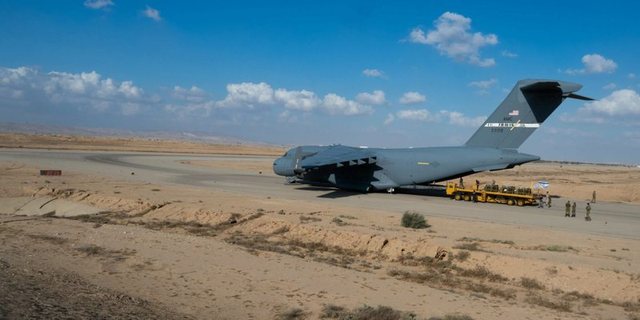
Government documents showing construction at a classified US base offer rare hints of a low-profile US military presence near Gaza.
Two months before Hamas attacked Israel, the Pentagon awarded a multimillion-dollar contract to build facilities for US troops for a secret base it maintains deep in Israel's Negev desert, just 20 miles from Gaza. Codenamed Site 512, the US base is a radar facility that monitors the skies for missile attacks on Israel.
However, on October 7, when thousands of Hamas rockets were launched, Site 512 saw nothing because it is focused on Iran, which is more than 1,100 kilometers away.
The US military is quietly moving ahead with construction at Site 512, a secret base atop Mount Har Qeren in the Negev, to include what government records describe as a "life support facility ".
Although President Joe Biden and the White House insist there are no plans to send US troops to Israel amid its war against Hamas, a covert US military presence in Israel already exists. And government contracts and budget documents show it's clearly on the rise.
The $35.8 million US troops facility, not publicly announced or previously reported, was obliquely referenced in an Aug. 2 contract notice from the Pentagon.
Although the Defense Department has made efforts to obscure its true nature — describing it in other records simply as a “worldwide classified” project — budget documents reviewed by The Intercept reveal that it is part of "Site 512". (The Pentagon did not immediately respond to a request for comment.)
Sometimes something is treated as an official secret, not in the hope that an adversary would never learn, but rather because the US government, for diplomatic or political reasons, does not want to officially admit it,” Paul Pillar told The Intercept. a former senior analyst at the CIA's counterterrorism center, who said he had no specific knowledge of the base.
"In this case, perhaps the base will be used to support operations elsewhere in the Middle East, in which any admission that they were organized by Israel, or involve any cooperation with Israel, would be inappropriate and likely to cause more negative reactions than benefits would result from the operations.”
The rare recognition of the US military presence in Israel came in 2017, when the two countries inaugurated a military base that the US government-funded VOA deemed "the first US military base on Israeli soil".
Israeli Air Force Brigadier General Tzvika Haimovitch called it "historic." He said: "We established an American base in the State of Israel, in the Israel Defense Forces, for the first time."
A day later, the US military denied it was a US base, insisting it was merely a "housing facility" for US service members working at an Israeli base.
The US military uses similarly euphemistic language to characterize the new facility in Israel, which its procurement records describe as a "life support area". Such obfuscation is typical of US military bases that the Pentagon wants to hide.
Site 512 has previously been referred to as a "cooperative security site": a designation intended to provide a low-cost, light-footprint presence, but applied on grounds that, as The Intercept previously reported, could accommodate up to 1000 troops.
Site 512, however, was not created to deal with a threat to Israel from Palestinian militants, but the danger posed by Iranian medium-range missiles. The overwhelming focus on Iran continues to appear in the US government's response to the Hamas attack.
In an effort to counter Iran - which supports both Hamas and Israel's northern rival Hezbollah, a Lebanese political group with a powerful military wing, both of which are considered terrorist groups by the US - the Pentagon has greatly expanded its presence in the Middle East. After the attack, the US doubled the number of warplanes in the region and stationed two aircraft carriers off the coast of Israel.
Key Republicans such as Senate Minority Leader Mitch McConnell, however, have condemned President Biden for his "supposed weakness on Iran." While some media accounts have said that Iran played a role in planning the Hamas attack, there have been indications from the US intelligence community that Iranian officials were surprised by the attack.
The history of US-Israel relations may lie behind the failure to recognize the base, an expert on US foreign military bases said.
"My speculation is that secrecy has been a stumbling block since US presidential administrations have tried to offer a pretense that they are not siding with Israel in the Israeli-Palestinian and Israeli-Arab conflicts," David Vine, a Professor of Anthropology at American University.
"The announcement of US military bases in Israel in recent years likely reflects a decline in that pretense and a desire to more publicly announce support for Israel."
The Intercept - Albanian: Hashtag.al
Happening now...











America may withdraw from Europe, but not from SPAK
Nga Gentian Gaba
ideas



top



Alfa recipes



TRENDING 




services
- POLICE129
- STREET POLICE126
- AMBULANCE112
- FIREFIGHTER128