


FLASH NEWS
NASA captures strange formation in the Sahara, older than dinosaurs

2025-12-14 20:28:08 / MISTERE&KURIOZITETE
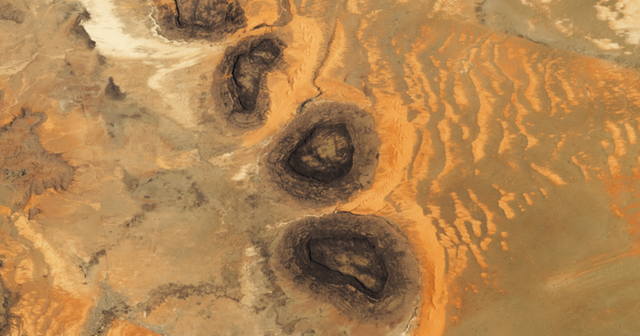
A new image from NASA's Earth Observatory revealed three black hills in Mauritania, remnants of the Paleozoic Era, according to sciencealert.com.
The three dark hills rising from the endless sands of the desert have attracted the attention of scientists, as they continue to form sand dunes and wind-carved spaces, visible even from orbit.
When an astronaut on the International Space Station captured a high-resolution image, three nearly identical hills, with dark, flat peaks, stood side by side.
To the east, the hills glowed with shades of red and gold; to the west, the sand disappeared altogether.
This contrast is a product of the interaction of geology.
These rolling hills, known as mesas, are covered with a thin layer of rock varnish, formed from clay, manganese, and iron oxides over thousands of years.
This varnish, partially stabilized by microorganisms, gives the mesas their dark color and has resisted millions of years of erosion, testifying to the geological stability of the planet.
Geologists believe that during the Paleozoic Era, the three mesas were part of a large rock formation, which was broken into isolated towers by water and wind erosion over millions of years.


Happening now...















ideas

Një ftesë për bashkim me dhunë ndaj Lapajt
Nga Ergys Mërtiri


The great loneliness of the West and liberal democracy
Nga The Economist
top







TRENDING 




services
- POLICE129
- STREET POLICE126
- AMBULANCE112
- FIREFIGHTER128