


FLASH NEWS
Albania in Washington, between symbolism and state seriousness

2026-02-20 11:04:08 / IDE
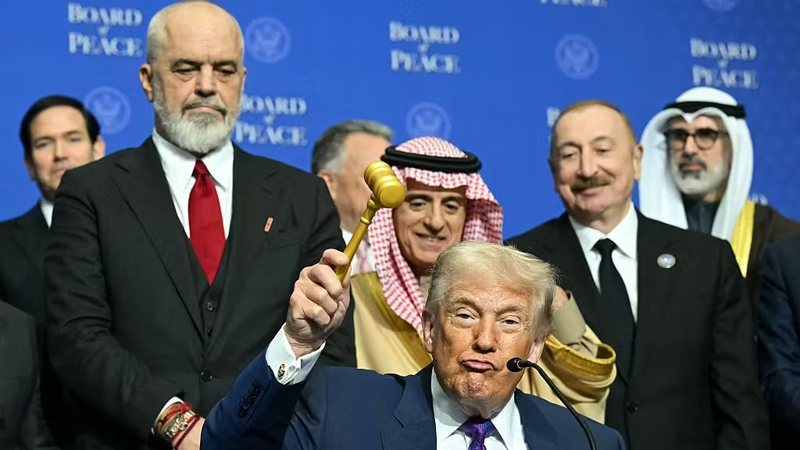
Prime Minister Edi Rama’s participation in a forum like the Peace Board in Washington immediately turned into another common Albanian battleground. One side proclaimed it a high-ranking diplomatic success; the other side downplayed it as a peripheral event, with no real weight in American policymaking. But, as is often the case, the truth is more complicated than the slogan.
For a small country like Albania, the presence in Washington is never insignificant. The relationship with the United States has been and remains the strategic axis of Albanian national security, from NATO membership to support for Kosovo. Every channel of communication with American decision-making circles is, in principle, an asset. Symbolism in diplomacy carries weight – and for small states, it often carries more weight than for great powers.
But symbolism is not enough.
The real debate should not be whether Rama was photographed in Washington or whether the forum had a higher or lower public profile. The essential question is: is Albania building a sustainable, institutional and bipartisan strategy in relation to the US, or is it personalizing foreign policy according to electoral cycles?
The reaction of the Albanian media was predictable. Some presented the event as evidence of the prime minister's "global profile", as proof that Albania is at the tables where big issues are discussed. Others treated it as an image operation, disconnected from domestic reality, where problems with corruption, the rule of law and immigration continue to weigh on the country's international perception.
Both approaches are partial.
It is true that modern diplomacy also involves image management. Leaders communicate, build networks, present narratives. But it is equally true that no forum replaces the silent, technical and continuous work between institutions: concrete agreements, joint projects, coordination on security, energy, technology and the region.
The Albanian problem is that every international move is read through the lens of internal party conflict. The opposition sees it as electoral capital for the government; the majority sees it as a seal of legitimacy against domestic critics. In this way, foreign policy, which in any consolidated democracy is the minimal area of national consensus, is transformed into an instrument of polarization.
This is state weakness.
A serious Albania must have a clear architecture of national interest: strong relations with the US, full European integration, strategic coordination with Kosovo, and regional stability. These are not the property of one party or one prime minister. They are long-term interests that must survive beyond mandates.
If participation in Washington is accompanied by concrete projects – investments, defense cooperation, advancement of regional issues – then it has real value. If it remains only at a declarative level, it will be dissolved in the usual Albanian media cycle.
In the end, this event is more a reflection of ourselves than a test of American diplomacy. Are we able to distinguish between national interest and partisan interest? Can we have a measured debate, where external success is not relativized by internal rivalry, but is not inflated for propaganda consumption?
Albania needs less euphoria and less cynicism. It needs institutional seriousness. Washington is important – but more important is whether Tirana knows how to behave like the capital of a mature state.
Happening now...







ideas


top

Alfa recipes








services
- POLICE129
- STREET POLICE126
- AMBULANCE112
- FIREFIGHTER128