


FLASH NEWS
The unknown history of the "Missing City": It was Esat Pash Toptani, who in 1907, changed the 'face' of the 'Old Bazaar', asking Tirana merchants to adapt to the times...

2025-07-19 09:08:25 / JETË
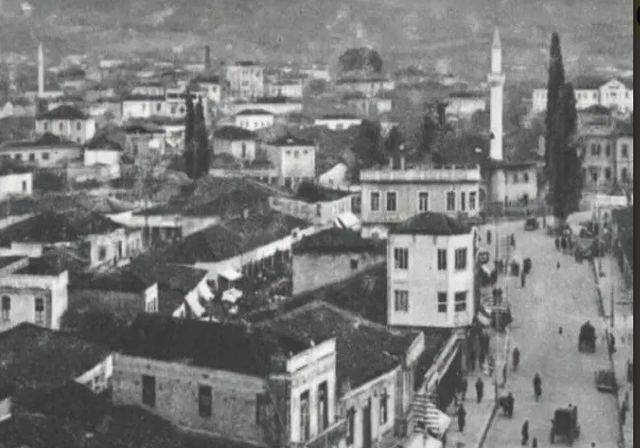
The “New Market”, located near the intersection of “Tefta Tashko” and “Hoxha Tahsim” streets, is a new landmark in the territory of Tirana. It would be the year 1928, which would separate the commercial activity of the “Old Market”, since although with a capacity of nearly 800 shops, by moving the village products, vegetables, fruits and meat, to a new location, its management would be facilitated. The “New Market” was built near the Old one to the northeast of it, in the so-called 'Parthern' square where 60 shops would be built. Only after 1939, would it take the name “New Market”, which it still bears today.
Tirana's "Old Bazaar", otherwise known as "The "Tirana Bazaar" was born with the city and gave Tirana its commercial character throughout the centuries. For almost 300 years, the Bazaar developed as the economic center of the city, the meeting point located at the intersections of the "Dibra" road with the "Durrës" road, the "Shkodra" road with the "Elbasan" road, was the most favorable position to develop intercity trade.
The commercial activity reached its glory in the late 1800s, when the capacity reached 727 shops. Each street had its own professionals, so the citizen knew where to go and what he would find in each of them. It was Esat Toptani, who in 1907, changed the “face” of the “Market”, asking the merchants to adapt to the times, first paving the bazaar alleys with cobblestones and then installing modern shutters on the doors and windows.
A decision in December 1959 (when the communist regime was installed in Albania) would announce the demolition of the “Old Bazaar”, without any explanation to the shop owners. The right to react was denied, so reactions were spontaneous and not organized in the form of strikes or rallies.
The “Bazar” was demolished on December 19, 1959, making way for the construction of the Palace of Culture. The shops that had been operating in that “Bazar” for three centuries were not moved and there was no plan for them to relocate, very few of them managed to find alternative spaces. Its destruction for the Tirana community is still a wound that has not healed.
The city lost its heart. The “Market”, living as a town within the city, functioned as the largest public space, a meeting point and a point of reference for residents.
The commercial character of the "Old Market", where everything from copper crafts to gold-embroidered linens were sold, did not find a place in the "New Market", which from the beginning was conceived as an extension of the "Market", without having the intention of replacing it. The "New Market", preserved its original character, that of fruit and vegetables and fish and meat markets.
The "Vjosa" Hotel, another vestige and landmark of the "New Market", was demolished in April 2019, while the last remaining traces of the "Old Market" shops, "Broadway Street", were demolished in May 2020, to make way for the construction of a multi-story tower, shaped like a human head.
The "New Bazaar" was revived with an investment from the American-Albanian Development Fund, launched in 2011 and inaugurated on March 14, 2017. The redevelopment of the Bazaar was achieved after three types of interventions:
1) Reconceptualization and construction of the Green Market (fruit and vegetable market.
2) Reconstruction of existing facilities, including the Meat and Fish Market.
3) Restoration of buildings declared Cultural Monuments. The author of this investment (AADF), with a capital of 3 million USD, in cooperation with the Municipality of Tirana and the Albanian Government, aimed at the project Development of the area for Tourism - TID Tirana.
The project included interventions in the reconstruction of public space and several private buildings declared second category cultural monuments. The project reconceptualized the urban space, treating the floor and facades of the buildings surrounding the square. Unused or poorly managed areas came to light, becoming an integral part of this urban ensemble.
“Pazari i Ri”, today is a pedestrian zone of Tirana, and functions as an open shopping center with restaurants, bars and a fish market in its center, and a fruit and vegetable market. This intervention has brought visible changes to the area, where although the main purpose is the “Pazari”, with trade as the dominant element of the public space, the largest share of customers in the area are mainly the bars and restaurants of the area.
At the time of inauguration, the "New Market" area had 15 cultural monuments protected by law, some of which have been restored and put into public use.

Happening now...







America may withdraw from Europe, but not from SPAK
Nga Gentian Gaba
ideas



top



Alfa recipes

TRENDING 




services
- POLICE129
- STREET POLICE126
- AMBULANCE112
- FIREFIGHTER128