


FLASH NEWS
Rama-Meloni Pact/ '144 beds, most of them empty'/ FAZ: How the 1 billion Euro Gjadri camp is failing

2025-08-06 23:53:50 / POLITIKË
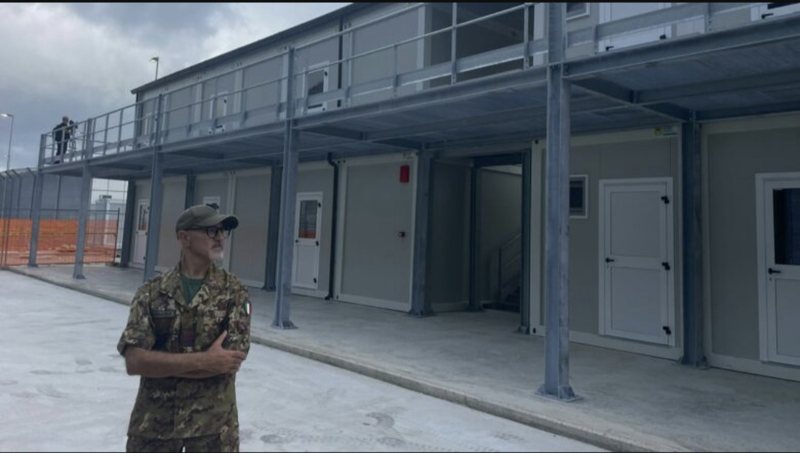
The well-known German daily 'Frankfurter Allgemeine Zeitung' has dedicated a long article to the Italian immigrant treatment center in Gjadra.
The newspaper writes that the investment, which could touch 1 billion euros, could result in a failure, not only for Italy, but also for the entire idea of the European Union to deal with migration to third countries.
144 beds, most of them empty
The Italian deportation camp in Gjadra, in northern Albania, has a capacity of 144 beds, but currently houses only 27 men. 113 employees of the operating company have been deployed to assist them, including medical personnel, legal experts and cultural mediators. In addition, there are police officers, carabinieri and immigration officials. Italy's second camp in Albania, the initial reception center in the port of Shëngjin, with a capacity of 880 people, has been practically empty since the two camps opened in October 2024.
The Ombudsman for Prisoners of the City of Rome and the Lazio Region, to which the two camps belong, had the opportunity to visit the extraterritorial facilities for the first time last week and conduct interviews with asylum seekers housed there. Reports of their visit in the Italian media provide new insights into the daily routine of the two facilities.
The list of 'safe countries' of origin is no longer valid
The men currently in the Gjader camp are mainly from Algeria, Ghana, Senegal, India and Pakistan. The three African countries are on the list of 19 countries of origin classified as 'safe' by the government in Rome, while the two Asian countries are not.
But with the ruling of the Court of Justice of the European Union (ECJ) on Friday, the list of 'safe countries' drawn up by the government in Rome is no longer valid. The judges in Luxembourg ruled that a country of origin can only be classified as 'safe' if it applies to all citizens of that state. They also demanded that the criteria for classification as a 'safe country' be transparent and thus 'inviolable by the court'. The plan for deportations to safe countries of origin after an accelerated asylum procedure in extraterritorial camps in Albania, approved by Prime Minister Giorgia Meloni in November 2023, has thus been put under a final judicial stay for the time being.
The migrant camps in Albania have reflected this legal reality for months. Italian courts had deemed the transfer of migrants (male, adult) by boat from the Mediterranean directly to Albania a violation of EU asylum law and ordered their transfer to facilities in Italy. These decisions are the reason for the empty beds in the camps.
Costs up to 1 billion euros
The only reason why some migrants have taken shelter in Gjadra is because, since April, it has been used as a conventional deportation camp for asylum seekers whose applications were rejected under Italy’s regular procedures. After their visit, the ombudsmen found no fault with the conditions in Gjadra, built on the site of a former military airport. Quite the contrary. However, they noted that there is sufficient capacity in Italy’s existing deportation camps and that an additional facility in Albania is therefore unnecessary.
The cost of running the camps in Albania, initially limited to 5 years, is estimated to be between 850 million and 1 billion euros. The camps are 'the most expensive scandal of recent years', said former Prime Minister Matteo Renzi of the liberal opposition party 'Italia Viva'.
The extraordinary costs of the camps in Albania are a political burden for Meloni.
Meloni and her center-right coalition's usual criticism of "red-robed judges" who pursue their own (left-wing) political agenda rather than applying the law resonates with their supporters. But the legal uncertainties were foreseeable even before the decision.
Meanwhile, Meloni is working on the second, much more successful pillar of her migration policy. In unannounced visits, she met with President Kais Saied in Tunisia last week and then with Turkish President Recep Tayyip Erdogan and Libyan Prime Minister Abdul Hamid Dbeiba in Istanbul. Both meetings focused on further intensifying cooperation in the fight against human trafficking, which has contributed significantly to the decline in migrant arrivals in Italy this year and last.
Finally, Rome hopes that the package for a new common EU asylum system will enter into force sooner, not as planned in June 2026. It aims to give member states more options for accelerated asylum procedures, the introduction of a common list of safe countries of origin and faster returns./ 'Frankfurter Allgemeine Zeitung' /
Happening now...
















America may withdraw from Europe, but not from SPAK
Nga Gentian Gaba
ideas



top



Alfa recipes




TRENDING 




services
- POLICE129
- STREET POLICE126
- AMBULANCE112
- FIREFIGHTER128