


FLASH NEWS
Built by King Pyrrhus, archaeologists begin their search for the ancient theater in ancient Antigone

2024-09-13 21:33:03 / EKONOMI&SOCIALE
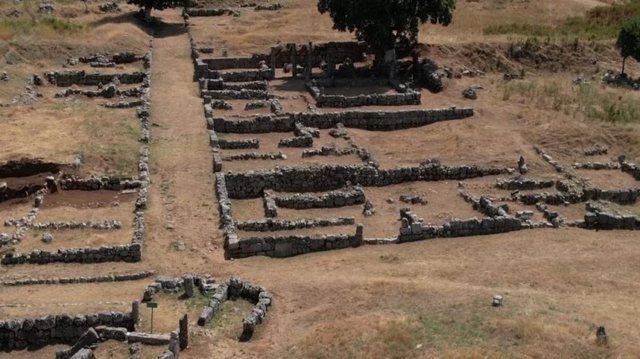
In the ancient city of Antigone, in the south of Albania, archaeologists started looking for the ruins of the ancient theater this year.
After conducting geo-physical studies, archaeologists are optimistic that they will be able to find the area where the theater and some of the main monuments of the city lie.
This year's excavations also brought to light new discoveries where the finding of construction structures belonging to the earliest periods of the city that was built by King Pirro is valued.
According to archaeologists around the year 295 BC, this hill under the foot of Mount Lunzheria and in front of today's city of Gjirokastra was chosen by the architects of King Pyrrhus to build the city that would perpetuate the name of his wife Antigone.
It was the city of the first love of a king who lived almost 150 years after Antigone was burned by the Romans who crossed and burned with it about 50 other cities of Illyria and ancient Epirus.
Albanian and Italian archaeologists and students climbed the hill that owns the entire Drino river valley this September in the fourth year of an archaeological mission that this time also aims to discover the ancient theater.
"The new thing this year", says archaeologist Roberto Perna, "is that we are starting to look for the theater".
"We have completed the geophysical study that has provided some hypotheses for some areas where we think to locate the theater. We are starting to look for it this year with a clearer idea and soon I am sure that we will have new news", says Mr. Perna.
Archaeologist Perna says that the excavations during these four years have given them the opportunity to deepen their knowledge of the city's organization with the discovery year after year of new buildings, passageways and numerous archaeological objects.
This year, says Mr. Perna, we were able to identify under the structures of the city built by King Pirro, older structures that speak of an even earlier civilization.
Albanian archeologist Sabina Veseli says that this year's excavations are bringing data that continue to help researchers to create clearer ideas about the size of the city and its life.
"It is the fourth year that we have been excavating in Antigone and we think that we will continue to work in the following years as the results have actually been very promising. We have focused mainly on the topography of the city, both in public squares and in private residences. This year, two new buildings have been discovered, which are very close to the Agora and can be auxiliary environments of the city's main square. Also, from the statistical excavation, we have found several levels of housing that belong to the old residents of Antigone."
This archaeological site, although at about 45 hectares in area and it is believed that only about 10% of the city has been discovered, continues to attract an increasing number of visitors year after year.
A small team works with passion for the maintenance and presentation of this important center, says the manager of this park Shkëlqim Guçe.
"The year 2024 has been focused on the works for the maintenance of the surrounding wall of the archaeological park, on the towers, crosses, road-passages but also on special monuments such as those on the main promenade of the city, but also on the northern and southern gates. The Acropolis as a main base of visitation to the church of Saint Michael but also to the paleo-Christian church in the south of the ancient city have been more visited. Here in the park we also have a small museum which has a historical overview of the construction of Antigone", he says.
The Albanian archaeologist Dhimosten Budina discovered the city in 1968 and through his finding of 14 voting tesserae the name of Antigone was learned.
Voting tesseras read "Antigoneon" and were bronze objects with which residents voted in referendums that were held from time to time on various issues in the city.
According to archaeologists, the finding of tesserae speaks volumes about the democratic decision-making of the time that led to the construction of a city with a perfect urban planning in the form of a chess box, where there is no lack of a wide road like today's boulevards and sidewalks that many newly built Albanian cities they no longer have them from the overload of constructions./ VOA


Happening now...









ideas



top



Alfa recipes



TRENDING 




services
- POLICE129
- STREET POLICE126
- AMBULANCE112
- FIREFIGHTER128