


FLASH NEWS
GOOD MORNING

2026-03-21 10:50:01 / IDE
There are deaths that do not take just one person with them, but that bring to light an entire society.
There are departures that reveal not only the pain of loss, but also the delayed shame for what was not said, not done, and not given in time. Such is the untimely departure from life of Namir Lapardha.
With his departure, our old culture was once again confirmed, in the most bitter way: the culture of “I will die without loving you.” That cold culture that teaches us to keep kind words inside, to save gratitude, not to express love, not to openly express appreciation, to behave as if time always waits for us. And then, when a person leaves, we explode in praise, in memories, in public mourning, as if with belated words we want to cover the void of what we did not give him while he was alive.
But the case of Namir is not only evidence of this emotional silence. It is also evidence of a deeper failure: the failure of society to recognize its valuable people in time, to place them where they belong in the moral, civic and public hierarchy of values. Because we do not only lack the word "I love you"; we also lack the words "this person deserves it", "this person has weight", "this person should be honored while he is still among us".
Our society often does not know how to appreciate the living. It knows how to mourn the dead.
It does not know how to honor a person in his life. It knows how to pay homage to him in his absence.
It does not know how to give him the place he deserves in time. It knows how to sing his praises when he no longer listens.
And this does not happen by chance. It happens because, in our country, the hierarchy of values is often not built on character, knowledge, honesty, nobility and ability, but on connections, interest, servility, advertising and false power. The good and capable man, in a healthy society, should be seen as a blessing to the community. But in a society uncertain in relation to value, he is often seen as a competitor. Not as an asset, but as a threat. Not as a model, but as a presence that highlights the shortcomings of others.
That is why it happens that a man of value is greeted not with admiration, but with envy; not with respect, but with envy; not with support, but with a silent fear. Because his presence becomes a mirror. His character embarrasses mediocrity. His ability shakes the small comfort of those who are accustomed to surviving not on merit, but on a whim, a scheme, an interest. And so, instead of elevating him, they set him aside. Instead of placing him where he belongs, they make him wait. Instead of honoring him, they relativize him. Instead of accepting him as a value, they treat him as someone who can be ignored.
Kjo është një nga padrejtësitë më të hidhura që mund t’i bëhet njeriut: t’ia njohësh vlerën vetëm pasi ai të mos “rrezikojë” më askënd me praninë e tij. Të flasësh lart për të vetëm kur ai nuk të bën më hije. Ta quash “figurë të rrallë” vetëm pasi ai të mos sfidojë më askënd me madhështinë e heshtur të karakterit të vet.
Në rastin e Namirit, kjo padrejtësi merr edhe trajtë konkrete. Në vitin 2021, Namirit i takonte të ishte deputet i Beratit. Jo si lëmoshë politike, jo si favor partie, por si meritë e natyrshme e një njeriu që kishte më shumë peshë qytetare, më shumë dinjitet përfaqësues dhe më shumë të drejtë morale se shumë të tjerë për të qenë zë i atij qarku. Nuk kemi të bëjmë vetëm me një njeri të mirë që nuk u vlerësua sa ishte gjallë, por me një njeri që duhej të ngrihej në një rol të caktuar publik dhe nuk u ngrit. Duhej të ishte deputet i Beratit në vitin 2021, sepse e meritonte. Dhe nuk u bë.
Kjo pyetje rëndon sot jo vetëm mbi ndërgjegjen e një partie, por mbi ndërgjegjen e një kulture të tërë politike: pse njeriu që duhej të përfaqësonte, u la jashtë? Pse u mbajt në hije një zë që mund të përfaqësonte Beratin me dinjitet? Pse, kur duhej të fliste merita, folën llogaritë? Pse, kur duhej të ngrihej vlera, u ul për të mos trazuar komoditetin e mediokërve?
Sepse ndonjëherë njeriun nuk e dëmton vetëm armiku. E dëmton edhe mosveprimi i të vetëve. E dëmton edhe heshtja e atyre që e dinin vlerën e tij, por nuk e kthyen atë vlerë në vendim. E dëmton edhe fakti që, në vendin e vet, nuk i jepet njeriut ajo që meriton, derisa detyrohet të marrë rrugën e ikjes.
Dhe po, Namirin e shtynë drejt emigrimit. Jo sepse ishte nga ata që nuk mund ta gjenin veten jashtë Shqipërisë. Përkundrazi. Ai ishte nga ata njerëz që, me kulturën, mendjen, karakterin dhe përmasën e tyre njerëzore, mund ta gjente veten kudo. Por drama e tij ishte më e thellë: ai nuk donte ta gjente veten atje. Sepse sa më shumë ingranohej në jetën e emigrimit, aq më shumë ndiente sikur po i largohej atdheut që e donte aq shumë.
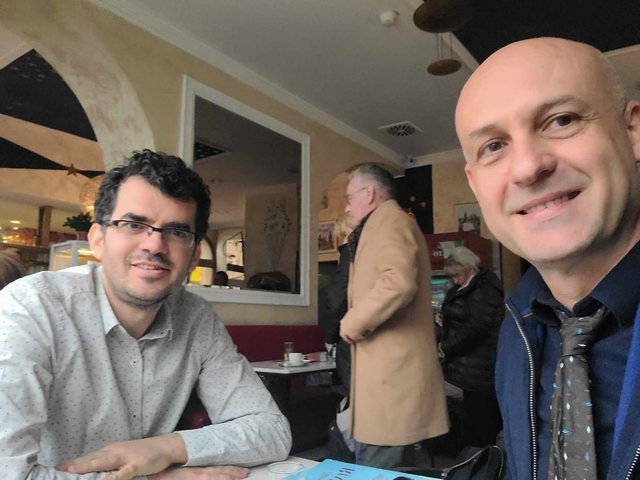
Këtë nuk e them nga larg. E them edhe nga një kujtim personal. Unë vetë e kam takuar Namirin në Gjermani. Kam pasur rastin të rri me të, të bisedoj me të, të ndaj me të hallet tona si emigrantë. Dhe pikërisht aty e ndieje më fort dramën e tij të heshtur: ai nuk ishte një njeri që nuk po përshtatej me jetën në Gjermani; ai ishte një njeri që nuk donte, në thellësi të shpirtit, të pajtohej me idenë se duhej ta gjente veten larg vendit të vet. Mund të jetonte atje, por nuk mund ta shpallte atë botë si shtëpinë e tij të plotë. Sa më shumë i hynte ritmit të jetës së emigrimit, aq më shumë i dhembte ndjesia se po largohej nga Shqipëria që e mbante brenda vetes si mall, si plagë, si besnikëri.
Even far away, he never separated himself spiritually. He looked for ways online, he found paths, he found spaces, so as not to lose touch with Albania, with the debate, with the people, with the country's troubles. His body was in Germany, but his heart continued to beat here. He lived with that painful discord that every honest immigrant knows well: you try to survive where you are, but without allowing yourself to become completely there, because you are afraid that, by settling down, you are betraying your love for your country.
And so Namir remained between two worlds: living in exile, but never accepting exile as a homeland; building a life abroad, but unable to move his soul from Albania. Until, torn apart by this long separation between a forced life and an unconquerable love for his country, his life itself was torn apart.
Namir, in this sense, is not just a good man gone too soon. He is also a mirror. A mirror of a society that often understands value only when it loses it. A mirror of a culture that spares love and overdoes mourning. A mirror of an order that exalts the noisy and leaves the wise in the shade. A mirror of a climate where the good and capable man is not seen as a model to follow, but as a concern to be managed. A mirror of a homeland that often alienates the people who love it most.
Therefore, the elegy for the good Namir must also be an indictment.
An indictment against the culture of unspoken words.
An indictment against the delay in appreciation. An indictment
against the envy that sees value as a threat.
An indictment against mechanisms that do not know how to place the right person in the right place at the right time.
An indictment against a society that is consoled with homage, but is not corrected with justice.
And perhaps this is the most difficult lesson that Namir's departure leaves us with:
do not let your best people live undervalued;
do not force them to seek outside what should be given to them in its place;
do not turn love into elegy and appreciation into repentance;
do not wait for death to accept what you should have said in time.
Namir is being honored with remembrance, but the true honor would have been to keep him close, to raise him, to love him, to cherish him, and to place him where he deserved to be while he was still among us, and perhaps we would still have him among us, even though he was so heartbroken.
Rest in peace, Namir!
Perparim Gjeka
March 20, 2026
#provlerave
Photo: Halle, Germany, February 26, 2025
Happening now...








Sali Llapa
Nga Bato Kosova
ideas



top



Alfa recipes








services
- POLICE129
- STREET POLICE126
- AMBULANCE112
- FIREFIGHTER128