


FLASH NEWS
Those who mocked and attacked Basha

2026-03-01 13:30:21 / IDE
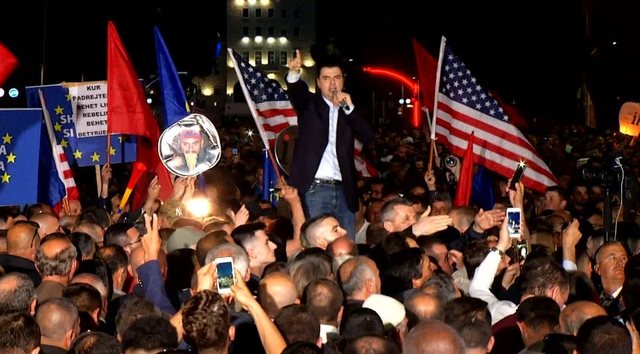
Edi Rama's government is in a clear phase of moral and political exhaustion. The latest moves seem more like an attempt to manage time than to produce political solutions. But legitimacy is not built on the passing of time, but on the trust that remains, and in his governance this trust has been lost for years. Today, even Ilir Meta seems like a weak student, even a dilettante, compared to Rama, for the way he has built and managed political power in these years.
A government surrounded by corruption, by occult shadows, by investigations and suspicions, today feels the presence of SPAK in its heart. The irony is poignant: the one who boasted of being its “architect”, today seems concerned about what he claims to have built. Despite the fact that reality shows that the one who has had and has close associates like Tahiri, Beqaj, Ahmetaj, Veliaj, Dako and most recently Balluku, cannot be a man who aspires to functional justice, because essentially you cannot preach morality and justice when you are surrounded by “sinners” who trample and steal from the country you lead.
But the essential question that arises today is: how is it possible that in this moment of weakness of the government, the traditional opposition fails to produce real pressure? How is it possible that Sali Berisha, with all his fiery rhetoric, fails to turn the moral crisis of the majority into a political crisis?
Yesterday's protest was more of a media spectacle with fireworks than an act of pressure. How can a party that cannot even symbolically challenge a police cordon, that cannot break it, claim to be able to overthrow a system?
Following the protest live with some democratic friends from Gosa to Spille, I was reminded of the protests of 2019. “Where do they compare to these?” — they told me. “Neither in numbers, nor in synergy, nor in strength.” Berisha, who called Basha “a broken leader,” is today showing every day his powerlessness to bring about the long-awaited rotation. In fact, today no one talks about Berisha’s political powerlessness, and this silence is more significant than any statement.
Here the figure of Basha returns, who today, apart from the legal battle for the DP seal, which was taken from him in agreement with Rama, is no longer active in politics. He was labeled as weak, indecisive, incompetent and a collaborator with the government. The "power of rumors" was used to attack him, he was reduced with a coordinated narrative, he was ridiculed by political opponents, but also by those who today claim to be the real opposition, just because he made a decision that time is proving him right.
Basha made a difficult choice: not only to face Rama, but also a triangular system of interests, where the conflict was often controlled and beneficial to everyone except the citizens. He said that with an anti-American and anti-SPAK line, the Democratic Party would never come to power. They laughed at it then, but today time is putting that thesis into the light, as the only judge who is not influenced by propaganda.
Time is teaching us something simple: laughing at someone is easy; replacing them is difficult.
In the end, politics is not a theater of jokes and mockery, but a test of moral strength. As Friedrich Nietzsche warned: “He who fights monsters must be careful not to become a monster himself.” Perhaps this is today’s drama: in an attempt to overthrow a system, some are adopting the very logic that keeps it afloat.
Time has shown that in politics, as in life, it is not noise that triumphs, but consistency. True power lies not in the one who speaks the loudest, but in the one who stands the longest in the face of time and does not become a reflection of the system it challenges.
Happening now...










Germany, the "curse" of Rama and Berisha
Nga Bato Kosova
ideas

Violent protests as group therapy
Nga Roland Lami

Those who mocked and attacked Basha
Nga Ermal Peçi

top



Alfa recipes



TRENDING 




services
- POLICE129
- STREET POLICE126
- AMBULANCE112
- FIREFIGHTER128