


FLASH NEWS
The chains we put on ourselves!

2025-12-09 15:54:21 / IDE
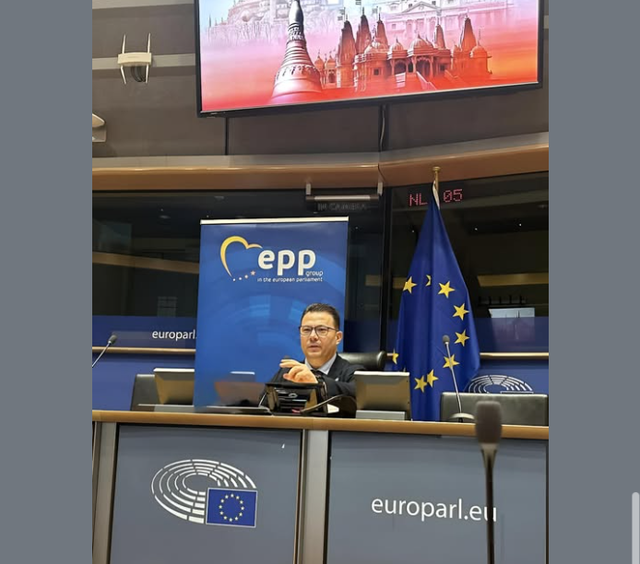
We have often seen in history, a man who goes out alone on a balcony, raises his hand and the crowd below bursts into shouts and applause.
At that moment it seems as if his breath moves history, his word decides destinies, his eyebrow is measured as a barometer of the future.
Drones overhead, cameras, banners, words written in large letters: “Leader”, “Savior”, “Irreplaceable”, “Father”, “Legend”, etc., etc.
Étienne de La Boétie, five centuries ago, would have smiled bitterly before this scene.
He would not dwell long on the face of a single man.
He would see it, he would feel its vanity, he would read its fears, but he would not call it the secret of history.
The secret, for him, lies somewhere else, not in the head that stands high, but in the long layer of necks bent down.
In the “Discourse on Voluntary Slavery” he does something that still shocks us today.
He shifts the gaze from “him above” to “us below,” from the knife of power to the hand that extends the knife.
We are accustomed to thinking of tyranny as a curse that comes from above, an evil man, greedy, thirsty for control, who climbs and rules.
La Boétie accepts that this face exists.
He does not strip reality of violence, the tyrant has an army, a police force, an apparatus of repression.
However, he asks a question that shatters any simplistic narrative: how can a single man keep everyone else in submission without immediately falling?
His answer is clear, cold, and painful.
Because they accept it.
Because they give it to him.
Because their submission is half his strength.
In La Boétie's reading, the tyrant is not only the cause, he is also the symptom of a deeper disease, the human tendency to give someone else the burden of his freedom.
The tyrant is the pinnacle of a structure, not the sole architect.
Without those who, voluntarily, out of fear, interest, habit or spiritual fatigue, choose to be under his shadow, he would be nothing more than a lonely man with a great appetite.
Today we know that slavery does not begin with tanks.
La Boétie had understood that it begins with education.
Man is born with a thirst for freedom, but generations raised under the shadow of an arbitrary power slowly forget what freedom looks like, forget what freedom feels like, forget how freedom is defended.
At first, kneeling comes from order and fear, from unjust laws, exemplary punishments, the collapse of biographies.
Some are convinced by terror, some by helplessness, some by cold calculation: “if I resist, they will crush me.”
Then fear turns into habit.
Habit turns into normality.
One day people start speaking with gentle phrases like “it’s always been this way,” “it can’t be any different,” “it’s better to stay calm.”
Children grow up watching parents who close their eyes, who whisper, who calculate so as not to clash with the “strong”.
They learn that bowing is not a curse, but a safe address.
Slowly, without realizing it, they read service not as a stain on the soul, but as a normal way of survival.
This is the moment when the chain no longer comes from outside.
It has taken root in the heart.
Man no longer bows only out of fear, but out of a kind of comfort, “better here, in its shadow, than alone facing the world”.
A people who have not seen freedom with their own eyes see slavery as a climate.
And when the climate becomes “natural”, no one asks why there are chains at the door.
The tyranny of the 21st century no longer walks only in boots.
It also wears a spectacle suit and an algorithmic cloak.
La Boétie had understood that the collapse of the mind is as important as the fear in the body.
In addition to the fist, the tyrant gives the toy.
In addition to the threat, he also gives gifts.
In addition to prison, it also gives shows.
In ancient Rome this was called “bread and games”.
La Boétie speaks of parties and spectacles, shows, courts, decorations, privileges cleverly distributed to feed the illusion that “we are remembered too”.
In today's language you could call them small subsidies, “relief” packages, political spectacles with lights and sounds, screens where politics is staged like a soap opera and the pain of a country is sold like a series with a new episode every evening.
A large part of this work is done today by the algorithm.
It is the most loyal courtier of the Tyrant, it decides what it sees and what it does not see, which speech to put at the top of the page and which to sink to the bottom, which cry to give thousands of reprints and which to lock in the “shadow”.
Algocracy is when not only the law, but also the order of news and thoughts revolves around the interests of a minority.
In this digital world, the collapse of the mind goes even deeper, it no longer comes only from the stage and the square, but from the phone feed, from the list of suggestions, from the “for you” column.
The moment you accept this as nature, slavery no longer comes to you as an order, it comes to you as a “personalized” selection.
Around Tirana, at this time, there is no longer only the physical circle of courtiers, but also an army of anonymous profiles, trolls and trollitans, militant trolls who work all day to drown every different word with ridicule, with personal attacks, with mud.
They patrol the virtual space as guards of fear and contempt, they turn every debate into an undignified fight, until the ordinary person says, “better not to speak, it’s not worth crashing into this wall”.
The algorithm fed by trollitans, clicks and hatred makes visible only the noise that benefits the system.
The invisible message is simple, don't deal with the root of injustice, deal with the decor.
Deal with the words, not with their weight.
Deal with the screen, not with what is hidden behind it.
A society that deals with backdrops and special effects no longer has the energy to notice that the stage is empty.
Entertainment, in this context, is no longer a healthy rest for the mind, it is an instrument to tire the mind out so that it does not ask questions.
The tyrant, for La Boétie, does not stand on a flat people, but on a whole pyramid of intermediate creatures.
He is the tip of the iceberg, the deep and cold part is the countless of those who stand below him.
At the top, a single man with a name and a portrait.
Below him, a narrow circle of friends and clients who take almost everything from him, money, positions, security, immunity.
Below, commanders, ministers, directors, prosecutors, judges, administrators who know that their careers grow at the same pace as their loyalty.
Even lower, heads of offices, people with files in drawers, structures that send orders down to everyday life.
Today, a whole digital layer has been added to this chain, clientelistic portals, influencers with a rented soul, opinion makers with a billable service, anonymous trolls who maintain the virtual perimeter of fear and ridicule.
At the base, those who benefit from the crumbs, a job for the son, a small contract, an intervention at the doctor, a small tax break, a local favor, a promotion on the front page.
Everyone in this pyramid says: “I am not a tyrant. I am playing the game, like everyone else. I am providing for my people. I am not the problem.”
La Boétie dismantles this self-justification with a cold sentence, every link that agrees to be part of this pyramid is a vote for voluntary slavery.
This man is not simply a victim.
He is a collaborator.
He agrees to be subjugated above, on condition that he is allowed to rule someone below.
Flags may change, names, parties, slogans may be swapped.
Tyrants may exchange the balcony for the screen, the podium for the profile, but if the logic of the pyramid remains the same, the claim of one man to be the center and the bending of many others to be satellites, the structure, according to La Boétie, means that tyranny is still there, even if the vocabulary about it has changed.
La Boétie does not romanticize the people, nor does he simply demonize the Tyrant.
He sees two diseases that feed each other, the disease of one man who will become the source of every fear and every hope of others, and the disease of a majority that agrees to make this man the source of everything, so as not to bear the burden of their own freedom.
He sees people who are accustomed to kneeling, who are tied to someone else's luxury in the hope that one day they too will touch that golden thread, who are fascinated by the spectacle of power like a flame on a cold night, who slowly rot from within from fear, interest, spiritual fatigue.
There are people who are enslaved by force, with no real path of salvation; for them, the struggle is to survive without losing all face.
But there are also others who have the opportunity to choose and decide to sell their dignity for peace, for a salary, for an armchair, for a bit of power over others.
And if you go even deeper, you see that the Tyrant himself is a prisoner of his own thirst for adoration, a slave to the need for applause, scared to the core by the possibility that one day the bent necks will straighten and the balcony will remain empty.
The most serious wound is not the chain on his feet.
It is the moment when a person learns to call the chain "normality."
When the words “this is the system,” “everyone is the same,” “nothing can be done” become chants, slavery has seized the strongest place, the heart.
In the face of this, La Boétie does not tell people to raise swords, but to stop and dismantle their submissive hands. He
does not call on them to “go out into the streets and burn everything,” but something more difficult, refuse to be part of the game.
Stop feeding it.
Stop serving it.
Stop doing it honor.
Stop giving it what it cannot take for itself, your will.
He does not say that it is enough to hate the tyrant.
To stop serving it, you must change the way you understand security, the way you see your career, the way you accept the comfort that comes from someone else’s silence and compromises.
A single man cannot put chains on an entire people if this people refuses to keep them.
He falls, not when someone forcibly removes his throne, but when he finally lacks the body on which he stood.
To many it may seem theoretical.
But La Boétie translates it into everyday language, the tyrant does not need to be loved.
He needs to be accepted.
Every time you, for a small favor, a small fear, a small comfort, choose not to disrupt the order of this pyramid, you have also given a brick to the wall that holds you hostage.
You yourself become a brick in the wall of your captivity.
None of us passes untouched.
That is why the motto, “Take away your brick,” remains today as the only true and honest revolution of our times.
Otherwise, everything else is a fall into the same trap.
Even if it's only once in our lives, we've known the strange peace that a "friend above" gives us, a secret favor, a shortened queue, a closed eye, and we've seen later that that peace has added another link to our inner chain.
Each of us has crossed that threshold when we have said to ourselves, I have also remained silent in the face of injustice, I have accepted some ease that I knew did not belong to me, I have been grateful for a door that opened for me, while someone else had the same door closed in their face, just because they did not have the “right person”.
Every time we have understood this, the momentary peace has seemed to us later not as a gift, but as a new iron ring around the soul, which tightens every time we want to say “no”.
Every time we confess: “I have no other choice, this is how everyone is, this is how the system is”, voluntary slavery takes a step forward.
And every time someone else says: “I do not have the strength to overthrow it, but I have the strength not to feed it with lies, with servility, with cheering, with sold silence”, an invisible thread is removed from tyranny's body.
Every country that has raised someone to a cult, every era where a voice has become law, every society where people say: “things are only done with the strong,” finds itself in this mirror.
Tyrants can change costumes and slogans, they can exchange the balcony for the screen, the podium for the profile, but the structure that holds them does not change without changing the will of those who submit to them.
La Boétie does not promise you a new world in a heartbeat.
He promises you something smaller and larger at the same time, the possibility that, even within a rotten system, you will not become part of the chain that keeps it alive.
At a time when many complain about tyrants, he asks himself, how many times have you chosen not to see, not to speak, not to oppose, just so as not to spoil your own work?
How many times have you accepted to do a small injustice, because “everyone did it”?
How many times have you felt the bitter peace that a “friend above” gives you, while somewhere below someone else pays the price?
For La Boétie, the tyrant is not the pair of eyes on the balcony.
It is a shadow that is magnified by the light that we ourselves give it.
The real chain is not the one hanging around our feet, it is the one we have agreed to wrap around our mind and heart.
And the moment a single person decides to no longer kneel before man, but only before the truth, the tyrant's strength begins to dissolve, like everything that has lived more from the fear and submission of others than from its own strength.
The question that remains, for each of us, is not whether there will be more tyrants, but how many chains we are ready to break within ourselves, before asking others to break theirs.
Arian Galdini
Happening now...












ideas

The Statute Review and Berisha's Sinking Boat
Nga Alesia Balliu

Will the new justice system unite the SP and the DP?
Nga Arbër Hitaj

Sovereignty as a fig leaf
Nga Namir Lapardhaja
top






TRENDING 




services
- POLICE129
- STREET POLICE126
- AMBULANCE112
- FIREFIGHTER128