


FLASH NEWS
Keep the Albanian nation alive / The magnificent history of the 'Vatra' association in the USA

2022-06-14 17:52:39 / JETË
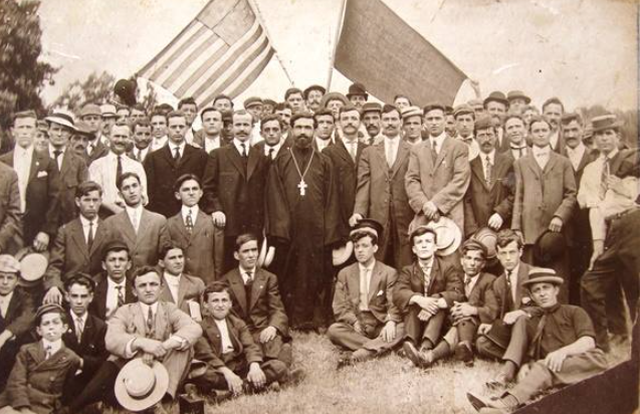
Albanians like all peoples of the world have moved in search of a better life, to the end of the world, it was said as far as Honolulu. There is research today that defines the time when Albanians first trespassed in America, as the earliest. The most trusted variant that they are found in America as citizens or citizens of Italian, Greek, Turkish, Romanian, Serbian, Bulgarian, Egyptian and Syrian, of Albanian origin, also as part of the Ottoman Empire. The reasons for seeking a better life were, the anarchy which was present in all parts of the Ottoman Empire, the lack of roads, and the insecurity of life. All this Arthur Jon Evansi writes in his article "Albania and the eastern key of the Adriatic", that the Ottoman rule "The sick of the Bosphorus" had turned Albania into a brutally destroyed country, and Durrës, had left him in his own time of broken old age, without children without offspring. This rule had turned the people and the culture into enslaving misery. And yet, Durrës had fascinated Evans, saying: "Durrës surpasses every ancient city I have seen". But even the first Albanian who set foot in America, as it is known until now, has appeared since 1876, unidentified and Abbot Prend Doçi arrived in 1877, and returned to Albania in March 1883. He is known with regular documents as the first Albanian emigrant Kole Kristofori from the village of Katund in the district of Korça, who arrived in America in 1884. Kole Kristofori was, so to speak, the first godfather of the path of Albanian emigration to America. He returned after six years to his native village and returned to America along with 17 of his fellow villagers, who are the first nucleus of the Albanian diaspora in America. The first stage of Albanian emigration to America begins at the end of the XIX century and ends in 1920, the second stage includes the period between the two world wars and the third stage includes the period after the Second World War, Albanian emigrants to America are divided into two categories, emigrant economic and political emigrant. The largest inflows of Albanian emigration to America are in the years 1904-1905, and 1912-1914. The first emigrants who went to America, began to work in textile factories and shoe factories, which did not need skilled workers. . The Albanian emigrants from America were scattered in 12 states and the largest number includes the state of Boston. The arrival in America of the patriot Petro Nini Luarasi greatly increased the national movement of the Albanian diaspora. Petro Nini Luarasi managed to create the first Albanian-American society called the "Motherland Commodity". In 1905 the intellectual Sotir Peci arrived in Boston from Romania, who, like Luarasi, played an important role in the spread of the national movement. On May 10, 1906, at the age of 24, the most prominent figure in the history of Albania, Fan Stilian Noli, arrived in America. Sotir Peci meanwhile in 1906 begins to publish the newspaper "Kombi". In this newspaper he starts working as a deputy editor Fan. S. Noli and Eftim Nasi who did three jobs. Later in 1907 Fan Noli would make an even more intense patriotic activity that would be finalized with the creation of the "Besa-Besa Society". In the Introduction to the Canon of Society, where it is explicitly stated: “We, the Albanians of America, were deeply moved by the freedom, power and unity of the American people, and we longed to understand the path that led them to solid government, feeling once we had one, our fate as a nation would be far away. "With a heart full of gratitude we confess that we have all the facilities in this country of freedom, we feel that we have a great duty to our country". A company called "Lidhja" was established in Sentluis with Nikola Xhambazi as its chairman. Another society was formed in New York and was christened "Time". In the second half of 1908 two more societies were formed, Seuth Framingham's "Benevolent" society, as well as the "Lucky" society created in Boston with Nicole Christopher as chairman. Another society was established in Southbrigde baptized with the name "The Sun of Albania". Meanwhile, the titanic efforts for the unification of all Albanian societies begin and this idea was thrown for the first time in the pages of the newspaper "Kombi". "Why not all mayors agree and work with a program and a goal. Why not be a big company that has branches in all the villages where there are Albanians? ” The pages of the newspaper "Kombi" became the subject of discussion, as the problems of holding a congress with representatives from all Albanian societies created, where issues that concerned our nation would be discussed. Divided and divided and as someone behind his mind we will never progress and we will be left alone with rage and praise. We should also take the example of the Albanians of Romania, who, seeing that it is squeezing us and time is not waiting for us, left their grievances and joined. However, the unification efforts had encountered obstacles with legal pretexts between the company "Mall i Mëmëdheut" and the company "Besa-Besa". He called for unification in May 1908 Sotir Mikeli, as chairman of the "Besa-Besa" society. He addressed a call to the Albanian Community of America stating: "We have before us a great rock that is the yoke of Turkey, as well as the chauvinist neighboring countries. This rock has blocked our way… unite, brothers, connect with each other for the good of you and our homeland ". The first international protest in defense of the Albanian national cause was led by the Albanian American Community, the Great European Powers and the US in The Hague, which had gathered to discuss arms reduction in the Balkans. A protest note was drafted by four representatives of Albanian societies and sent to The Hague in defense of the Albanian cause. This is the most important work, Noli would emphasize at a meeting of the "Besa-Besa" society. The arrival in America of the patriot Bajo Topolli as a representative of the Committee "For the Freedom of Albania" gave a new impetus to the National Movement in the ranks of the Albanian diaspora in America. Kristo Dako, on the other hand, after studying theology at a seminary at Ohio State Theological University, created a wide circle of American friends, including influential people, whom he used to raise public awareness about the Albanian cause. Also, in the city of Jamestown, the first Albanian library in America was established. The patriot Petro Nini Luarasi also opened the library in Malboro Mass, a library that would deal with the sale of all Albanian books that would be printed at the printing house "Mbrothësia" in Sofia, Bulgaria. The Italian singer (tenor) of Albanian origin Giachino Stassi comes to America, where he organized several concerts for the Albanians of Boston. The autocephalous Albanian Orthodox Church was proclaimed in March 1908 and for the first time church books were published in the Albanian language at the initiative of Fan Noli. The "Besa-Besa" society of Boston from February 15, 1909 began to publish the newspaper "Dielli" which later became an organ of the "Fire" Federation. This newspaper had Fan Nolin as its first editor. The program of the society "Besa-Besa" opened with the division "Albania for Albanians". This newspaper would fight for the recognition of the Albanian nation by the Turkish government, for the recognition of the Albanian language as an official language throughout Albania, for the Albanian national education in all Albanian schools that were opened or that would be opened to be taught in Albanian . On October 10, 1909, Faik Konica would take over the management of the newspaper "Dielli" and thus this newspaper became the epicenter of the Albanian National Movement in America. The company "Mall i Mëmdheut", through a letter published in the newspaper "Dielli", sought the union of societies and gave arguments as to what profits they had from this union. While the "Besa-Besa" society, the largest and most organized until those years, made a call for unification, made a call for a general meeting of all societies. All Albanian societies closely followed the situation in Albania and the Albanian uprisings of 1910 and unreservedly supported them. A grand rally was organized in the city of Boston, in support of the Albanian uprising. At this rally were speakers like Fan Noli, Faik Konica, Filip Kristoforidhi and Misto Millona and the American Heri Worli representatives of the Arbëresh of Italy living in America. As Faik Konica pointed out "For the first time we have in this united uprising Christians and Muslims against the common enemy and this will bring freedom or death to Albania." At another rally in Boston on May 18, 1910, Fan Noli said, among other things, "Remember the men addicted to Kosovo, the crazy women, the babies in bayonets, the exiled patriots, the closed schools, the customs of violated. "Thus you can prepare a new united and solid race like a rock, against which the attack and the earthquake of the Asian storm are broken." On the day of the rally, a campaign was launched to financially support the uprising. From the first days, $ 3,000 was raised. After the money reached the insurgents, the insurgency committee and Miss Durham sent a thank-you telegram to Besa-Besa. Prominent Albanian-American's Charles Crane from Chicago also helped with the uprising. In July 1911, a group of volunteers was organized to go to fight in Albania. The chairman of the "Besa-Besa" company, Koli Rodhe, was appointed at the head of this committee, who said that he would perform his duty to the homeland. The anti-Ottoman movements had to be supported thanks to a union of Albanians and through the newspaper "Dielli" there was a call for unity with the call "Long live the Union". With the tireless work of the director of the newspaper "Dielli" Kristo Floqi, who organized within three months 100 press conferences in the Albanian colonies, where he trumpeted for the general union based in Boston. In the newspaper "Dielli" a call was made to the American societies, where it was announced the establishment of a Central Committee which would serve to coordinate the process of unification of all Albanian societies. Also in the newspaper "Dielli" was published the Kanunorja (draft) of the Central Committee, which would be discussed at the meeting of December 24. The union of societies would aim to fight for the salvation and progress of the nation, the spread of knowledge to the Albanians of America, Albania and wherever they were through the Albanian press and books and schools. On December 24, 1911, a general meeting was organized in the "Rathbone Hall 724, on Washington Street", where the issue of the unification of Albanian societies was widely discussed. This day marked the beginning of a new stage for the entire Albanian community in America. The meeting was entrusted to Kristo Floqi. provided it was funded by the company. Faik Konica and Kristo Floqi were assigned the task of drafting the canon. Names such as "Plugu", "Parmenda", "Kastrioti", "Skënderbeu", "Përlindja" were proposed. Fan Noli with his patience and eloquence managed to convince the delegates that the newborn federation should be baptized with the name "Vatra". This name was officially approved at the union meeting on March 31, 1912. On April 14, the Kanunor of the "Vatra" Federation was approved. The three main figures of the Pan-Albanian Federation "Fire" as Fan Noli, Faik Konica, Kristo Floqi, within a short time were scattered throughout the states and cities of America to form the branches of the newly formed society. Vatra society from the beginning was organized on a democratic system. Any Albanian living in the US and Canada could become a member of "Vatra", if he agreed with the Canon of the company. The official recognition of the Pan-Albanian Federation "Vatra" took place on June 13, 1912 and received its diploma signed by Albert L Langty (Albert P Langty), Secretary of State of Massachusetts. The names of those Albanians who signed the declaration of recognition are Faik Konica, Llambi Çikozi, Fan Noli, Kristo Floqi, Elia Tromara, Naum Cerre, and Kosta Kota. At the extraordinary assembly of December 8, 1912, it was unanimously decided that Faik Konica be sent as the delegate of the Albanian American diaspora to Europe and Albania, to participate in the discussion of important problems for the future of the Albanian people. The place of Fan Noli and Kol Caknaq, who left America for Europe, was taken by Naum Cerre and Llambi Laro, respectively. On December 11, 1916, the "National Fire Band" was created with conductor prof. Thoma Nashi and it included 30 instrumentalists with the most expensive instruments of that time. Members of the Vatra National Gang participated as volunteers in the Vlora war./ Prepared by Kastriot Kotoni
Happening now...



America may withdraw from Europe, but not from SPAK
Nga Gentian Gaba
ideas


top


Alfa recipes

TRENDING 




services
- POLICE129
- STREET POLICE126
- AMBULANCE112
- FIREFIGHTER128