


FLASH NEWS
REL: Is it too late for talks on a new government in Kosovo?

2025-04-10 16:04:49 / KOSOVA
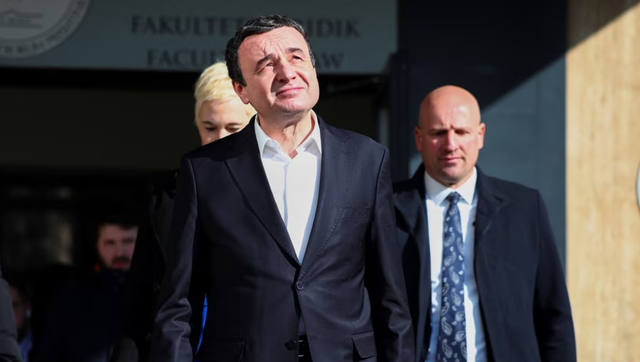
The winner of the February 9 elections, the Vetevendosje Movement, will not be able to form a government without a coalition with Albanian parties. This entity does not have the full support of the non-majority parties, but even if it did, it would not be enough to form the executive.
This fact was acknowledged on Tuesday by the vice-chairman of LVV, Glauk Konjufca, who said that the formation of the new government cannot be done without the inclusion of Albanian parties in a governing coalition.
According to him, there are currently two scenarios: voting for a new government until the election of a new president - April 2026 - or voting for a long-term executive.
Both scenarios require 61 votes from MPs.
The LVV of the incumbent Prime Minister, Albin Kurti, has won 48 seats in the Assembly, the Democratic Party of Kosovo, 24, the Democratic League of Kosovo 20, and the coalition Alliance for the Future of Kosovo with Social Democratic Initiatives has eight MPs.
Kurti invited the LDK led by Lumir Abdixhiku for talks, but the offer was rejected. During the campaign, Kurti did not spare words for this party and it seems that the LDK has not forgotten this. Also, the LVV had said that it prefers a government with only non-Serb minorities.
Political scientist Dritëro Arifi estimates that the LVV has "wasted time", as it should have begun talks with other parliamentary parties on the formation of a new government immediately after the parliamentary elections.
"From my perspective, negotiations with parliamentary parties should have begun on February 10th, to see on which points they agree from a programmatic perspective. But, LVV has done the opposite," he says.
He believes that "a larger Albanian coalition is needed" to create "a good momentum to face both the major geopolitical changes that are taking place, but also the reforms that are important for the well-being of the citizen."
Emir Abrashi from the non-governmental organization Demokracia Plus emphasizes that a new government can be formed with the support of non-Serb minority communities only if Fatmir Limaj's Initiative also becomes part of the governing coalition.
Unlike other Albanian parties – which were in opposition during the previous legislature – Limaj has said that there are no red lines for any party. PDK has no red lines either, but has stated that it prefers an executive without the LVV.
However, Abrashi emphasizes that such a government would not be stable and would face difficulties in passing laws in the Assembly.
"The first big question she would face would be the election of the president next year," he says, recalling that 80 votes of deputies are required to elect the president - in the first two rounds, and then only 61 are required.
"The support of one of the largest opposition parties will be necessary, otherwise extraordinary elections will be declared. However, Kurti's rhetoric in the past leaves little room for agreement," Abrashi emphasizes.
In the Kosovo Assembly, out of 120 seats, 20 are reserved for non-majority communities: 10 for the Serbian community and 10 for other communities.
Kurti is not even sure of the 10 votes of non-Serb communities, which have traditionally supported the governing coalition, even though most have said they would vote for an executive led by him.
The nine votes that the Serbian List has are not even taken into account. This party, since its establishment in 2013, has been part of every government, having always won all the seats reserved for Serbs.
This time, there is a legal basis for the Serbian List to be excluded from the government, as Nenad Rašić's Serbian Party for Freedom, Justice and Survival has won one MP.
Abrashi estimates that the Serbian List will not play a significant role in the formation of the new government and cites as a reason the direct involvement of its former deputy leader, Milan Radoićić, in the armed attack in Banjska.
He adds that the Serbian List is not a reliable partner, because it has been boycotting Kosovo institutions for more than two years.
"It is imperative that the Serbian community find a way for healthier representation in Kosovo's institutions, in order to avoid a scenario where any major political party in Kosovo thinks that no kind of cooperation with their representatives is possible," he emphasizes.
According to the Constitution of Kosovo, one ministerial post in the Government is reserved for the Serb community and another for other non-Serb communities. If the executive branch has more than 12 ministries, then another minister is appointed from among the non-majority communities.
The selection of these ministers is done in consultation with the parliamentary parties. If someone is appointed from outside the parliamentary parties, then approval is required from a majority of the MPs from the community to which the minister belongs.
If LVV fails to secure 61 votes, then it is up to President Vjosa Osmani to mandate the party that ensures it has the votes for the executive. PDK has said that it is ready for this responsibility, if its turn comes. But, even if the second mandate fails, then Kosovars will once again turn to the ballot boxes.
But, before electing the Government, let's first wait for the election of the President and Vice-Presidents of the Assembly of Kosovo./ REL
-

May 11th elections/ The two SP and DP candidates pose together
April 10, 15:48 -

Happening now...




83 mandates are not immunity for Rama's friends
Nga Gentian Gaba
ideas

"Preliminary sentence for Belinda Balluku", response to Baton Haxhiu
Nga Blendi Kajsiu

Teatri që fsheh prapaskenën
Nga Patrik Sadikaj

Berisha's red line and the black line of democracy in the DP
Besmir Semanaj
top



Alfa recipes




TRENDING 




services
- POLICE129
- STREET POLICE126
- AMBULANCE112
- FIREFIGHTER128