


FLASH NEWS
How could the sun be creating water on the moon?

2025-04-26 12:21:19 / MISTERE&KURIOZITETE
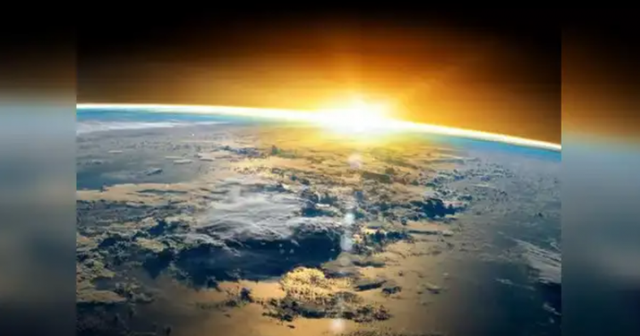
Lunar samples show evidence that the solar wind could be behind water molecules on the moon's surface, according to NASA.
The results could shed light on how water ice collects in 'cold traps' created by areas of permanent darkness at the moon's poles.
A new NASA-led experiment suggests that constant bursts of particles from the sun may be creating water molecules on the moon.
Scientists have detected traces of water molecules, as well as hydroxyl (OH), a component of water, on the surface of the moon through various space missions.
The source of this water has long been a mystery, although some theories suggest volcanic activity, the release of gases from the depths of the lunar regolith (the mixture of rocks and dust on the moon's surface), and collisions with small meteorites.
The new NASA experiment, described March 17 in the journal JGR Planets, tests another idea: that the solar wind is the cause.
The solar wind is a continuous stream of charged particles coming from the sun at a speed of over 1.6 million km/h.
It hits everything in the solar system, including Earth, and causes colorful auroras when it collides with molecules in our atmosphere.
Earth’s magnetosphere protects us from most of this “space weather.” The Moon, however, has a very weak and uneven magnetic field, so it is less protected.
Water is made up of hydrogen and oxygen atoms. The rocks and dust that make up the moon's surface contain a lot of oxygen, but not a lot of hydrogen.
The solar wind consists mainly of protons, hydrogen atoms without electrons.
Without a strong magnetic field to protect it, the solar wind collides with the moon's surface every day, filling it with protons that 'steal' or 'borrow' electrons from the lunar regolith to form the hydrogen needed to create water.
According to NASA, the water that has been discovered on the moon follows an interesting pattern, changing in a daily cycle. Areas that are warmed by the sun release water as vapor, while cooler regions retain it.
If the source of the water were, for example, micrometeorite impacts, we would expect the amount of water in warm areas to continue to decline until there were more impacts.
But the amount of water detected returns to the same level every day, even though some of it is lost to space. This makes it more likely that the solar wind is the cause.
To test this theory, the researchers simulated the effects of the solar wind hitting the moon using lunar regolith samples collected by Apollo 17 astronauts in 1972.
They built a small particle accelerator in a vacuum to release "artificial solar wind" onto the samples for several days, simulating the real effects of the solar wind on the Moon for 80,000 years.
They then measured chemical changes in the samples, and discovered evidence of the presence of water that wasn't there before.
"Things get exciting when we see that with just lunar soil and a basic ingredient from the sun, which is always releasing hydrogen, there is the possibility of creating water," said Li Hsia Yeo, a planetary scientist at NASA's Goddard Space Flight Center and the study's lead author.
Understanding how water forms on the Moon is crucial for future astronaut missions, according to researchers.
Water ice stored at the lunar south pole could be an important resource for astronauts, for example.
The results also provide insights into the interaction of the solar wind beyond the moon.
Other celestial bodies that don't have much of an atmosphere or magnetic field are also buffeted by the solar wind, so studying these environments can help us understand the celestial chemical processes that create or break down water, a key ingredient for life.
-

Triple accident in Qafë-Thane, two cars and a van collide
April 26, 12:04 -

One Man Show Election Campaign
April 26, 11:53
Happening now...














83 mandates are not immunity for Rama's friends
Nga Gentian Gaba
ideas

"Preliminary sentence for Belinda Balluku", response to Baton Haxhiu
Nga Blendi Kajsiu

Teatri që fsheh prapaskenën
Nga Patrik Sadikaj

Berisha's red line and the black line of democracy in the DP
Besmir Semanaj
top


Alfa recipes



TRENDING 




services
- POLICE129
- STREET POLICE126
- AMBULANCE112
- FIREFIGHTER128