


FLASH NEWS
Egnatia Road: The risk of disappearing between asphalt and institutional negligence

2026-03-04 22:34:30 / AKTUALITET
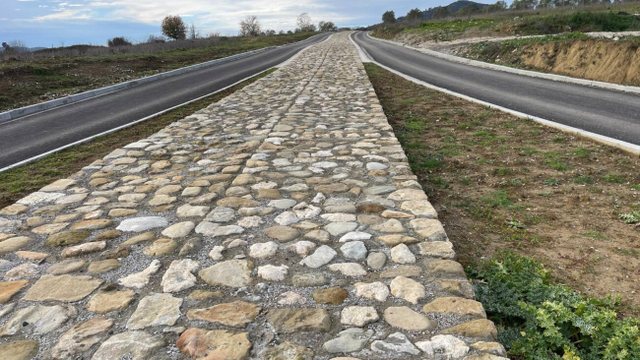
The Via Egnatia is one of the most important political and military trajectories in Southeast Europe. Built in the 2nd century BC, in honor of the Roman consul Gnaeus Egnatius, this road was a continuation of the Via Appia, which ran from Rome to Brindisi.
Then, through maritime transport in the Adriatic, it was connected to the port of Dyrrachium, from where the segments of the Egnatia route that connected Dyrrachium with Apollonia, Scampa and Lychnida departed, continuing through the present-day territory of North Macedonia and Greece to Constantinople.
Although this road had great religious, cultural, political, and military importance from Antiquity to the modern period of history, its traces today are in serious danger.
First, unauthorized construction in Durrës and Elbasan, especially since the 1990s, has led to the disappearance of some traces of the Egnatia Road. An example is the construction of the 15-story building (known by the Durrës locals as “te Fly”) and the reconstruction of the Port Square near the Venetian Tower, which have damaged the archaeological heritage of the Egnatia Road and ancient and medieval Durrës.
Also, the transformation of the Sea Gate into a restaurant known as “Portiku” has not improved the condition of the Egnatia Road route in Durrës. This transformation has erased significant parts of the cobblestones and reduced the visibility of the ancient heritage to the public.
Another case is observed at the ancient Ad Quintum station in Elbasan, where the monument has been poorly preserved by the residents of the village of Vidhas. Taking advantage of the lack of attention and control from local and central institutions, this situation has led to the gradual degradation of the traces of the ancient road.
Secondly, the blockage of the Librazhd–Qafë Thanë road axis and the construction of the Elbasan–Qafë Thanë highway have further worsened the situation of the ancient Egnatia road. Faced with this unexpected and difficult situation, many drivers traveling towards Pogradec, Korça and Greece have used the traces of the ancient road in the villages of Mirakë and Dardhë in Librazhd as an alternative route.
This phenomenon not only constitutes a violation of road traffic regulations, but also a direct damage to the archaeological integrity of the road. The ancient Roman trajectory was not designed for the loads of modern vehicles.
The lack of signage and institutional monitoring has turned this segment into an improvised road, accelerating its deterioration. This situation reflects a kind of institutional erosion, where infrastructure development prevails over legal protection of cultural heritage.
At the beginning of 2026, the risk of the Egnatia road disappearing is no longer hypothetical, but real and visible. The asphalting of segments, their use for modern traffic and the lack of a clear conservation strategy constitute direct threats to the survival of this ancient artery.
Its protection requires urgent institutional intervention: the complete identification of the traces, the declaration of segments as protected areas, and the prohibition of any intervention that violates the original structure.
Otherwise, we risk that one of the most important historical corridors in the Balkans will remain only on the maps of history, while on the ground it will disappear under asphalt and institutional neglect./ amafora.al
Happening now...















Protest is not just about "protesting"
Nga Poli Hoxha
ideas

"People's Parliament", facing the Rama-Berisha duo!
Nga Indrit Gjyzeli


The beautiful cry of protest against the Rama-Berisha establishment
Nga Mirela Karabina
top



Alfa recipes



TRENDING 




services
- POLICE129
- STREET POLICE126
- AMBULANCE112
- FIREFIGHTER128