


FLASH NEWS
The Migration Pact from the European Parliament/ What does the new EU asylum policy bring?

2024-04-11 08:23:54 / BOTA
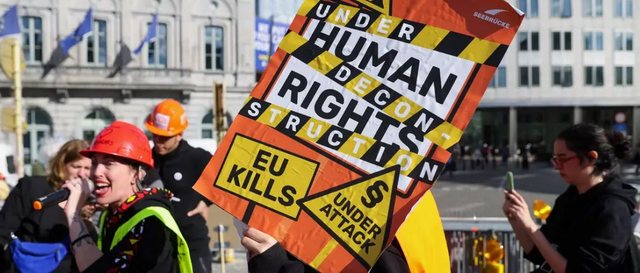
After eight years of difficult negotiations with the 27 member states, the European Parliament approved a fundamental reform of asylum procedures in the EU.
The so-called Migration Pact, which consists of eight laws, aims mainly to reduce the number of asylum seekers coming to the EU, speed up asylum procedures and relocate them outside the EU's borders.
According to Eurostat, last year the number of asylum requests was 1.14 million. This number has been continuously increasing for four years. In addition to them, since 2022, around four million war refugees from Ukraine have been sheltered in the EU.
How will asylum procedures work at the EU's external borders?
Asylum seekers and refugees will be clearly identified within seven days after entering the EU by land, sea or air and will be registered in the extended biometric system "Eurodac". Immigrants from countries whose asylum recognition rate is less than 20 percent will be held at the border for up to twelve weeks. In these camps, which will be set up in Greece, Italy, Malta, Spain, Croatia and Cyprus, it will be decided who will return to their country without further examination of the request. This affects only a minority of those who come. The capacity of these camps will be for 30,000 people throughout the EU.
Immigrants from countries with a higher level of recognition of asylum claims will be subject to the normal asylum procedure. These procedures, which today can take years, will be shortened. Rejected asylum seekers will be deported directly from the EU's external borders.
How can the burden on destination countries for asylum seekers be eased?
Many asylum seekers who enter the EU from Greece or Italy continue directly to Germany, Austria, France, the Netherlands or Belgium. This also applies to rejected asylum seekers in these countries. In fact, the first country they enter (eg Italy) is obliged to readmit and house these immigrants. However, in practice this does not happen. With the new Migration Pact, these rules will be revised. It is also expected that the incentives or attractive factors that encourage the migration of refugees from one EU country to another will weaken, such as social assistance and other benefits. This is thought to be achieved by establishing a unified social assistance as well as similar housing conditions in all EU countries.
Likewise, in the future, the EU border guards will record and transfer to a common system that can be accessed by all offices and institutions in Europe the biometric data of all asylum seekers entering the EU. The purpose is to dictate e.g. if a migrant rejected in Greece applies again for asylum in Austria, or in other countries. In such a case, this asylum seeker will be deported more easily to the country where he first entered the EU and finally to his country of origin.
Will deportations of rejected asylum seekers become easier?
The pact also foresees that in the future asylum seekers will be deported more quickly to their countries of origin or transit countries that are considered safe. For this purpose, the European Union aims to reach more agreements with third countries so that they can accommodate rejected migrants. The recent agreement with Tunisia is often mentioned as an example. In exchange for economic aid, Tunisia has agreed to accept its citizens who are expelled from the EU. However, the Tunisian government does not want to allow people from various African countries who have immigrated to the EU through the territory of Tunisia to return to this country. A similar agreement signed with Turkey in 2016 resulted in a reduction in the number of Syrian refugees entering Greece. But this agreement is now no longer valid, because Turkey no longer accepts Syrians expelled from Greece./DW

Happening now...










America may withdraw from Europe, but not from SPAK
Nga Gentian Gaba
ideas



top



Alfa recipes




TRENDING 




services
- POLICE129
- STREET POLICE126
- AMBULANCE112
- FIREFIGHTER128