


FLASH NEWS
Why does dust blow from the Sahara to Europe? Experts reveal how it is created and whether it poses a risk

2024-05-15 12:16:46 / BOTA
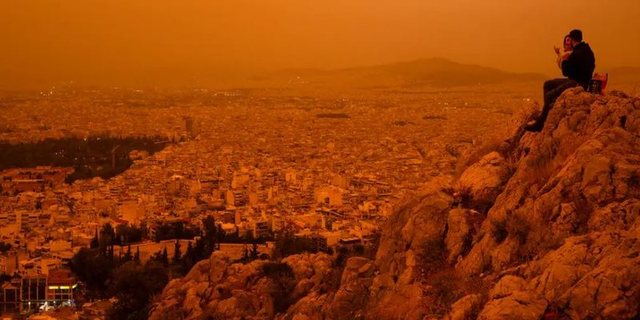
It is no longer a rare event for dust storms to reach Europe from the Sahara, and this has been happening for a long time.
This spring the dust of the Sahara arrived in Athens, over a thousand kilometers away. This caused an impressive natural event, for it appeared as if the Acropolis was temporarily located in March. Everything was covered in reddish orange.
How is a dust storm created in the Sahara?
Dust storms are created when the Sahara has strong winds in dry conditions. The Sahara desert covers a large part of North Africa. Desert sand consists of particles of different sizes, Carlos Perez Garcia-Pando, sand and dust expert at the Barcelona Supercomputing Center, explains to Deutsche Wellen.
Some particles are large and heavy, these are carried by the wind. But these are not the ones that arrive in Europe passing through the Mediterranean Sea.
When these large sand particles hit the ground, they hit the sand piles which break up into very small dust particles, Garcia-Pando explains. And it is precisely these small particles that spread over long distances, because they are very small and light.
These dust storms form when weather conditions are very dry. Otherwise, the sand particles become wet and heavy, so they cannot fly long distances. Sandstorms occur more in areas that have little vegetation, because the vegetation would block the wind and the dust would stay on the plants.
Why do these winds bring dust to Europe?
Dust storms occur regularly in the Sahara Desert. But for them to travel thousands of kilometers to the north, the weather conditions must be such as to create strong winds. Only then does the storm travel long distances.
In most cases, Sahara dust is transported from a low pressure area to the Mediterranean Sea and from there to Europe. These systems are very strong and create strong winds that move counterclockwise, Garcia-Pando says. It is typical that they appear in the spring. It is rare, but even high pressure weather conditions can cause such events.
The dust particles that end up in Europe can stay in the air for a long time because they are smaller than grains of sand, which fall quickly to the ground, explains Stuart Evans, an expert on dust issues at the University of Buffalo in New York, in an E-mail to Deutsche Wellen. "What's coming to Europe is a dust storm, not a sandstorm," Evans explains.

Happening now...












America may withdraw from Europe, but not from SPAK
Nga Gentian Gaba
ideas



top



Alfa recipes



TRENDING 




services
- POLICE129
- STREET POLICE126
- AMBULANCE112
- FIREFIGHTER128