


FLASH NEWS
Joan of Arc, the saint who was burned alive at the stake

2024-05-30 12:12:56 / MISTERE&KURIOZITETE
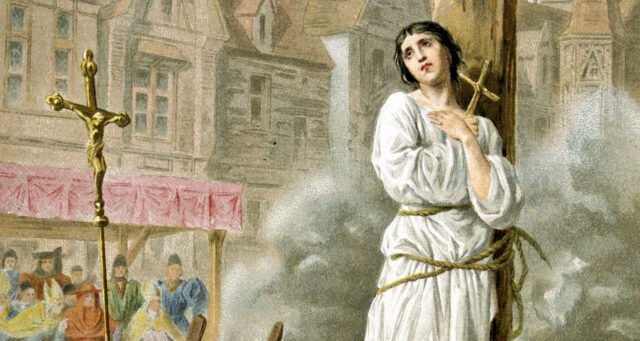
Joan of Arc, a pious peasant in medieval France, believed that God had chosen her to lead France to victory in its long war with England. With no military training, she convinced Crown Prince Charles of Valois to allow her to lead a French army into the besieged city of Orléans, where they achieved a stunning victory.
After such a wonderful victory, Jeanne d'Arc's reputation spread wearing the halo of a heavenly miracle descended on the faith of a girl. She and her followers escorted Charles through enemy territory to Reims, taking cities that resisted forcefully and enabling his coronation as King Charles VII in July 1429.
Jean d'Arc floated the idea that the French should press their claim to retake Paris, but Charles wavered after his favorite at court, Georges de La Trémoille, warned him that Jean was becoming too powerful. The Anglo-Burgundians were able to strengthen their positions in Paris and turned back an attack led by Joan of Arc in September.
In the spring of 1430, the king ordered Jean to face a Burgundian attack on Compiège. In her attempt to protect the city and its inhabitants, she was deliberately thrown from her horse and left outside the city gates as they closed. The Burgundians took him prisoner and brought him amid much tumult to the castle of Bouvreuil, occupied by the English commander at Rouen.
And it all begins there, where a farcical trial came to life and intrigues unfolded and no meanness and inhuman act was spared against her, to bring her to her knees and blame, to humiliate and denigrate what she had achieved through miracle and faith. Alone against all, defenseless against an army of judges and harbuts.
She, Jeanne d'Arc, (January 15, 1412- May 30, 1431) was the daughter of the divine will, who was burned alive for heresy, who 489 years later was declared a saint, but remains just as sanctified in the justification of injustice the most emblematic in history are also those who suppressed this cruel mechanism by taking an innocent girl to the gallows.
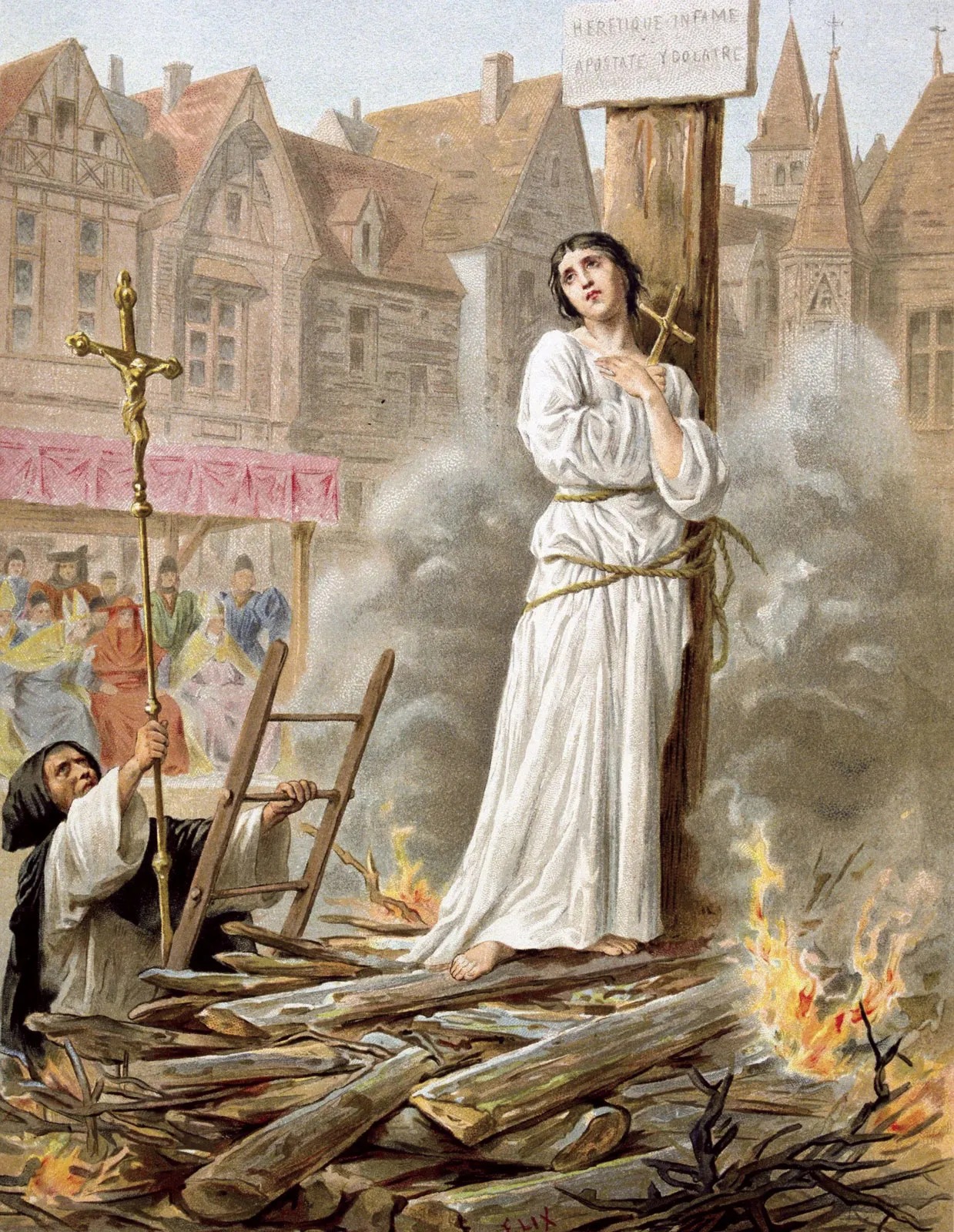
There is no story in history like that of Jeanne d'Arc, the peasant girl of medieval France, who on May 30, 1431 was burned alive in the Old Market Square in Rouen, not yet 19 years old. In 1920 the Catholic Church would declare Joan of Arc a martyr and saint, while Shakespeare, Voltaire, Michelet, Schiller, Mark Twain, Anatole France, George Bernard Shaw, and others too numerous to mention, who displayed heroics and her fatal fate, by the mastery of their creative spirit, immortalizing her and ascending to heaven above any ecclesiastical decree or canonization.
In the ensuing trial, Joan of Arc was ordered to answer about 70 charges against her, including witchcraft, heresy and dressing as a man. The Anglo-Burgundians aimed to get rid of the new leader as well as discredit Charles, who owed his coronation to her.
In an effort to distance himself from an accused heretic and witch, the French king made no attempt to negotiate Joan of Arc's release. In May 1431, after a year in captivity and under threat of death, Jean relented and signed a confession denying that she had ever received divine guidance.
However, a few days later, she defied orders by wearing men's clothes again, and the authorities pronounced her death sentence. On the morning of May 30, 1431, at the age of 19, Jean was taken to the old market of Rouen and burned alive at the stake.
Her fame only grew posthumously, however, and 20 years later a new trial ordered by Charles VII erased her name, but could not eradicate her from historical memory and the consciousness of those who witnessed the miracles. hers. Long before Pope Benedict XV canonized him in 1920, Joan of Arc had achieved mythic stature, inspiring numerous works of art and literature over the centuries, including the classic silent film The Passion of Joan of Arc.
In 1909, Joan of Arc was beatified in the famous Notre Dame Cathedral in Paris by Pope Pius X. A statue in the cathedral of Joan of Arc, who eventually became the patron saint of France, pays tribute to her legacy.
Happening now...
















ideas


Enver-Sali!
Nga Indrit Vokshi

Idolaters and idolatry have nothing to do with democracy!
Nga Ardi Stefa
top






TRENDING 




services
- POLICE129
- STREET POLICE126
- AMBULANCE112
- FIREFIGHTER128