


FLASH NEWS
Khamenei's dead end

2025-06-20 23:27:39 / BOTA
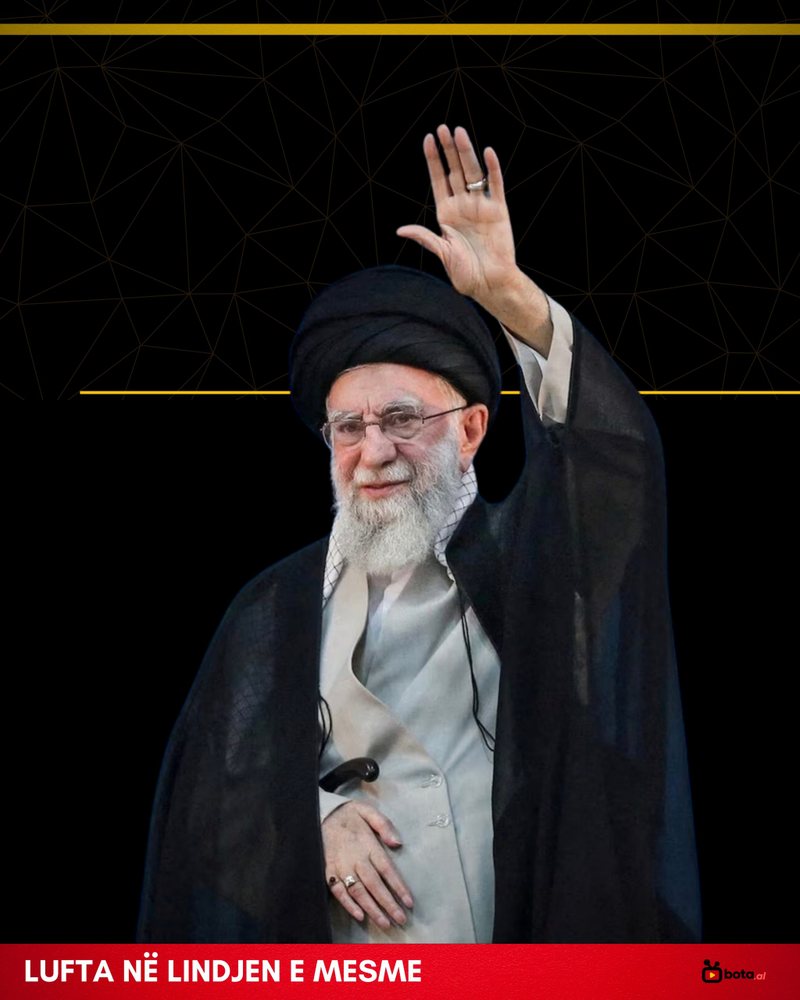
The Iranian supreme leader has no more cards to play. All he has left is martyrdom. And, like Imam Hussein, he launches a final volley of missiles. But for him, assassination is the most glorious and desired end.
There is an episode in Shiite mythology that always returns, remembered in theatrical form in the celebrations of the “martyrdom” of Imam Hussein. His family and most devout followers are surrounded by the army of the caliph Yazid, (the evil character) in a piece of desert near the Euphrates River. Hussein’s brother, Abbas, called “the Moon of the Hashemites”, breaks the siege, reaches the river and tries to bring water to the children and women who are dying of thirst. But he is killed. Then Hussein, at a decisive moment, decides that he has come for the moment to sacrifice his life.
Iranian propaganda has always used this episode to justify the resistance of the Palestinian Hamas in Gaza. And some can feel confident that they see this story written on the forehead of Ali Khamenei, the Supreme Leader of the Islamic Republic and a reference point for Shiites throughout the Middle East. This dual role has determined his fate.
The institutional architecture created by Khomeini sees the Supreme Leader as the pivot of the scales between spiritual and secular power. On one side stands the merchant bourgeoisie of the bazaar and on the other the “bonyads,” the foundations of the great, very wealthy sanctuaries.
The president, that is, the executive, is confronted by the “Majlis”, the Parliament. And likewise, in the military plan, on one side are the armed forces, and on the other the “Pasdarans”, the Revolutionary Guards, who have more powerful means. Khomeini used this balance of powers to avoid an end like that of Shah Reza Pahlavi, who had concentrated all powers in his hands and in those of the secret service, Savak. And he was overthrown by a popular revolution.
The Islamic Republic survived protests, revolts, the occupation by Saddam Hussein, sanctions, because of a more solid architecture. Now the final moment has come. In Khamenei's words, "the battle has begun," there is the example of Imam Hussein, not to win, but not to repent, to throw himself into the final attack against the most numerous forces, with the conviction of his divine mission: in this concept, "martyrdom" is the true victory.
At 86 years old, with a cancer that has returned, for a religious figure like Khamenei – albeit in the background compared to Khomeini – being killed is the most glorious and desired end. This does not mean that he is not trying in every way to leave his son, Mojtaba, 55, as his successor, but that is a story in itself. The game remains open. At least until some Western troops are at the gates of Tehran, the Supreme Leader will not be replaced, at least formally, by a military man. Even General Qassem Soleimani himself, who enjoyed a popularity hundreds of times greater than that of the ayatollah, has never considered such a solution.
Khamenei has no way out. He tried first to modernize the economy in a modern capitalist way with Rafsanjani, then to radicalize the regime, focusing on the poor and religious strata of the population with Ahmadinejad and his unqualified subsidies. Then to reconcile with the West, even on the nuclear issue, with the reformist Khatami.
But in the end, in 2018, he hit the Trump wall. He didn’t want to follow North Korea’s path, to leave the Nuclear Non-Proliferation Treaty and to build a bomb as soon as possible, because of the Byzantine nature of power in Tehran and the ambiguity it used as a negotiating weapon. Now he no longer has the cards in his hand, Trump himself would say. To surrender would mean imposing on his country a humiliation not seen since the beginning of the 20th century, when Persia was a half-British, half-Russian protectorate. To flee would mean ending up on the same plane as the Shah, at the height of humiliation and contempt, in front of all his followers.
And then, the final weapon: a final volley of missiles. Like Imam Hussein. In mind, perhaps, is General Soleimani, who like Abbas in the Shiite imagination, had tried to break the siege of sanctions, of America's Arab allies, of international isolation. And has created the Shiite militias trained by the Pasdaran, in Iraq, Lebanon, Syria - all in the face of Israel. A threat and a deterrent. There is no other, or almost no other. Soleimani has been "martyred", by the hand of Trump. The most trusted and effective ally, Hassan Nasrallah, is still alive. The game to overthrow Khamenei has begun./ La Stampa
Happening now...










83 mandates are not immunity for Rama's friends
Nga Gentian Gaba
ideas



top



Alfa recipes



TRENDING 




services
- POLICE129
- STREET POLICE126
- AMBULANCE112
- FIREFIGHTER128