


FLASH NEWS
"Exam Hall on the Beach"/ When Education Wins Over War! Students in Gaza Are Tested on the Beach, Footage Goes Viral

2026-05-11 11:17:20 / BOTA
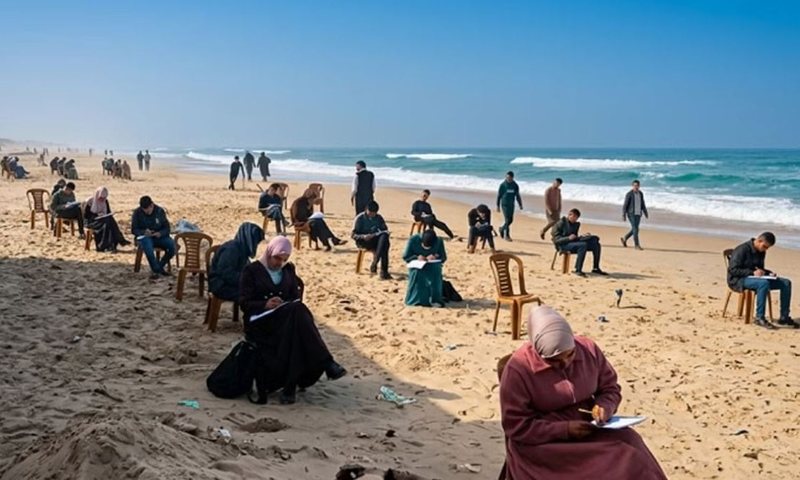
Under the April sun, Iyadi, a fourth-year engineering student, walked briskly along the Gaza coastline. He didn't have a fishing rod in his hand or a beach towel over his shoulder.
Instead, he clutched a worn plastic folder containing pages of his work tightly under his arm.
A few meters from the waves was a sign that read: “Exam Room: Beach.” Next to it, a long row of plastic chairs had been set up on the sand, without desks, for students to take their exams. “Before the war, I would walk around the campus well-dressed, take my exams in an air-conditioned classroom, and then visit the main conference room,” he told the Independent Arabia newspaper.
He took a seat in chair number 14, propping the folder on his knees like a makeshift table. Next to him, his classmate, Omari, was wiping the sweat from his forehead with his shirt collar. In front of them stood Hamidi, the professor who had lost both his home and his university. He moved with dignity, calmly on the sand, silently distributing the exam papers.
“Start in the name of God. You have two hours. And don’t forget that your names are the most important thing you will write today, so that your rights are not lost in this chaos,” he said, his voice mixing with the sound of the waves. Immediately, the students began reading the questions of the final exams that separated them from graduation. The decision to hold the exams on the beach was made after the destruction of universities in Gaza.
Iyadi began to read the first question, as the strong sea winds tried to snatch the paper from his hands. He placed a bottle of water on top of it as a weight, placing all his dreams on his cheek. A strange mix of sounds filled his ears: the roar of the waves, the crying of a child in a nearby tent, and the distant hum of a surveillance drone on the horizon.
He closed his eyes for a moment, inhaled the strong smell of iodine, and imagined himself back in that old lecture hall with its wooden benches. Then he began to write rapidly, solving complex mathematical equations as if his pen were the only way to face reality.
As the exam continued, he realized that passing this exam was not just a grade on an academic record, but a declaration that the engineer within him was not buried under the rubble of the crumbling university buildings.
As time ran out, Iyadi stood up, brushing sand from his pants. He watched the rows of chairs empty, then handed in his exam. The scene was not just a university exam. It was a silent epic, written in the ink of determination on the Gaza coastline.
He returned to his tent, carrying his bag, full of hope that the person who would solve the equations of reinforced concrete under the scorching sun would one day be able to rebuild all that had been destroyed.
“Educational genocide”
Gaza’s education system has lost irreplaceable human capital. More than 20,000 students from schools and universities have been killed. The sector has also lost more than 1,000 teachers and administrative staff, as well as more than 220 university professors and scholars, many of whom were internationally recognized authorities in specialized academic fields.
Academic institutions have been reduced to rubble or overcrowded shelters, while major university buildings have been completely or partially destroyed.
These include advanced laboratories, lecture halls and research centers.
Israeli military spokesman Avichai Andrai said the universities were used by Hamas for military purposes, including training and technical development. Meanwhile, the Palestinian Ministry of Higher Education has described the attacks as “educational genocide” and called for an international investigation.
Happening now...





Sali Llapa
Nga Bato Kosova
ideas

Does Albania have a foreign policy?
Nga Ditmir Bushati

Republic of Thieves!
Nga Gjergji Nika

Albania, this ship stuck in the business of theft!
Nga Edison Ypi
top

Alfa recipes







services
- POLICE129
- STREET POLICE126
- AMBULANCE112
- FIREFIGHTER128