


FLASH NEWS
The land of beer and wine, but in Germany people are consuming less and less alcohol. Here's why

2025-02-04 08:05:38 / BOTA
January is gone, and perhaps those who observed the first month of the year sober were looking forward to February 1. Or others are thinking more carefully about their relationship with alcohol in the months ahead.
Surprisingly, an increasing number of people in Germany are taking a more conscious approach to drinking alcohol.
Beer and wine have long been an inseparable part of the culture in the land of Oktoberfest (the Bavarian beer festival).
In Germany, not only is it allowed to drink alcohol in public spaces, but the country also allows teenagers aged 14 to consume alcohol in the presence of their parents.
Germans consume twice as much alcohol as the world average.
Across the country, bars, breweries, and restaurants remain important places of social interaction, contact that is alcohol-based.
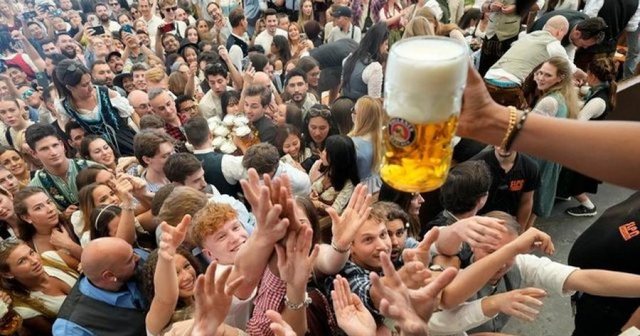
A large group of people at the Munich beer festival and a hand extending a glass of beer towards the peopleA large group of people at the Munich beer festival and a hand extending a glass of beer towards the people
Beer remains the drink of choice in such settings. Germany produces over 5,000 varieties in 1,500 breweries, most of them with a long history.
As far back as the first century AD, the Roman historian Tacitus described the Germanic people as passionate about beer consumption. In the Middle Ages, Germanic monks began to diligently brew beer in their monasteries, initially for personal consumption and later for sale.
In 1516, the "Purity Law" came into force in Bavaria with the aim of controlling the quality of beer and guaranteeing the use of only three ingredients: water, barley and the flower of the plant "Humulus lupulus". This is the oldest food law still in force and many of the local beers still boast having passed the purity test.
The first brewery opened in Munich about 200 years ago, where today one of the largest beer events in the world is organized: Oktoberfest.
Bavaria, the southern German state that hosts the annual beer, food and culture festival, produces more than half of all domestic beer.
"Beer is made by man, wine by God," said Martin Luther, the man who sparked the Protestant Reformation in Germany in the early 1500s.
For centuries, Germans have produced numerous varieties of red and white wine with difficult-to-pronounce names, such as Spätburgunder, Weissburgunder or Müller-Thurgau. The most common variety, however, remains Riesling. The grape varieties grow mainly in the hills of the southwestern regions such as Rheinhessen, Palatinate, Baden and Mosel.
The German version of champagne, Sekt, is also found almost throughout Germany. The most famous brand of Sekt, Rotkäppchen, dates back to 1856.
The company was nationalized by East Germany after World War II. But with the unification of the country, "Rotkäppchen" was privatized and since then its production has only grown, selling hundreds of millions of bottles a year.
However, beer and wine are being drunk less in Germany.
Personal beer consumption has decreased by almost a quarter of its former amount. In 2013, a person consumed an average of 107 liters per year, while in 2023 it will be about 88 liters.
Wine consumption also declined. In 2023, a person consumed an average of one liter less wine than the previous year.
Germans of all ages want to avoid the calories and diseases that come with alcohol. Sales of non-alcoholic beer have doubled in the past 10 years.
Beer and wine may be part of Germany's cultural identity, but 1.6 million people are addicted to alcohol and this problem should not be underestimated./ DW
Happening now...















America may withdraw from Europe, but not from SPAK
Nga Gentian Gaba
ideas

Who is the Surrel Rabbit?
Nga Sidi Hasanaj

The two wrong paths of the opposition with the Ombudsman
Nga Patrik Sadikaj
top



Alfa recipes



TRENDING 




services
- POLICE129
- STREET POLICE126
- AMBULANCE112
- FIREFIGHTER128