


FLASH NEWS
Edi Rama's successive attacks against the media

2025-08-07 23:50:27 / EDITORIAL
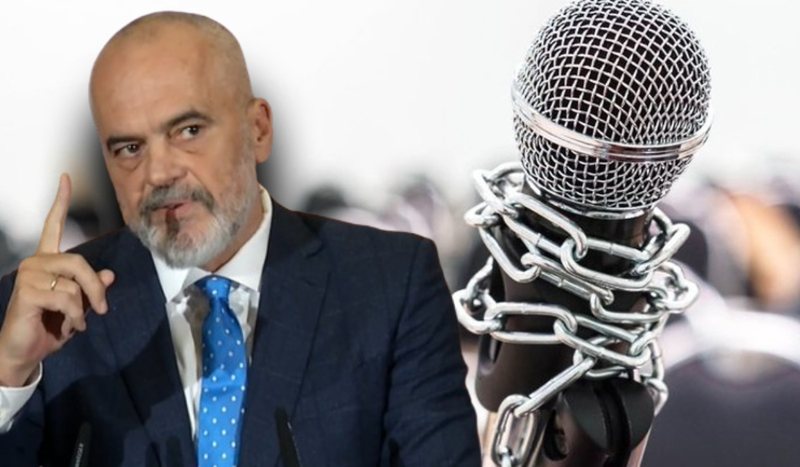
Prime Minister Edi Rama recently declared that criticism from human rights groups of the Criminal Code introduced by the Ministry of Justice is unreasonable and suggested that critics “not sit in the sun.” But a brief history of the last twelve years suggests that, in fact, the latest initiative is a spectacle we have seen many times before.
In November 2015, the current prime minister had just over two years in power when the media suddenly revealed that a proposal for amending the Penal Code had been submitted to the Albanian Parliament. The proposal’s report stated that the initiative had been taken by the prime minister himself, with the aim of punishing anyone who “abusing freedom of expression, intentionally spreads, by any means and manner, defamation against a high-ranking state or elected official.”
The proposal was to include in the list of crimes against the state, in addition to criminal acts such as terrorism, espionage, sabotage or insurrection, another crime, that of defamation against high-ranking officials.
This was the first, but not the only, time that the government of Prime Minister Edi Rama took initiatives in which the dignity of the prime minister is equated with that of the state and where the preferred punitive measure is prison. Not even 12 hours after the proposal was revealed, widespread domestic and international pressure forced Rama to withdraw. He apologized and tried to defend himself by saying that the aim of his legal proposal was not to punish journalists, but opposing politicians.
Just a few months later, the Ministry of Innovation proposed a legal initiative to amend the law “On Electronic Commerce,” which, it was implied, would also include online media and where “offensive comments would have to be withdrawn immediately.” In April 2015, Majlinda Bregu, then an opposition MP, had made a similar proposal, which also targeted “offensive comments.”
In 2019, the government proposed sweeping legal changes presented as an “anti-defamation package.” It took three years of struggle, as well as the engagement of international actors, the European Union, the Council of Europe, and the Venice Commission, for the government to be forced to withdraw from the initiative that envisaged fines and closure orders for media outlets, as it placed online media under the supervision of the Audiovisual Media Authority, an institution that in normal countries only has regulatory authority over television and radio.
In March 2020, a leaked document from the Ministry of Justice revealed that the government was once again keen to amend the Criminal Code, to toughen penalties for defamation and insult, and to differentiate officials as persons whose dignity is far more costly to offend than that of ordinary citizens. The Ministry of Justice confirmed at the time that the document was genuine, but described it not as an initiative but as a “working document.”
The latest initiative, the one through the complete amendment of the Criminal Code, for which the government says it had no role and that it has entrusted it to some experts, again provides for similar changes as before. This time, defamation and insult are again provided for as criminal offenses, while the fines are increased if the alleged victim is a political official. In the chapter on crimes against the state, mockery or contempt of “institutions” is followed by a fine or imprisonment of up to four years. In the article that punishes insult, the “experts” have added the concept of “serious insult”, which provides for up to 2 months in prison. Meanwhile, the defamation article is drafted in such a way that it equates the individual with the institution. In a word, if you “defame” or “offend” not the individual, but the institution, you are punished the same.
Unlike in the past, such as the 2015 initiative to criminalize defamation against high-ranking officials or the anti-defamation package, this time the government is insisting that it has nothing to do with what is being proposed and that the proposals are the product of a “group of experts.” None of the experts involved in drafting the new Criminal Code have come out in defense of their work, nor have they responded to public protests about the content of specific articles of this proposal.
What is clear is that, both in the case where the proposals came from Rama himself or his government, and in the current case where the proposals were made by “experts”, there is an extremely large gap between the proposals and the cases reviewed by the European Court of Human Rights. In particular, in several cases where prison sentences were reviewed by Turkish courts against President Erdogan, such as, for example, the sentencing of a cartoonist for insulting the president to 11 months in prison, the ECHR has emphasized that freedom of expression includes those ideas that “offend, shock or disturb”.
Based on these criteria, the European Union has officially requested Albania not only not to toughen penalties for defamation or insult, but also to abolish current criminal penalties and leave these cases to be dealt with only by civil courts. The most recent document dates back to June of this year. Against this reality, it is unclear where the independent experts got their inspiration when they drafted articles that are clearly in conflict with the European Charter of Human Rights and the decisions of the European Court of Human Rights. /BIRN
Happening now...













America may withdraw from Europe, but not from SPAK
Nga Gentian Gaba
ideas


Who is the Surrel Rabbit?
Nga Sidi Hasanaj

The two wrong paths of the opposition with the Ombudsman
Nga Patrik Sadikaj
top



Alfa recipes




TRENDING 




services
- POLICE129
- STREET POLICE126
- AMBULANCE112
- FIREFIGHTER128