


FLASH NEWS
Belinda Balluku's suspension: Decision within the law, not a violation of the Constitution

2025-11-20 20:01:51 / IDE
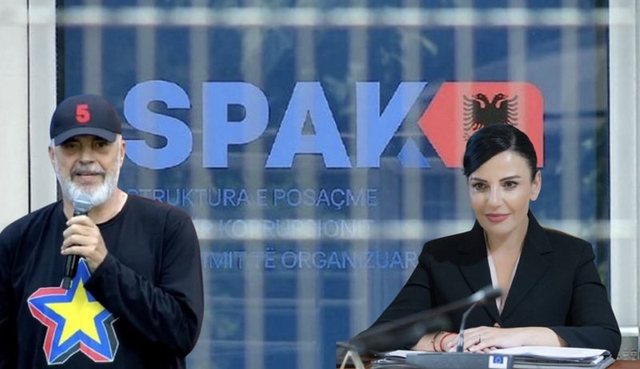
The public debate following the suspension of Belinda Balluku from her duties as Deputy Prime Minister and Minister of Energy has focused in recent hours on the question of whether this decision violates the Constitution?
The correct answer, based on the law and case law, is no. The suspension is a fully constitutional measure, provided for by law and implemented in accordance with the powers that the Constitution recognizes for the judiciary.
The crux of the matter lies in Article 242 of the Code of Criminal Procedure, which gives the court the right to suspend the person prosecuted from office when there is a risk that he, by continuing in office, will obstruct the investigation, influence subordinates or destroy evidence. This article makes no exception for members of the government and there is no constitutional restriction that prohibits the application of this measure to ministers. The reason is clear: the Constitution considers ministers to be appointed functionaries, not elected by the people. Article 103 of the Constitution stipulates that ministers are appointed by the Prime Minister and decreed by the President, which places them in the category of executive officials, who are necessarily subject to control and criminal liability like any other subject of the law.
Similarly, the immunity argument does not hold. Article 73 of the Constitution guarantees immunity only to deputies and only for investigation-arrest, not for measures related to the exercise of executive power. Parliamentary immunity does not extend to the governmental function: it does not protect a minister from suspension from office if there is a risk of obstructing the investigation. In this sense, the suspension does not affect her mandate as a deputy, does not violate the representation of the people and does not interfere with the electoral will. It affects only an executive function that the Constitution itself has placed under the control of the law and the judiciary.
On the other hand, the suspension does not affect the functioning of the government and does not create a constitutional vacuum. The Constitution clearly provides that the government is a collegial body and functions even when a minister leaves, is dismissed, resigns or is suspended. The powers of a minister can be delegated, or the Prime Minister can propose a new name. Nothing in the Constitution links the stability of the government to the mandatory presence of a single individual, therefore the measure of suspension does not produce any effect that could be interpreted as a violation of the constitutional order.
If we were to accept the opposite logic, that a minister cannot be suspended under any circumstances, then top-level officials would be practically untouchable, even when suspected of obstructing corruption investigations. This would not only be against the spirit of the Constitution, but would also turn executive immunity into a shield against the law. And it is precisely for this reason that the legislator has provided for the possibility of suspension as a temporary measure, directed not against democracy, but in its defense.
In the European context, such suspensions are common. Italy, Romania, Croatia, the Czech Republic and France have applied the same practice to ministers, mayors and senior officials when there was a risk of undermining investigations. In all these cases, the courts have assessed that the suspension is a measure that guarantees the separation of powers and the functioning of the rule of law, not an arbitrary interference with the executive.
Therefore, to the big question that has been asked today whether the suspension of Belinda Balluku is a violation of the Constitution, the answer is clear, well-argued and indisputable: no. It is a legal, constitutional, proportionate measure and in line with the standards of EU countries. In a society where for years we have heard complaints about the impunity of high-ranking officials, the fact that justice is acting against such an important figure is not a threat to democracy, but is evidence that democracy is finally starting to function.
Happening now...







Karmën nuk e ndalon dot Sali Berisha!
Nga Bato Kosova
ideas

"Topple" Edi Rama by lying to yourself...
Nga Patrik Sadikaj


Only accepting Berisha's truths will save the DP from final extinction!
Nga Neritan Vladi
top






TRENDING 




services
- POLICE129
- STREET POLICE126
- AMBULANCE112
- FIREFIGHTER128