


FLASH NEWS
Institutional crisis in Kosovo, DW: There is a lack of trust among the parties to reach a political solution! How will this crossroads be resolved?

2025-11-13 14:27:22 / KOSOVA
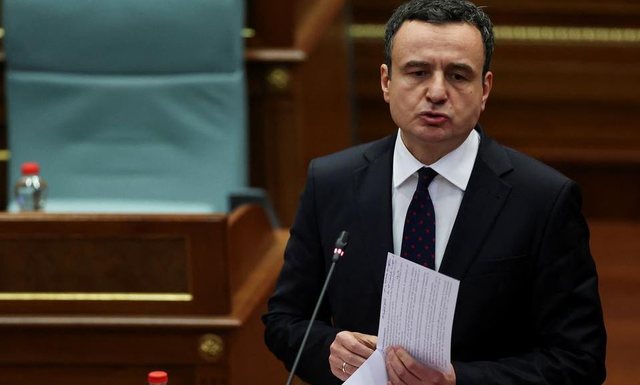
Kosovo continues to be in an institutional crisis awaiting the second attempt to form a new government. After the failure of the acting Prime Minister Albin Kurti to form a new government, President Vjosa Osmani has mandated his colleague from the Vetëvendosje party, Glauk Konjufca, to form a majority.
For Albin Kurti, the leader of Vetëvendosje, which emerged as the first party in the February 9 elections, receiving 42% of the vote, the deputies have only two options. “The deputies of the Assembly of the Republic are facing the selection of either Kurti 2.5 by December, or Konjufca 1 by April, but without either of them it is not possible.”
But the opposition parties so far do not accept impositions and accuse Kurti of deliberate procrastination, with the proposal for a minority government. The leader of the LDK, Lumir Abdixhiku, said that "our citizens are now being proposed as a solution a minority government for a transitional period to handle state issues. They are now calling it a transitional unity, and of course it is imposed. So, not with discussion and inter-party dialogue, but with decisions of a political party."
Kosovo President Vjosa Osmani expects the session for the new government to be convened as soon as possible. She has meanwhile mandated Glauk Konjufca as the second prime minister. “The second prime minister is still within the constitutional deadline. So, as you know, the session must be convened within the constitutional deadline. There are still a few days left. We hope that this will be done as soon as possible and we will see the result of this session.”
The leader of Vetëvendosje, Albin Kurti, the leading party but which failed to form a majority in its first attempt, says that if it fails to do so in its second attempt with its party colleague Konjufca, there will be new elections. According to Kurti, these could be either in December 2025 or in spring 2026, when the country's President should also be elected. "The second attempt, in our strong belief, is not only right, but also an obligation, so that everything possible is done to avoid new elections. It would be a great loss if we were forced to go to elections in December and April."
Institutional blockage costs money
In the absence of a new Kosovo government and a parliament that is constituted but not functional, Kosovo cannot receive aid from the EU's growth plan, nor can it approve the budget for 2026. Kosovo's President, Vjosa Osmani, says she has raised these issues, but the will of political parties is needed. "I have also raised the issue of the growth plan, which is over 800 million euros, the issue of agreements with the World Bank, which now at the end of December are 100 million euros, but which are another 200 million at the end of the year that could be lost if they are not ratified. So, we are talking about a billion euros, which is a quarter of Kosovo's budget, which Kosovo should not lose, but benefit from. All that is needed is the will of the political parties so that these decisions are made by this Assembly, by the representatives of this Assembly, who were voted on February 9, but have not yet decided anything."/DW
Happening now...




Karmën nuk e ndalon dot Sali Berisha!
Nga Bato Kosova
ideas

"Topple" Edi Rama by lying to yourself...
Nga Patrik Sadikaj

Only accepting Berisha's truths will save the DP from final extinction!
Nga Neritan Vladi
top



TRENDING 




services
- POLICE129
- STREET POLICE126
- AMBULANCE112
- FIREFIGHTER128