


FLASH NEWS
Why does candidate status for Ukraine and Moldova not mean rapid EU membership?

2022-06-18 07:48:36 / KOSOVA
The Head of the European Commission, Ursula von der Leyen, and the EU Commissioner for Enlargement and Neighborhood Policy, Oliver Varhelyi.
Ukraine and Moldova also have a lot of work ahead.
Following the decision of the European Commission to propose to the European Union to grant candidate status to these two countries, each of the 27 member states is now expected to give its consent.
Ukraine applied for EU membership on February 28, four days after the start of the Russian occupation of this country, in eastern Europe.
Moldova and Georgia did the same on March 3 this year.
Georgia has not received the green light from the European Commission, arguing that its application will be reconsidered.
However, the history of the enlargement of the European bloc, especially in the case of Turkey, has shown that candidate status means nothing to the expectation that a country must pass until it joins.
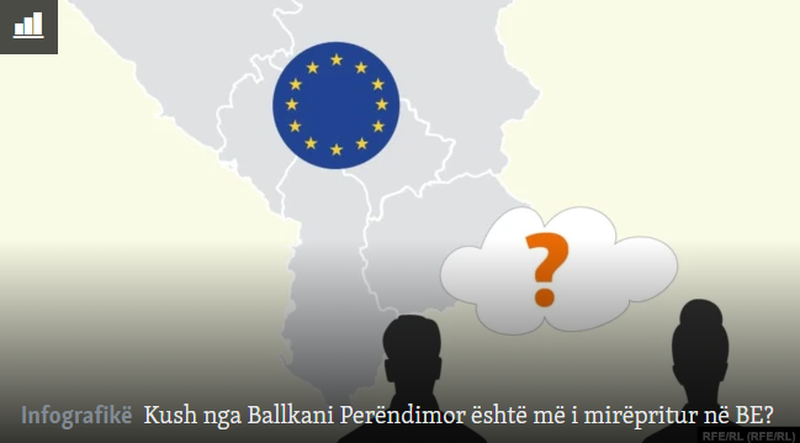
Kosovo and Bosnia and Herzegovina lag behind Moldova and Ukraine?
All the countries of the Western Balkans have stated that EU membership is their strategic goal and they are all at different stages of the integration process.
At the same time, both countries - Ukraine and Moldova - will pass Bosnia-Herzegovina and Kosovo into the integration process, although the latter have been waiting in line for years.
Both Kosovo and Bosnia and Herzegovina have the status of potential candidates, which means that they have been promised membership 'when they are ready'.
But it must be borne in mind that after the Russian occupation of Ukraine, Bosnia-Herzegovina and Moldova found themselves in the same basket.
NATO chief Jens Stoltenberg, along with Georgia, has described the three countries as countries where Russia could provoke destabilizing situations.
Announcing the candidacy decision, the head of the European Commission, Ursula von der Leyen, stressed the "crucial reforms" carried out by Moldova, especially in the fight against corruption.
What is expected in the case of Bosnia and Herzegovina?
Unlike Ukraine and Moldova, Bosnia and Herzegovina has no recommendation to become a candidate country for full EU membership.
Asked about the possibility of granting candidate status to Bosnia, EU Enlargement Commissioner Oliver Varhelyi recalled that the country must meet 14 conditions before the start of membership negotiations.
"Bosnia has its own way and the conditions that apply to it. Bosnia must meet 14 criteria… we are still waiting for that to happen. "If we renegotiate the terms, it would mean shortening the process, and we do not do that."
Among the 14 criteria that Bosnia has in front of it, is that of changing the constitution of the state, and therefore it poses a special challenge.
The three ethnic groups, Bosniaks, Croats and Serbs, are failing to find an agreement that would abolish their exclusive rights to elections or executive, legislative and judicial appointments.
So far, Bosnia has fully met a priority related to the functioning of the Stabilization and Association Parliamentary Commission.
In recent days, however, voices have been heard again in support of Bosnia's path to the European bloc.
One of the messages coming out of the Prespa Forum, which was held in northern Macedonia from June 16th to 18th, is that Bosnia and Herzegovina should receive EU candidate status as soon as possible.
"I propose a new package, for Bosnia and Herzegovina to receive candidate status immediately, without additional conditions," said Slovenian President Borut Pahor.
Slow steps towards the EU
Bilateral relations between Bosnia and Herzegovina and the EU have been developed for more than 25 years and it all started in 1997, when Bosnia was given the opportunity to use the so-called autonomous trade preferences.
Negotiations for the signing of a Stabilization and Association Agreement between Bosnia and the EU began in 2005.
The documents were signed three years later and entered into force in 2015.
In December 2010, Bosnia entered the regime. of free movement within the EU.
In 2016, Bosnia submitted its application for EU membership.
At the end of that year, Bosnia accepted the documents, through which the European bloc assesses the readiness of a state to start the membership process.
In 2019, the European Commission issued its opinion on the request, saying that Bosnia and Herzegovina must meet 14 criteria in order to gain candidate status.
Ukraine and Moldova will meet these criteria later, if they receive the status.
The “speed” of the procedure
Bosnia and Herzegovina submitted its application for candidate status in February 2016. The European Commission issued a (negative) opinion in September 2019.
Serbia submitted its application in December 2009. In October 2011 , The European Commission has issued an assessment that this country deserves candidate status. In December 2012, Serbia was granted candidate status.
Montenegro submitted the application in December 2008. The recommendation of the European Commission came in October 2010. The candidate status was approved in December of that year.
Northern Macedonia submitted its application in March 2004. The positive recommendation was announced by the European Commission in November 2005, and this country was guaranteed candidate status the following month. This country is still waiting for the start of membership negotiations.
Albania submitted its application in April 2009. The European Commission Recommendation was made public in November 2010. The candidate status was approved in June 2014. This country is still awaiting the start of membership negotiations.
Where is Kosovo in this process?
Kosovo has the status of a potential candidate.
The Government of Kosovo has announced that it will apply for full EU membership this year.
However, Kosovo is not recognized as a state by five member states - Greece, Romania, Cyprus, Spain and Slovakia, and the decision requires the consent of all member states.
In 2012, the European Commission launched a dialogue with Kosovo on visa liberalization.
Former Prime Minister of Kosovo, Isa Mustafa, and former EU High Representative for Foreign Affairs, Federica Mogherini, signed the Stabilization and Association Agreement in 2015.
In 2016, Kosovo met all 95 criteria set by European bloc on visa liberalization.
The European Commission has recommended member states to adopt visa liberalization for Kosovo in 2018.
However, some member states are preventing this.
Among them, France is the most vocal.
Who currently has candidate status?
Currently, five countries have candidate status: Turkey since 1999, Northern Macedonia since 2005, Montenegro since 2010, Serbia since 2012 and Albania since 2014.
If they receive candidate status, Ukraine and Moldova will approach the position of Albania and Northern Macedonia, but with one difference - the European Commission has already recommended the start of membership negotiations with Skopje and Tirana.
The three stages of EU enlargement
The process of joining the European Union consists of three stages:
When the EU assesses that a country that wants to join is ready for this process, then it becomes the official candidate for membership - but this does not means that formal negotiations begin.
In the second phase, the candidate country starts formal negotiations. This process includes adaptation to EU law, as well as the implementation of necessary reforms in the judiciary, administration, economy and other areas. These are otherwise called membership criteria.
In the end, when negotiations are completed and reforms are carried out, with the approval of both parties, a state joins the European bloc - if all member states agree.
Turkey is knocking on the gates of the EU for the longest time.
This country applied to join the European Economic Community in 1987 and in 1999 was considered eligible to join the EU.
Accession negotiations began in 2005, but only one of the 30 chapters has been completed so far.
Many of the chapters are vetoed because Turkey does not recognize the Republic of Cyprus, an EU member state.
Turkey has not opened a single chapter in five years, and Brussels has said there are a number of reasons why negotiations have stalled with Istanbul.
"Turkey is a strategic partner of the EU on issues such as migration, security, economy, fight against terrorism, but it has lagged behind in the field of democracy, rule of law and fundamental rights. In response, in June 2018, the General Affairs Council declared the accession talks with Turkey as effectively frozen ", it is said on the official website of the European Commission./REL
Prepared by: Krenare Cubolli
Happening now...










83 mandates are not immunity for Rama's friends
Nga Gentian Gaba
ideas


top


Alfa recipes




TRENDING 




services
- POLICE129
- STREET POLICE126
- AMBULANCE112
- FIREFIGHTER128