


FLASH NEWS
Monte Nuovo, the dormant volcano that could destroy Europe

2025-05-26 23:11:38 / MISTERE&KURIOZITETE
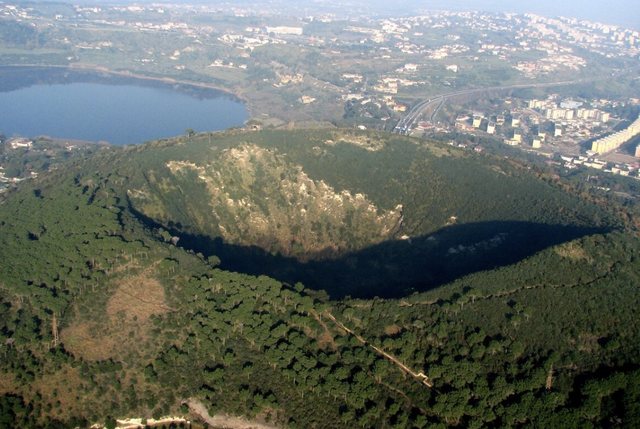
In ancient times, volcanic eruptions were quite frequent throughout the world, and a natural disaster to which people were forced to adapt. Most volcanic eruptions were of a small scale, and incapable of causing much damage.
Some of them destroyed entire cities, while others managed to wipe out entire civilizations. Over time, volcanic eruptions became less frequent until the 19th century. The southern part of Italy has always been one of the most active volcanic areas for centuries.
Even in ancient times, volcanoes like those at Pompeii and Herculaneum erupted more than a dozen times, sometimes just a few decades apart. Volcanoes are classified based on their explosive potential, the destructive power of which is calculated based on size, position, and volcanic activity.
The volcano Monte Nuovo is located in the southern part of Italy. It has a very impressive appearance today, as wildlife has flourished on the dormant volcano. The last time this volcano was active was in 1538. Its history is very interesting. The location of the volcano is about 10 kilometers from the city of Naples, in a place called Campi Flegrei, which in Italian translates as "scorched earth".
It takes its name from ancient mythology, as it is said that Zeus and his brother and sister defeated the Titans there. But don't be fooled by the actual appearance of the volcanic mountain. The volcano itself is mostly underwater, covering an area of over 100 square km, and having a total of 24 craters.
Monte Nuovo has the potential to destroy all of Europe and perhaps even beyond. An example of the power of this volcano is an event that occurred about 40,000 years ago. After the eruption, a thick cloud of smoke covered a large part of Europe, covering an area of about 1 million square kilometers.
That volcanic eruption is said to have played a major role in the extinction of the Neanderthals, as the eruption wiped out a large portion of the animals in southern Europe. Another eruption occurred 15,000 years ago, which was of a much smaller scale.
And as we mentioned above, the last one is the one from 1538, which also created the conical shape that the mountain has today. This means that this volcano has not had any activity in the last 600 years. If we refer to the history of the volcano, this does not constitute a very big concern.
The general concern is the increase in volcanic activity around the world since the 19th century. Since the beginning of that century, more and more volcanic eruptions have begun to occur. Their number continues to increase at a rate that has greatly concerned volcanologists, as it could provoke super-volcanoes such as that of Monte Nuovo in the past.
Based on the description of the volcano, it is very difficult for volcanologists to predict exactly when this volcano might erupt. Every volcano is completely different from the next, so each requires a different method of analyzing volcanic activity and the probability of an eruption.
Some experts say the eruption itself wouldn't be that catastrophic. But the seismic force would displace a huge volume of water from the sea, which could provoke a giant tsunami. At the same time, they say the upcoming eruption would be the most powerful our modern world has seen, due to climate change.
And that means that most of Europe will be destroyed by the power of the explosion.
You might be wondering how exactly the rest of Europe will be affected. Well, just like it was 40,000 years ago. The smoke caused by the black ash produced by the eruption will shroud Europe for years to come.
It will affect all living beings, slowly killing them due to its toxicity and by removing access to natural vitamin D (obtained from the Sun), which is vital to the well-being of every human being. Food sources would be destroyed, crops would not grow, and plant and animal life would disappear./ Bota.al


Happening now...










83 mandates are not immunity for Rama's friends
Nga Gentian Gaba
ideas



top



Alfa recipes


TRENDING 




services
- POLICE129
- STREET POLICE126
- AMBULANCE112
- FIREFIGHTER128