


FLASH NEWS
Scientists discover a hidden volcano on Mars

2025-06-14 09:07:53 / MISTERE&KURIOZITETE
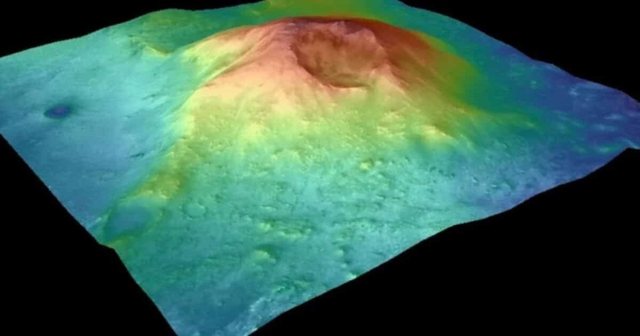
A team of researchers has discovered intriguing evidence that suggests a mountain on the rim of Mars' Jezero crater may be a long-hidden volcano. The discovery, published in Communications Earth & Environment, could hold key insights into the planet's volcanic history and the potential for life on Mars. With the help of data from NASA's Perseverance rover and multiple Mars orbiters, scientists have provided compelling evidence that Jezero Mons may not just be a mountain.
Mars is a mysterious planet, its surface marked by vast craters, deep canyons, and strange geological formations. Among these features, Jezero Crater has always intrigued scientists, largely because of its potential to once have held water. Researchers had long suspected that the prominent peak on the crater's rim—Jezero Mons—might be volcanic, but definitive evidence had been elusive. That is, until now.
Using data collected by Mars orbiters and the Perseverance rover, scientists have confirmed that Jezero Mons shows similar characteristics to volcanic formations known on Mars and Earth. The size and shape of the mountain mirror those of volcanic features such as Zephyria and Apollinarus Tholi on Mars, and even Mount Sidley in Antarctica. These similarities provide strong evidence that the feature may have been formed by volcanic activity.
The most compelling aspect of this discovery is what it reveals about the geological history of Mars. The team, led by James Wray, a professor of astrogeology at Georgia Tech, studied multiple data sets from orbiters, including the Mars Odyssey, Mars Reconnaissance, and ExoMars Trace Gas orbiters. Their analysis revealed that Jezero Mons shares striking characteristics with explosive volcanoes found elsewhere on Mars and Earth. This includes the shape of the mountain, as well as the lack of impact craters.
Also, parts of the northwest flank of Jezero Mountain show signs that closely resemble past lava flows. These flows appear to have reached the bottom of the crater, further linking the mountain to volcanic activity. This is particularly significant because NASA's Perseverance rover found that the floor of Jezero Crater is made of volcanic rock, not sedimentary rock as expected from a previously flooded area. This discovery led the team to hypothesize that the volcanic material may have originated from Jezero Mountain itself.
The possible volcanic nature of Jezero Mons carries broader implications for the search for life on Mars. Volcanic activity may have created hydrothermal environments – conditions that could have supported microbial life in the planet's distant past. This discovery revives the possibility that Mars, particularly Jezero Crater, once had the right conditions to harbor life, at least in its early history.
To investigate further, the team is now awaiting the return of samples collected by the Perseverance rover. These samples, when returned to Earth, will be analyzed through radioisotope dating, which will provide more precise data on the age of the volcanic rocks. This will help scientists understand when volcanic activity occurred in relation to the presence of water.
While there is still much to learn, this latest research suggests that Jezero Mons may not be a one-off feature. “If we’re just identifying one volcano here, imagine how many others there could be on Mars,” Wray said, highlighting the potential for many more discoveries across the Martian surface.

Happening now...
















83 mandates are not immunity for Rama's friends
Nga Gentian Gaba
ideas



top



Alfa recipes




TRENDING 




services
- POLICE129
- STREET POLICE126
- AMBULANCE112
- FIREFIGHTER128