


FLASH NEWS
The Constitutional Court removes political protection from majority MPs: We also accept opposition lawsuits directly

2025-07-16 10:32:12 / POLITIKË
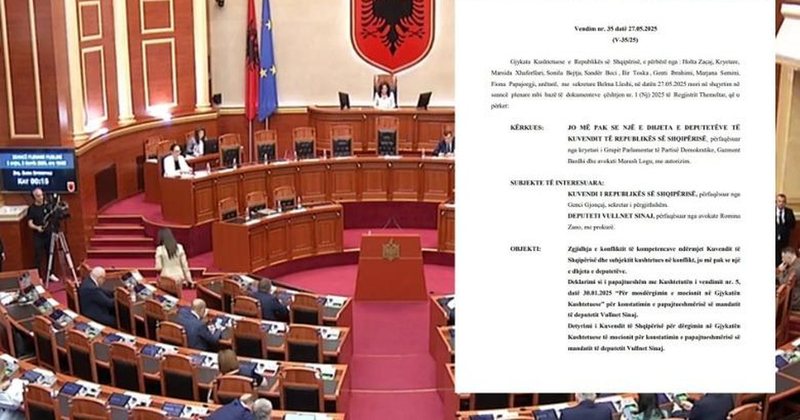
A decision announced by the Constitutional Court in May overturned the opposition's mandate for MP Vullnet Sinaj, but the disclosure of this decision on July 10 reveals that the Court itself has finally created a liberating mechanism for the parliamentary minority.
Thus, the Court clearly states for the first time that when 1/10 of the deputies think that an MP should lose his mandate because he has benefited from public funds, they automatically set Parliament in motion, informs journalist Esiona Konomi.
And if the Assembly decides by majority vote not to refer the case for review to the Constitutional Court (as happened twice for Olta Xhaçka and Vullnet Sinaj), then 1/5 of the deputies (28 deputies) can directly address the Court to request it to judge the case in question.
Previously, the Constitutional Court had not followed this practice, and in cases where the opposition has moved the Assembly, the majority has protected its deputies and they have not been able to be judged in the Constitutional Court on whether or not they should retain their mandate.
Despite successive decisions by this court that the Assembly refer the matter to the Constitutional Court, Parliament has not been convinced.
Although this decision of the Constitutional Court saved the mandate and "dignity" of the two cases in question, the latest decision strips the majority MPs of political protection in the future.
PART OF THE DECISION:
The Court emphasizes that the purpose of the constitutional competence to control the incompatibility of the deputy's mandate implies a judgment on the merits by it, in which it assesses whether the concrete actions carried out by the deputy are incompatible with his mandate and finally establishes this incompatibility, if that is the case. In order to achieve this purpose, the constitution-maker has also provided for one tenth of the deputies as the subject that sets in motion the parliamentary procedure for sending the issue of the suspected incompatibility of the deputy for examination on the merits to the Court. Under these conditions, in cases where the Assembly is set in motion by a motion of one tenth of the deputies or of its President, it (the Assembly) has the constitutional obligation to initiate the parliamentary procedure for the examination of the motion for sending the issue of the incompatibility of the mandate to the Court.
In the event of the rejection of the motion of one-tenth of the deputies of the Assembly or its President, consequently in the event of the failure of the Assembly to initiate the Court, in the sense of making effective this mechanism of constitutional control provided for by letter “e” of point 1 of Article 131 of the Constitution, the submission of a request by no less than one-fifth of the deputies, in the sense of its right under letter “c” of point 1 of Article 134 of the Constitution, already reflected in the content of point 2 of Article 66 of Law No. 8577/2000, constitutes the alternative means for initiating the constitutional trial for the control of the incompatibility of the deputy's mandate.
The right of one-fifth of the deputies under Article 66, point 2, of Law No. 8577/2000 is related to the setting in motion of the Court in those cases when the Assembly itself, after examining the motion of its President or one-tenth of the deputies, decides to reject the motion in a plenary session, consequently not to accept the referral of the case to the Court. Only in this way does Article 70, point 4, of the Constitution become applicable and the right of the parliamentary minority, not less than one-fifth of the deputies, to request from the Court the final examination on the merits of the issue of the incompatibility of the deputy's mandate becomes valid.
Happening now...













America may withdraw from Europe, but not from SPAK
Nga Gentian Gaba
ideas



top



Alfa recipes




TRENDING 




services
- POLICE129
- STREET POLICE126
- AMBULANCE112
- FIREFIGHTER128