


FLASH NEWS
Protests in Bulgaria "folklore" in Albania

2025-12-03 15:03:33 / POLITIKË
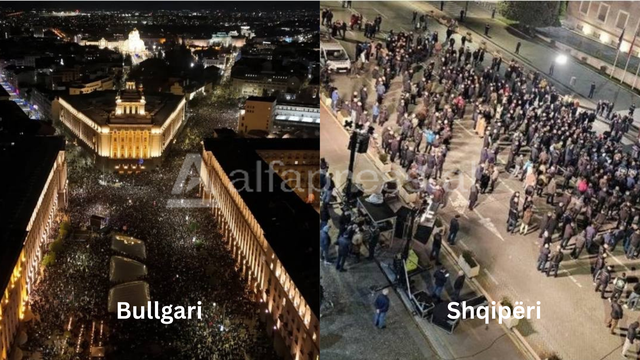
In recent days, in several cities in Bulgaria, the opposition has been mobilizing tens of thousands of citizens against corruption, activating a normal mechanism, that of public pressure. While in Tirana, and almost in several cities in Albania, the opposition is organizing serial forums where, as its important figures say, the aim is not massification but a space for people to speak. So our opposition model is much more "advanced" than the Bulgarian one, as we have passed the protest phase and have entered a series of activities that PD sympathizers direct and talk about their daily lives.
What is called a protest there, is called a "poltora" here, a political format that in terms of structure closely resembles group therapy in terms of the number of participants and the topics discussed individually, where participants listen to each other about their troubles.
In Bulgaria, protests articulate dissatisfaction with the government. In Albania, dissatisfaction is packaged as a “fight against corruption” to avoid making it seem as if the core of the problem is the leadership crisis within it. The greatest irony is that while in other countries the opposition seeks to build credibility to take power, in our country it seems as if part of the opposition is busy defending the continuity of the leadership. We thus have a paradox, an opposition that seeks to fight government corruption, while important figures within it are perceived internally and externally as corrupt.
The scale of the protests says it all. In Bulgaria, people are coming out because they see themselves in the cause. In Albania, those who feel compelled to preserve the image of a worn-out leadership, which bases its political battle more on rhetoric than real credibility, are coming out.
So, while Bulgaria grapples with corruption, we are grappling with a deeper problem than corruption itself: a political culture that depends on fixed figures and the effort to revive them, even as society has moved on. Perhaps this is the bitterest irony of the whole picture. Albania has no shortage of reasons to protest, but it lacks credible people to organize them.
In this context, the contrast with Bulgaria helps us understand a simple reality, that of the functional opposition starting from within itself. While in Sofia the protests are aimed at the government, in Albania the dissatisfaction is circulating like an undercurrent within the DP itself, where a part of the structures and figures tired of recycling the same political logic are looking for a new direction, but without daring to articulate it openly. The irony is that the internal movements, which in any other party would be a sign of vitality, in ours seem more like an attempt to save themselves from shadows that never leave the scene.
And so, while Bulgaria measures the opposition spirit with protesters, the DP measures it with groups of discontented people who move in silence, caught between the desire for resurgence and the fear of challenging the leader who has turned political transition into a lifelong profession.
Happening now...






Karmën nuk e ndalon dot Sali Berisha!
Nga Bato Kosova
ideas

"Topple" Edi Rama by lying to yourself...
Nga Patrik Sadikaj


Only accepting Berisha's truths will save the DP from final extinction!
Nga Neritan Vladi
top




TRENDING 




services
- POLICE129
- STREET POLICE126
- AMBULANCE112
- FIREFIGHTER128