


FLASH NEWS
A month of war in Lebanon, when the conflict in the Middle East is expected to end

2026-04-03 21:36:05 / BOTA
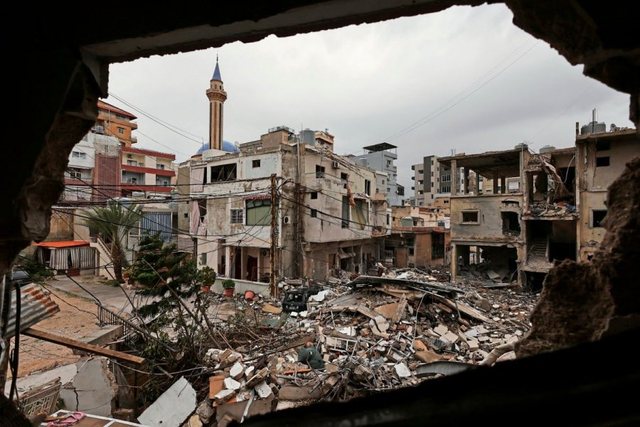
This week marked the second month of war in Lebanon: 1,300 dead, more than a million displaced – and no end in sight to the fighting, which is receiving little attention in the shadow of the Iran-Israel War.
Prime Minister Nawaf Salam described the country on Thursday as "a victim of a war, the outcome and end date of which no one can predict."
Lebanese Hezbollah, weakened but not incapacitated by near-daily Israeli attacks during a ceasefire, opened a new front against Israel in early March, following the start of US-Israeli missile strikes on Iran in support of Tehran. Prime Minister Salam expressed particular concern about recent statements from Israel: “The stance of Israeli representatives and the actions of their army reveal broad objectives, including a significant expansion of the occupation of Lebanese territories.”
The terms “security zone” or “buffer zone” were recently used by Israeli Defense Minister Israel Katz to describe the area between the Israeli border and the Litani River in southern Lebanon, about 30 kilometers inland. The far-right minister, Bezalel Smotrich, went even further, calling for the Litani River to become Israel’s new border.
But Katz also announced that Israel intends to control the area up to the Litani River, until further notice. More than 600,000 Lebanese residents will be barred from returning south of the Litani until “the security of residents in northern Israel is guaranteed.” To this end, all homes in villages near the border in Lebanon will be demolished, following the example of Rafah and Beit Hanoun in the Gaza Strip, “in order to permanently eliminate threats near the border for residents in northern Israel.”
In addition to euphemisms for “mass displacement” and “occupation,” observers see that the “Gaza manual” is now being implemented in Lebanon: In addition to the declared destruction of all homes in villages near the border, bridges are also being systematically demolished to divide and fragment the area south of the Litani.
The aid organization Oxfam criticizes Israel for deliberately destroying water and sanitation infrastructure, as it did in Gaza. According to Oxfam, at least seven vital water sources, supplying nearly 7,000 people in the Bekaa Valley alone, were damaged in just four days. Lebanese health workers also complain of targeted Israeli attacks, including the “double-knock” tactic, where one bombing is followed by another targeting rescue workers.
"The Shia must leave"
In total, more than a million people – a fifth of the population – have been forced to flee, mostly from Shiite-majority areas in southern Lebanon. The Israeli evacuation orders affect a total of 15 percent of the country – but according to media reports, not all residents there are affected equally.
Israeli military officials reportedly assured some Christian and Druze communities in southern Lebanon, in confidential talks with local representatives, that they could stay in the evacuation zone. The New York Times reported this on Wednesday. However, the affected communities were reportedly pressured to expel all Lebanese from neighboring Shiite Muslim communities who had sought refuge with them. The message was: “The Shiites must leave.”
The Reuters news agency recently reported that about 9,000 Lebanese Christians have announced their intention to remain in their villages within the evacuation zone.
The UN Office for the Coordination of Humanitarian Affairs (OCHA) recently warned that “the humanitarian situation is deteriorating at an alarming rate”: hospitals are overwhelmed and a large number of health personnel have been affected by evacuation orders.
“What we are seeing in Lebanon is a massive displacement crisis,” says Andreas Knapp, Secretary General of Caritas Austria’s international aid program. “Around 370,000 children – roughly one in five children in Lebanon – have lost their homes. Tens of thousands are living in emergency shelters, with relatives, in makeshift shelters or on the streets. Their daily lives are characterized by a lack of access to hygiene and medical care, as well as an increasing risk of violence and family separation,” Knapp continued in a press release.
In many parts of the country, schools are closed, either due to evacuations or because they are being used as emergency shelters. For hundreds of thousands of children, this means not only the interruption of education, but also the loss of safe spaces, social contacts and a stable routine. “The risk of hundreds of thousands of children growing up without prospects is increasing every day,” says Knapp. The protection of civilians is enshrined in international humanitarian law, “just like the right of children to education and protection – and these obligations also apply in times of war.”/ Der Standard.
Happening now...












ideas

Renaissance is Disaster Capitalism
Nga Klodian Tomorri

Pse tifozeria e Kosovës ishte aq e vdekur dhe mungonin simbolet kuqezi?
Nga Kreshnik Spahiu

top



Alfa recipes



TRENDING 




services
- POLICE129
- STREET POLICE126
- AMBULANCE112
- FIREFIGHTER128