


FLASH NEWS
Astronomers discover 3D structure of an alien planet's atmosphere

2025-02-21 16:40:29 / MISTERE&KURIOZITETE
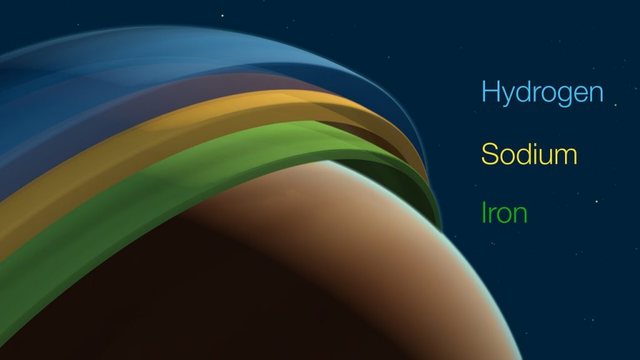
Astronomers have for the first time deciphered the three-dimensional structure of the atmosphere of a planet beyond our solar system, revealing three layers, like a wedding cake, on a planet of hot gas, which orbits close to a star larger and hotter than our sun, according to Reuters.
Researchers observed the atmosphere of WASP-121b, a planet also called Tylos, by combining all four units of the European Southern Observatory's Very Large Telescope based in Chile, discerning a stratification of layers with different chemical compositions and intense winds.
So far, researchers have been able to determine the atmospheric chemical composition for several planets outside our solar system – called exoplanets – but without mapping the vertical structure or how the chemical elements were distributed.
WASP-121b is an "ultra-hot Jupiter," a class of large gaseous planets that orbit close to their host star, making them extremely hot.
Its atmosphere is composed mainly of hydrogen and helium, like that of Jupiter, the largest planet in our solar system.
But WASP-121b's atmosphere is unlike anything ever observed before.
The researchers distinguished three layers by looking for the presence of specific elements.
The lower layer of WASP-121b was characterized by the presence of iron – a metal in gaseous form due to the incredible heat of the atmosphere.
Winds move gas from the hot side of the planet to its colder side.
The middle layer was characterized by the presence of sodium, with a jet stream blowing around the planet at about 43,500 miles (70,000 km) per hour – stronger than any wind in our solar system.
The upper layer was characterized based on its hydrogen, with part of this layer being lost to space.
The researchers also detected titanium in gaseous form in the atmosphere of WASP-121b.
On Earth, neither iron nor titanium exists in the atmosphere, because they are solid metals – due to our planet's lower temperatures, compared to WASP-121b.
Earth has a layer of sodium in its upper atmosphere.
WASP-121b has roughly the same mass as Jupiter, but twice the diameter, making it more bloated – and is located about 900 light-years from Earth in the direction of the constellation Puppis.
A light year is the distance light travels in one year, 5.9 trillion miles (9.5 trillion km).
The planet orbits its star at about 2.5% of Earth's distance from the sun.
It is about a third closer to its star than our solar system's innermost planet Mercury is to the sun – so close that it completes an orbit in 1.3 days.
Its host star, called WASP-121, is approximately 1-1/2 times the mass and diameter of the sun, and hotter.
Being able to discern the structure of an exoplanet's atmosphere could be useful as astronomers search for smaller rocky planets capable of supporting life.


Happening now...
















83 mandates are not immunity for Rama's friends
Nga Gentian Gaba
ideas



top



Alfa recipes




TRENDING 




services
- POLICE129
- STREET POLICE126
- AMBULANCE112
- FIREFIGHTER128