


FLASH NEWS
Albanian fighters hiding ammunition under the bridge, an engraving that tells the story of 1903

2026-04-12 16:01:35 / MISTERE&KURIOZITETE
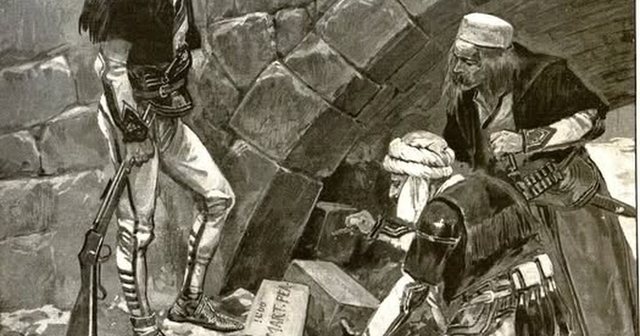
There are images that are not just frozen glimpses of a moment, but open windows into the memory of a people, a people born in war and tempered in the fire of war and centuries-old struggles for freedom.
One of these is an engraving from 1903, where a group of Albanian warriors, dressed in the characteristic clothes of the north, Shkodra and the highlands, are hunched over some ammunition crates, hiding them under a stone bridge. There is no noise, no war cries, but tension, determination and manly silence permeate every line of this work.
It is a scene that speaks to us without words about the way the freedom movement was prepared and kept alive, away from the stands and official parades. It is a sight that embodies the invisible, silent and dangerous act that was often the foundation of those uprisings that history later recorded with great names.
This engraving is not just an artistic testimony, it is a visual twist of our collective memory, made by a foreign eye that knew how to see beyond the numbers of war and captured the feeling of the threshold of the uprising. Let us take a closer look at this work, to understand what is hidden under the stone bridge, not only ammunition, but history, resistance and trust.
This is an engraving by the British artist, R. Caton Woodville, in 1903, and is entitled “Albanian fighters hiding ammunition under a bridge.” It represents a dramatic and tense scene from the early 20th century, a turbulent period in the Balkans, when Albanians, through secret and armed organizations, were preparing for an uprising against Ottoman rule, in the name of national liberation and self-determination.
The characters depicted in this engraving are dressed in traditional Albanian costumes, xhoka, tirqe, vests with weapons and shoka, which suggest their origin from the mountainous areas of Northern Albania. Their clothing, in particular, is reminiscent of the features of the costumes of the Shkodra region and the surrounding highlands, which reinforces the belief that the artist was inspired by that ethnographic area.
Along these lines, it is possible that the bridge depicted is one of the historic bridges of Shkodra, such as the Middle Bridge, although the latter is larger and more monumental. However, the bridge in the engraving may represent a smaller, peripheral bridge, typical of Ottoman construction, used by the insurgents to hide ammunition or to pass supply caravans.
In the center of the scene, crates of ammunition are seen, which are being carefully hidden under the bridge. This indicates the conspiratorial and dangerous way in which the weapons for the uprising were secured. One of the interesting details is the inscription on the crates: “MART PEA”, an inscription that does not correspond to any Albanian word, but is most likely a stylized note by the artist. This could represent a shortened form for “munition militaire” (French) or “military parts/ammunition” (English), or it could be a fictitious label, as was common practice in documentary engravings of the time. The aim was to highlight the military content of the cargo, without going into technical details of accuracy.
The authorship is confirmed by the artist's signature in the lower left corner, R. Caton Woodville, an illustrator known for drawings reflecting conflicts of the time, often for major European magazines such as The Illustrated London News.
Another intriguing element is the decorative carving on the upper part of the bridge wall, on the right. It appears to be an ornamental relief, perhaps with symbols that could be Ottoman or allegorical, but without a precise heraldic identification. These symbols, although undefined, have an expressive function within the work, giving it an authentic nuance and the feeling of a coded location.
It should be noted that often foreign artists who created Balkan scenes, as in this case, used a combination of direct observation, artistic imagination and second-hand sources (photographs, newspaper or traveler descriptions), so each element should also be seen as part of the illustrative composition, not necessarily a photographic evidence.
The year 1903 coincides with a tense period in the Balkans, with the outbreak of uprisings in Macedonia and Kosovo, and preparations for the Albanian League of Peja, as well as similar movements in the north and south of the country. This engraving, in this sense, becomes a vivid picture of the efforts of Albanian fighters to organize resistance, often in secret, maintaining contacts with patriots at home and abroad, to secure weapons and logistical support.
Happening now...





Sali is gone, Rama is gone.
Nga Bato Kosova
ideas


Mr. Rama, the algorithm is a consequence!
Nga Ermal Mulosmani

Botërori, më shumë se futboll
Nga Andi Lila
top


Alfa recipes


TRENDING 



services
- POLICE129
- STREET POLICE126
- AMBULANCE112
- FIREFIGHTER128