


FLASH NEWS
The mystery of the disappearance of 400 kg of uranium

2025-06-24 18:53:42 / MISTERE&KURIOZITETE
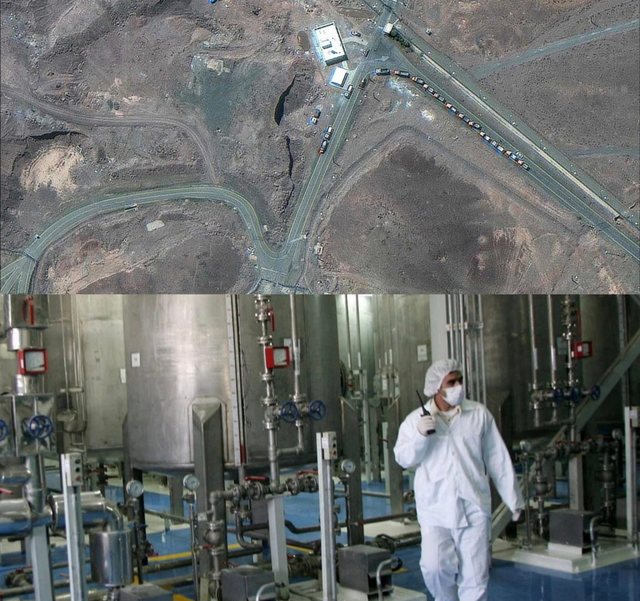
The shell was broken, but inside it was empty.
At the three Iranian nuclear sites of Fordow, Natanz and Isfahan – bombed by Israel, then by the United States and again yesterday by Israel – there were no 408.6 kilograms of 60 percent enriched uranium, which in May had alarmed the UN International Atomic Energy Agency. With that material, the Islamic Republic has the ability to build a bomb, as Netanyahu and Trump claim, so the threat is still present.
Israeli aircraft, American 13-ton bombs, Tomahawk missiles, have destroyed the facilities, above and below ground, with a level of damage that can only be assessed over time, but in the meantime the Iranians have moved the uranium to secret locations.
For Israel, this is reason enough to announce another phase of the hunt for Iran's radioactive treasure.
This was understood immediately after the American attack. While Trump spoke of a "total destruction" of the targets and of "monumental damage", highlighting the spectacular long-range mission of the B-2 Spirit bombers, the American intelligence services remained cautious in their statements.
In the New York Times, a qualified source said that the US government does not know where Iran's enriched uranium is stored.
Even US Vice President JD Vance, in a television interview, admitted: "If dangerous material was moved before the attacks, we need to talk to the Iranians."
Another confirmation comes from the director of the International Atomic Energy Agency: "On June 13, Tehran sent a letter to the IAEA to signal that it would adopt special measures to protect nuclear equipment and material," explained Rafael Grossi, adding that it must now ask the Islamic Republic for permission for inspectors to go and verify the place where the uranium is stored.
And how can Israel neutralize this uranium reserve, while, according to nuclear weapons experts, the Iranian regime in the Fordow laboratories could have managed to enrich uranium to 90 percent (i.e. to the limit for producing a bomb) in just three weeks.
“We have an interesting lead on where those 400 kilograms might be,” Netanyahu declares, referring to intelligence information that Mossad will not hesitate to use to track the stockpiles, control them and, if necessary, intervene.
According to satellite images, 16 trucks were seen at the entrance to the Fordow facility two days before the US attack, so it can be assumed that they were used to move uranium.
Were those vehicles tracked to their destination? It is not clear whether the trucks were used to transport the uranium, as this requires smaller vehicles, given that the material is in powder form and stored in metal cylinders.
Just as the 10,000 square meter "underground nuclear site," built inside a mountain near Natanz, that the Iranians speak of, still remains a mystery.
"There are almost certainly secret laboratories that we know nothing about," says Professor Jeffrey Lewis of the Middlebury Institute of Monterey, a researcher in the nuclear nonproliferation program.
In addition to the espionage network, in the hunt for Iran's radioactive treasures, Israel can also rely on a special American aircraft: the WC-135 Constant Phoenix.
This is a plane adapted to detect radioactivity in the air. The latest models are able to identify even the smallest traces. It tracks movements in the airspace of suspicious targets. A military source claims that a WC-135 has been in Saudi Arabia for a month – which has also been confirmed by the Russian channel Topwar – but there is no official confirmation yet.
It should also be noted that Iran's radioactive treasure trove is not just 60 percent enriched uranium. In its latest report in May, the IAEA estimated that Iran possesses 274 kilograms of 20 percent enriched uranium, 5.5 tons of 5 percent enriched uranium, and 2.2 tons of 2 percent enriched uranium.
“We were forced to intervene militarily,” Netanyahu says, “because Tehran, after the assassination of Nasrallah in Beirut in September, was rushing towards building the bomb.”
This does not fully align with the IAEA report, which finds an unusual increase in the production of enriched uranium by 60% (166 kg more in three months), and which for the first time in 20 years criticizes Iran for violating the Nuclear Non-Proliferation Treaty.
But at the same time, the report contains no evidence that Iran is building a bomb. “We do not want a nuclear Iran, nor do we want other states with nuclear weapons,” IAEA Director Rafael Grossi declared.
However, the Iranian parliament is discussing a bill that would suspend cooperation with the United Nations Atomic Agency./ bota.al


Happening now...













83 mandates are not immunity for Rama's friends
Nga Gentian Gaba
ideas



top



Alfa recipes




TRENDING 




services
- POLICE129
- STREET POLICE126
- AMBULANCE112
- FIREFIGHTER128