


FLASH NEWS
Horsehair

2026-02-22 20:25:13 / JETË
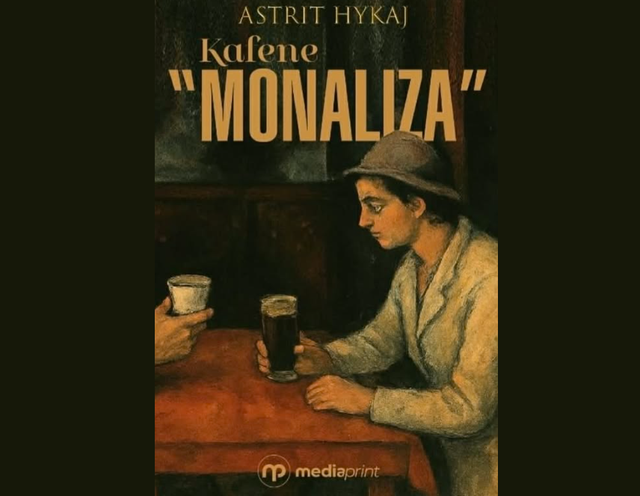
Notes on the novel "Kafene Monaliza" by Astrit Hykaj
Have you ever been walking down the street, and in the meantime, the sight that appears before your eyes brings back images from another time, when you were a different person, a different being? And that sight, that small bend in the road, those two small steps on the sidewalk in front of a cafe door that is not the same, and suddenly you see a young man, with hair like a horse's mane, walking with quick steps towards nowhere, without knowing where the goal will be?
While I was browsing the novel "Kafene Monaliza" by Astrit Hykaj, I saw my young self in the nineties; poet, black-haired, full of dreams, late student, lover, rebel, while in the background I was listening to Michael Jackson's Billie Jean. I continued to follow myself through the streets of Tirana, like a shadow on Elbasan Street, then to the Philological Faculty to the Student City Buildings, and I followed with my eyes the shadows of the girls of those years, who I don't know why, but they resembled wild flowers, rough and virgin at the same time. Then I turned back on foot, to the Academy of Arts, and I remembered that beautiful girl whose name I never learned, sitting on the stone steps of the Academy, to whom I had given a bouquet of roses, for no apparent reason, just because she was the most beautiful creature I had ever seen.
This is "Café Monaliza". A novel that pulls you by the hand and takes you to a time that no longer exists, but that still beats within the heart. And just as you immerse yourself in the pages of the novel, a deep and long 'oh' involuntarily comes out of your soul, like a painful groan for your new self, lost in the streets of the only city, in which you have seen the most beautiful dreams in the world.
This world has fragile and painful light and shadow; between dream and disappointment, between newly discovered freedom and the emptiness caused by disappointment. You don't know, you don't understand, you don't feel where you lost your dreams. Really, where did they go? Where did they go, where did we lose them?!
I remember the walks to the dollar market near the Bank of Albania. A strange, almost surreal scene: sharp-eyed men speaking in low voices, hawkers selling and buying everything - crumpled dollars, German marks, used watches, foreign cigarettes, passports, drachmas, wallets, bags, razors, florins, silver and copper jewelry. The improvised theater of freedom, where everyone sold the same things, and bought the same things. There you would find wholesale swindlers and prestidigitators, who would deceive you eye to eye, who would steal half of your money when you counted it in front of your eyes.
Tirana was a perfect and wild chaos. Small cafes that sprang up overnight; music, cigarette smoke and brandy, long hair, torn jeans, books with torn pages that were passed from hand to hand, unexpected loves that began on the sidewalk and ended at the Train Station. We were all a little crazy, a little hungry, very dreamy, in love with the idea of great love, but without clear ideas for our lives.
And above all, there was the feeling of flight. Friends would suddenly disappear from the sidewalks, leaving empty tables in cafes. Italy was the magic word that attracted raft rowers like Circe at the end of the Adriatic, while the wild mountains of the south between Greece and Albania were washed with the blood of dreamers. Beyond, far beyond, stretched Europe, a horizon that seemed tangible and distant at the same time. Often there were no goodbyes; people simply did not appear anymore. And the city continued to live with their gaps.
Hykaj's novel brings back this world full of nostalgia and life, with a seemingly cold narrative, but one that hits you hard and suddenly, precisely because it is not cold. Because Hykaj does not dramatize the narrative; he narrates the digestion with a kind of "coldness" that is in fact an irresistible wave of longing. For yourself, for your memories, for your youth lost to the seas and a Europe that still remains far from us.
And as you read it, you understand that that time, no matter how harsh, had a beauty that today seems impossible to return. Because it was a time when everything was unfinished, when every morning seemed like a new beginning, when even poverty had a strange light on it, because no one yet knew where the road would end. That time is drowned in longing. And love.
Perhaps this is the reason why that generation remains the most dreamy generation of Albania. Not because he had more talent or more luck, but because he found himself at a historical moment when everything collapsed and everything had to be imagined from scratch. And imagination became our way of surviving.
The novel “Café Monaliza” is a journey of memories that involuntarily takes you, takes you down roads where you think you will never return, and suddenly puts you face to face with your former self - that boy who walks quickly, with hair like a horse's mane, towards a future that he does not yet know, but that he feels he must follow, even if this path takes him far, very far, to where dreams become memories and memory becomes another form of life.
Perhaps this is why “Café Monaliza” is not read as the story of a character, but as the memory of a generation that did not have time to grow up gradually - but was immediately thrown into the waves of life.
I just saw that girl whose name I don't know again on the steps of the Academy of Arts. Sitting there on the stone steps, on books. With the dried bouquet of roses that I had given her, while she looked at me with surprise, joy and fear, caressing the red petals with her lips like blood. And again I leave without asking her name.
February, 2026
Happening now...





ideas



top



Alfa recipes



TRENDING 




services
- POLICE129
- STREET POLICE126
- AMBULANCE112
- FIREFIGHTER128