


FLASH NEWS
Balluk's suspension from public functions, the Constitutional Court's decision is revealed. How the 8 members of the panel of judges argued for the government's request

2026-02-06 22:18:10 / POLITIKË
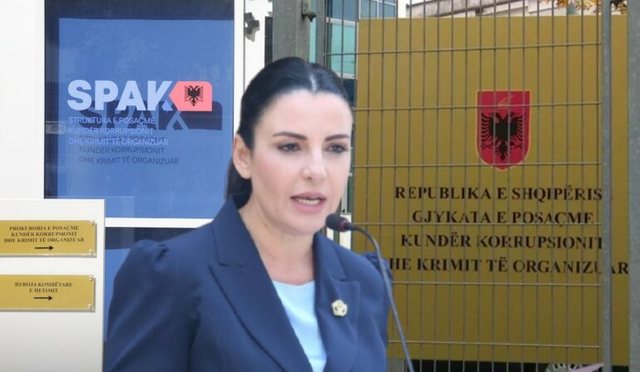
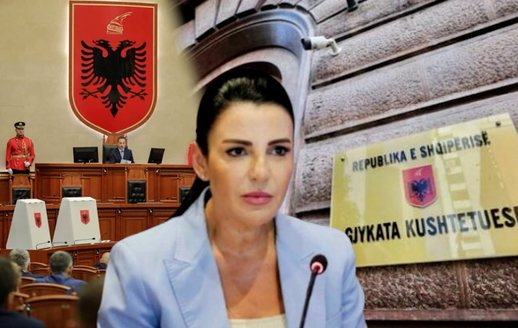
The Constitutional Court's decision on the government's request to suspend Deputy Prime Minister Belinda Balluku from public office is announced, upholding the GJKKO decision, ousting Rama.
The Constitutional Court, convened today on 06.02.2026, considered the case at the request of the Prime Minister of the Republic of Albania with the objective of: resolving the dispute over competence created between the Prime Minister and the Council of Ministers on the one hand, and the Special Court of First Instance for Corruption and Organized Crime, on the other hand; annulling the judicial decisions of the Special Court of First Instance for Corruption and Organized Crime for the part that ordered the imposition and continuation of the prohibitory measure of suspension of the exercise of the duties of the Deputy Prime Minister and Minister of Infrastructure and Energy, as well as the interpretation of point 3, Article 103, of the Constitution.
The Court unanimously considers that the immunity of the minister is regulated by Article 103, paragraph 3 of the Constitution in conjunction with Articles 73, paragraphs 1 and 2. The constitutional regime of the immunity of the minister, as well as that of the deputy, does not include the guarantee provided for in Article 242, paragraph 2 of the Code of Criminal Procedure, according to which the measure of suspension of the exercise of a public office or service does not apply to persons elected under the electoral law.
The Court emphasizes that according to the Constitution, the system of government is based on the principle of the rule of law, according to which even ministers are subject to the law and can be held legally responsible if they violate it. Other fundamental principles include the supremacy of the Constitution as the highest law and the direct application of its provisions, the obligation of the state to act within the basis and limits of the law, and the separation and balance between the legislative, executive and judicial powers.
Regarding the subject matter of the request, at the end of the discussions, the judges' assessments were divided into two positions and the Court did not reach the required number of votes for decision-making, according to the provisions of Article 133, paragraph 2, of the Constitution and Article 72, paragraph 2, of its Organic Law.
According to one position, the Court in its jurisprudence regarding Article 73, paragraph 3 of the Constitution has stated that the immunity of deputies is not their personal privilege, but its main purpose is to protect the Assembly itself and in particular its proper functioning.
In this sense, obtaining authorization from the Assembly for the implementation of measures that limit the freedom of the deputy in advance aims to protect the activity of the Assembly itself (see decision no. 81, dated 21.11.2024 of the Constitutional Court). This means that even Article 103, point 3 of the Constitution, by providing that members of the Council of Ministers enjoy the immunity of the deputy, aims at the protection and functioning of the executive body, of which the minister is also a part. Referring to the measure of suspension of the exercise of the duty or public service, it is assessed that, by its scale and intensity, it affects the constitutional political function of the minister. Therefore, in balancing the constitutional principle of the effectiveness of criminal prosecution and that of the functioning of the executive power in terms of the principle of separation and balance of powers according to Article 7 of the Constitution, the granting of prior authorization by the Assembly is also required for this measure.
According to another position, similar to the standard of interpretation accepted by the Court in the case of the immunity regime, which should be narrow/limited, based on the will of the constitution-maker in the 2012 reform to reduce immunity, the Constitution in its current form has provided for the prior authorization of the Assembly for criminal procedural measures expressly provided for in Article 73, paragraph 2 thereof.
This provision does not foresee the prohibitive measure of suspension from office under Article 242 of the Code of Criminal Procedure, although the application of this measure prevents the exercise of the functions of the minister and consequently interferes with the activity of the Council of Ministers. From the perspective of the principle of separation and balance of powers, the issue of adding or changing balancing mechanisms, which also include such guarantees, is a matter for the assessment of the constitutional legislator.
Regarding the above, the Constitutional Court decided:
Lifting the suspension measure imposed by the decision of the Meeting of Judges dated 12.12.2025.
This decision is final and enters into force upon publication of the decision in the Official Gazette.
The final decision will be announced with reasons within the legal deadlines provided for by Law No. 8577, dated 10.02.2000 “On the Organization and Functioning of the Constitutional Court of the Republic of Albania”, as amended by the Regulation on Judicial Procedures of the Constitutional Court.
Happening now...








ideas



top



Alfa recipes



TRENDING 




services
- POLICE129
- STREET POLICE126
- AMBULANCE112
- FIREFIGHTER128