


Lajme flash
Rama, the "Grandmother" of information and algorithm manipulation, paid 50 million messages against Lulzim Basha in 2021

2026-07-27 12:48:35 / EDITORIAL
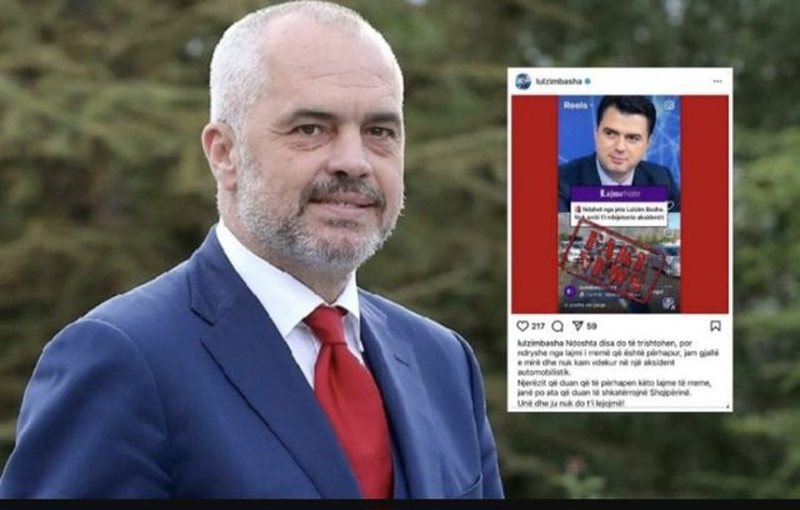
Prime Minister Edi Rama's recent debate on the role of algorithms in social networks and the manipulation of information sounds like a belated alarm, but also a great political irony in itself. For years, Albanian politics has lived precisely within that "algorithm" and disinformation that is being denounced today: a reality where public perception is no longer built on facts, but on the constant amplification, framing and manipulation of the narrative.
In theory, the concern is justified. In practice, it is unbelievable, when it comes from those who have benefited the most from the same system.
Because in Albania, the algorithm is not just technology. It is a political instrument. Its grandmother is Edi Rama
For years, the figure of Lulzim Basha has become the clearest example of how a public image is attacked in the digital age. Not with political arguments, but with an entire industry of irony, memes, and repeated narratives, to damage the image. Do you remember Taulant Balla how he constantly uses a 7X7 slip? He was ironic about Basha's mathematics, to escape the fact that he was denouncing the terrible corruption with the Incendiaries. Balla himself fell victim to the slip in the accounting of the years of Albania's independence. But for Balla this is not a problem, for Basha it is. Because in fact Balla made a slip to defend corruption, and Basha to denounce it.
In this field, investigative reporting like BIRN’s has long raised serious questions about the way digital campaigns are built in Albania, including the use of coordinated communication networks and targeted strategies for public influence during electoral processes. It is not about perceptions, but about a reality where political communication has crossed the line between traditional propaganda and opinion engineering.
Rama, who is complaining today, in 2021 alone has distributed 50 million denigrating messages to diminish Lulzim Basha in the eyes of Albanians. Basha was himself the leader of the opposition and his "mistake" was denouncing Rama's corruption and connections with crime. While Rama is today the prime minister who for 14 years has used the state as private property and a place where criminal money is laundered.
And herein lies the essential hypocrisy of today's debate: The same methods that were once not accepted as a problem are now denounced only when they are perceived to strike in the wrong political direction.
In Britain and other Western countries, investigations and reports have documented networks of automated content and coordinated accounts that have influenced the spread of narratives against political leaders, including figures like Keir Starmer. So the phenomenon is not local, but global. The difference is that there it is discussed as a democratic threat; here Edi Rama has used it as a selective political weapon.
And this makes the debate even fiercer: Because we are not dealing with a war against manipulation, but a war to control manipulation.
In this sense, the question is no longer whether algorithms influence politics. The question is who uses them, when they use them, and against whom.
Because in the end, the double standard has become the rule: When the algorithm hits you, it's called a problem; when it hits your opponent, it's called a political strategy!
But today Rama is not being hit by the algorithm, but by the rampant corruption of his power. /Alfapress.al
Po ndodh...


Basha, Berisha and a meeting with parents in the USA!
Nga Ermal Peçi
ide

Edi Rama, kujt i ankohesh? Ti ke qenë problemi!
Nga Gjergji Nika


The SP and the DP have created an unshakable Nash equilibrium.
Nga Fitim Zekthi
top


receta Alfa


TRENDING 


shërbime
- POLICIA129
- POLICIA RRUGORE126
- URGJENCA112
- ZJARRFIKESJA128