


FLASH NEWS
NAME/ New President of the German Bundestag Elected, Former Minister of Agriculture Holds Second Highest Post in the State

2025-03-25 21:37:48 / BOTA
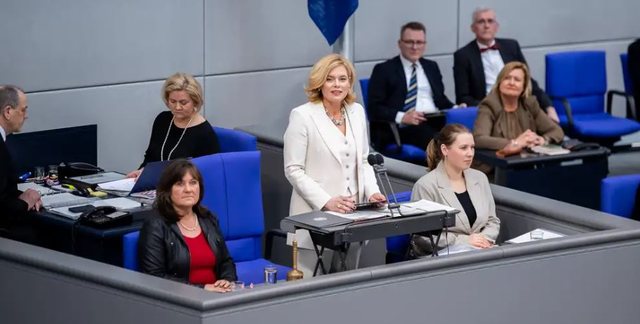
CDU politician Julia Klöckner is the new President of the Bundestag. At the Bundestag's inaugural session, members of parliament overwhelmingly elected the 52-year-old to the second-highest position in the country.
The oldest president in terms of years of service as a deputy, the newly elected Gregor Gysi, after the vote handed over the chairmanship of the session to Klöckner.
The 52-year-old received 382 votes in favor in a secret ballot, 204 MPs voted against and 31 abstained. The potential future governing coalition of the CDU, CSU and SPD has 328 seats in the Bundestag.
Fourth woman in the second highest position in the state
After Annemarie Renger, Rita Süssmuth and her predecessor Bärbel Bas, Klöckner is the fourth woman to hold the second highest office in the state.
The CDU politician said she saw her election as President of the Bundestag as an obligation and expressed gratitude for the trust placed in her. She said she wanted to carry out her duties impartially, calmly and courageously.
“Our liberal democracy is not something to be taken for granted,” Klöckner said in her first speech. She will not only make sure that speaking time is respected, but she will also listen, both on the podium and in the hall. There is a measuring stick here, which is graceful behavior. “I will make sure that we maintain civilized cooperation,” Klöckner said.
The outgoing governing coalition has collapsed due to intense disagreements, Klöckner said. "Given the demands our country faces, we all need to reconsider our style of speaking," she added.
Klöckner: Influence on debates in society
Klöckner emphasized: “The way we treat each other here and exchange arguments influences the debates in society.” She urged: “Let us always be willing to listen to others and understand their motives, even if we do not share them.”
In this sense, the majority is not automatically right, but neither is the minority. “Let us criticize each other, but let us not personally insult each other.” Anyone who takes freedom of expression and diversity seriously must tolerate and accept other points of view.
Regarding the declining percentage of women in parliament, Klöckner called for a better balance between family life and politics. Specifically, she referred to the current need for a “complicated” special permit to bring a baby or small child into the plenary session, for example, during a vote. It is not about turning the Bundestag into a “baby group”, but rather about the realities of life, said the Bundestag President.
Criticism of electoral reform
Klöckner also criticized the recent electoral reform. According to her, it is true that the goal of reducing the size of the German Bundestag has been achieved. However, it is difficult to explain to voters that 23 candidates did not win a single seat, despite having won a majority in their constituencies. "It must be possible to combine the goal of the electoral reform - a significant reduction of the Bundestag - with a comprehensive and fair electoral law," said Klöckner.
Klöckner also raised the possibility of reducing the Bundestag administration's workforce, which currently has 3,200 employees. The question of whether a smaller parliament can manage with fewer resources is legitimate.
The CDU politician was born in Bad Kreuznach, in the state of Rhineland-Palatinate. She was Germany's Minister of Agriculture from 2018 to 2021 under Chancellor Angela Merkel (CDU). Klöckner was a member of the Bundestag from 2002 to 2011 and has served again since 2021.
Most recently, she served as the economic policy spokesperson for the unionist parties. Since 2022, Klöckner has also served as the CDU's federal treasurer. She has now resigned from that position.


Happening now...















Denouncing Berishism is a prerequisite for denouncing the government
Nga Blendi Kajsiu
ideas


top



Alfa recipes








services
- POLICE129
- STREET POLICE126
- AMBULANCE112
- FIREFIGHTER128