


FLASH NEWS
Germany is preparing for exit from the EU?! AfD: We will follow the "Brexit" model

2024-12-21 13:04:33 / BOTA
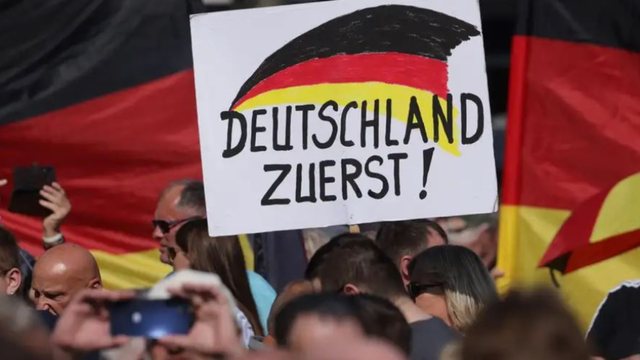
The far-right German party "AfD" has stated in its electoral manifesto that it wants the country to leave the European Union and follow the Brexit model.
The AfD (Alternative for Germany) has doubled down on its promise that if it takes power, it will take the country out of the EU and stop using the common European currency, the Euro.
In an electoral manifesto sent to its members ahead of the internal party vote, expected to take place early next January, the anti-immigration party repeated the promise made during the European elections this summer, saying: "We think that it is necessary for Germany to leave the European Union and create a new European community".
Instead of the EU, the AfD wants to present the so-called "Europe for the Fatherland" platform, a union of states that includes the common market and the "economic community and common interests". The far-right also wants to take Germany out of the single currency area that came into force in 2002 and replace it with a "transfer union". The party admits through this manifesto that such a "radical change" would not be fruitful, therefore it proposes to renegotiate relations with all EU member states and other European states.
For these issues, the AfD demands a referendum, even though the country's exit from the EU would not be so simple since Germany's membership is "sealed" in the Constitution.
Even if in the future the AfD would govern the country and officially request the exit of Germany from the Union, this move would be anti-constitutional, as "Dexit" would require a 2/3 parliamentary majority.
AFD's plan represents a reinforcement of the party's position on the subject of the EU: in February of this year, party co-leader Tino Chrupalla said it was "too late" for Germany to leave the EU.
The other co-leader of the party, at the same time the candidate for Chancellor, Alice Weidel, defined "Dexit" rather as a "Plan B", in an interview given to the British "Financial Times" some time ago.
The most important economic institutions and industrial associations in Germany have condemned this proposal. The German economic institute IW, based in Cologne, has estimated that leaving the EU would cost the country 690 billion euros ($725 billion), because the Gross Domestic Product would shrink by 5.6%, which translates to 2.5 million fewer jobs.
"The damage would be the same as the pandemic and the energy crisis combined" - says the IW study.
The German Association of Small and Medium Businesses (BVMW) was even harsher, describing the AfD's plan as a "kamikaze mission".
In a statement issued before the EU elections in June of this year, the BVMW emphasized all the positive elements that the common currency brings to small and medium-sized businesses: "The monetary union is the proper complement to the common market of EU. This market creates significant facilities for the sale of goods and services in other countries of the Union. The Euro eliminates incalculable risks for commercial companies".
Ronald Gläser, the AfD's spokesman in Berlin, dismisses these concerns.
"Yes, Germany benefits from the EU, but we believe that we would have advantages from other agreements as well. And when I hear economists claiming that leaving would bring economic disaster, then I raise the question: Are they the same ones who said that Europe and England would be horribly affected by Brexit? I remember all the scary scenarios of that time, but in fact everything went more or less normally", Gläser told DW.
A report published by "Cambridge Econometrics" in January of this year found that Brexit blocked economic growth and employment in the United Kingdom, predicting that the country will record 3 million fewer jobs by 2035.
The IW study relied on the impacts that Brexit had on British regions that have similar economies to German regions.
"We can easily have many times greater consequences because we are more connected to the EU than the British. We have the Euro, which means we would have more complications than the British" - said the executive director of IW, Hubertus Bardt, also co-author of the report.
"' Dexit' means that we would be 5.5% poorer in the next 5 years. This would be a severe economic crisis, forewarned long ago. Of course, it would be particularly harmful for companies that depend on the markets and suppliers of other EU states , "said Bardt.
Spokesman Gläser believes that a similar solution could preserve free trade.
"Why do you think that companies and consumers in Italy, France, Sweden or wherever, would no longer want German products if the country is no longer part of the EU? Switzerland is not even in the EU, but exports to all countries "- he said.
"I consider this idea unrealistic, senseless and futile. The destruction of the EU would not bring a new model better than the current one" - says Berdt.
But the idea of "Dexit" is not welcome among the German population. A poll published this year by the Konrad Adenauer Foundation (KAS), which is close to the conservative Christian Democratic Union (CDU) party, concluded that 87% of Germans would vote for the EU if they had to they voted in the referendum.
But why did the AfD decide to include such a drastic and unpopular measure in its electoral manifesto? Gläser insists that leaving the EU would be the right thing for Germans, whether they like it or not.
" We do not draft policies based on surveys. We want to implement the ideas that we think are necessary and important" .
Wolfgang Schroeder, a political science expert at the University of Kassel, emphasized that the AfD's position is in line with the principles on which it was founded: in 2013 they were created as a party of economists, critics after the Euro crisis. They then began to emphasize anti-immigration policies, but their Euro-skepticism was still there, although not as evident as in its beginnings.
"Fundamentally, AfD is a nationalist party. She is an opponent of globalism, which has always brought with it a skeptical attitude towards international authorities. For them, all international organizations such as the EU or the UN have their own goals and values, and therefore are a danger to the true will of the people," said Schroeder.
But is the AfD serious in its proposal to replace the EU with another type of international community, even though this would cause "headaches" for the economy and the constitution?
"We can answer this question in two ways. On the one hand, we say that they are not serious as long as they represent the minority and can say whatever they want to show the panorama of a different world." - says Schroeder.
Personally, Schroeder thinks the AfD's position is a gamble that costs very little, but in the long run.
"They are betting that many countries will agree with their Euro-skepticism and in the future it will be a new development that goes in the direction of Eurasia, with new economic and political perspectives," he said. /DW
-

Terrorist attack/ Reuters: Saudi Arabia had warned the German authorities
December 21, 12:13 -

Happening now...










83 mandates are not immunity for Rama's friends
Nga Gentian Gaba
ideas

top



Alfa recipes




TRENDING 




services
- POLICE129
- STREET POLICE126
- AMBULANCE112
- FIREFIGHTER128