


Lajme flash
950-year-old painting showing UFOs, fact or historical misinterpretation? What do historians say?

2026-04-11 21:02:04 / MISTERE&KURIOZITETE
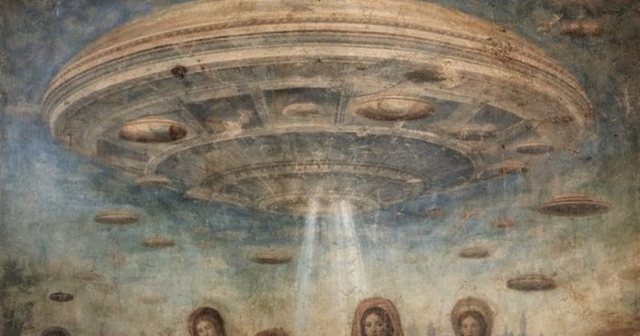
A claim circulating widely on social media says that a 950-year-old painting, discovered in an isolated monastery in Romania, depicts unidentified flying objects (UFOs) over a medieval city.
According to this interpretation, discs appear in the sky that look similar to modern descriptions of UFOs, while the inhabitants below appear frightened.
However, scholars of art history and the medieval period have given different interpretations.
What do historians say?
Experts point out that in medieval art, the elements in the sky are often not realistic representations of physical objects, but religious symbolism.
In the 11th–14th centuries, painters used circular shapes, discs, or "wheels of fire" to represent:
• divine presence
• angels or heavenly forces
• biblical phenomena such as “chariots of fire”
These motifs are often associated with biblical accounts such as the visions of the Israelite prophet Ezekiel, which depict "burning wheels" in the sky - a symbol of God's power, not technology.
Similar cases in Europe
Such claims are not new. Several other works have been misinterpreted as "UFOs":
• “The Crucifixion” (14th century) – some shapes in the sky are interpreted as spaceships, but in fact represent the Sun and Moon.
• “The Madonna with Saint Giovannino” – an object in the background is often called a UFO, but researchers link it to a religious symbol or natural phenomenon.
What about the “monastery notes”?
Descriptions like "wheels of fire" and "metal birds" have historical explanations:
• The “wheels of fire” are consistent with biblical language and the mystical visions of the time.
• “Metal birds” can be poetic metaphors for phenomena such as meteors, comets, or lightning storms.
In the absence of modern scientific knowledge, people in the Middle Ages used symbolic language to describe natural phenomena that they did not fully understand.
Is there evidence for UFOs in the Middle Ages?
To date, there is no scientific evidence that these paintings or writings are documentation of advanced flying objects. Researchers are almost unanimous:
• Modern interpretations often misunderstand ancient art.
• The paintings are mainly religious and cultural symbolism.
• Historical sources are often read out of context.
While the idea that people in the Middle Ages may have seen UFOs is intriguing, evidence suggests that these paintings are a reflection of the religious beliefs and artistic imagination of the time, not evidence of unknown technology.
The painting is a fresco on the wall of the church built in the 13th century, but the paintings were added later (around the 16th–17th centuries).
There, a disc-shaped object is seen above a building, which many people today interpret as a "UFO".
The church is located in Sighișoara, Romania, a Gothic-Lutheran church within the fortified city, part of the historic center protected by UNESCO.
Po ndodh...


ide


top


receta Alfa


TRENDING 


shërbime
- POLICIA129
- POLICIA RRUGORE126
- URGJENCA112
- ZJARRFIKESJA128