


Lajme flash
From elite rotation to elite replacement

2026-07-21 20:36:54 / IDE
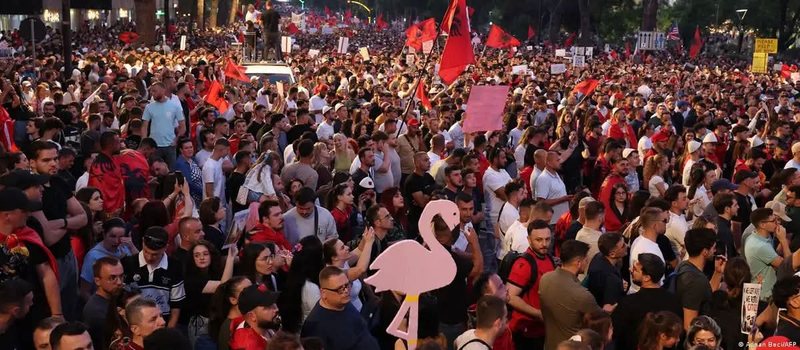
Albania, for more than three decades, has functioned on the logic of power rotation. The Socialist Party and the Democratic Party have been the two main pillars of our political system. They have alternated power, but essentially the two actors that have also monopolized political representation have remained, especially after the constitutional changes of 2008.
As a result, until now, citizens' dissatisfaction and anger has been continuously channeled within the same system, without being able to produce a new alternative outside of it.
However, recent developments with the protest suggest that this model may be entering a phase of transformation.
This is because anger and discontent have rejected the current system and have erupted into the largest protest of all time, a protest that is not only articulating opposition to the government, but is increasingly expressing a distrust of the entire political establishment. This is a qualitative change, not just a quantitative one, and in political science terminology, it represents the transition from a crisis of governance to a crisis of representation.
If in a crisis of governance, citizens demand a change of government, in a crisis of representation, they begin to demand a change of the entire system, and this is because they feel betrayed by the system itself. It is at this moment that space arises for new political actors.
In fact, this is the mechanism that has produced significant transformations in many democracies. First, the legitimacy of traditional elites is weakened (the stage in which the protest is currently located), then a new collective identity is created through social movements, and only in the third stage does political organization arise that seeks to translate this energy into electoral representation.
From this perspective, protest can be seen not only as a form of pressure on the system, but also as a process of producing a new political culture. Within it, groups, networks and communities of faith are created, new demands are articulated and a new generation of individuals is formed, a generation that gains legitimacy through civic engagement and not through traditional party hierarchies.
This is why focusing too much on the number of protesters or the incidents of the day is a formula for avoiding and missing the essence of the process. This is because the most important political changes do not necessarily begin when a new party is created or when an election is won. They begin when the way citizens imagine and conceive of political representation changes.
In this sense, the historical significance of the protest is not measured only by its short-term impact on the government. It can be measured by its ability to bury the entire legacy of the transition along with its most important figures and to create the social and political conditions for the birth of a new elite.
If this process is consolidated, Albania will soon not simply experience another political rotation, but will enter the phase of replacing elites, a process that in the history of democracies constitutes the turning point between a system that reproduces itself (transition) and a system that guarantees the representation of the primary interest of citizens.
Po ndodh...


The "small flower" and the big problem of Rama and Berisha!
Nga Ermal Peçi
ide


It's not the Cauliflower Trust, it's the Aruba Cartel!
Nga Gjergj Erebara

Tri krizat dhe tri zgjidhjet
Nga Përparim Gjeka


receta Alfa


TRENDING 


shërbime
- POLICIA129
- POLICIA RRUGORE126
- URGJENCA112
- ZJARRFIKESJA128