


FLASH NEWS
TID project in Durrës, the state demolishes residents' homes without fair compensation

2025-12-21 11:54:14 / AKTUALITET
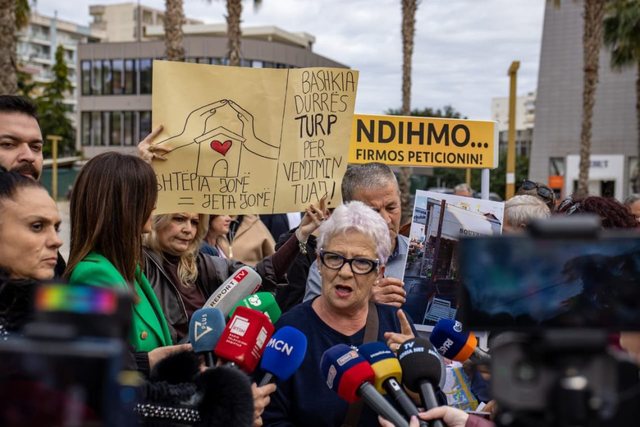
Since learning that his house near "Epidamn" Boulevard would be demolished to make way for the TID Durrës project, Isuf Idrizi has traveled five times to his hometown from Padua in Italy, where he has lived for years.
But in addition to the uncertainty and rising bills, Idrizi is also recently facing legal costs for challenging the amount of compensation determined by the government. And the lawsuit seems to be bearing fruit.
Idrizi told BIRN that unlike the Municipality's initial calculations, the Council of Ministers' decision combined with the court's assessments have tripled the value of his 188.7 square meter property.
"But who will win in the end, God knows," he shrugs.
Most of the families affected by the revitalization project of the historic center of Durrës are in the same situation.
Following last month's protests, the community of residents has begun efforts to pursue judicial proceedings, file administrative requests and complaints, and communicate with national and international institutions.
“The goal of the community is not to block development or hinder investments,” urban planner Entela Koja, a representative of one of the families, told BIRN, “but to establish the law, guarantee justice and respect the principle of proportionality, so that urban development is not carried out at the expense of the fundamental rights of citizens and the city’s heritage.”
According to Koja, the families affected by the TID Durrës project were not consulted and were not made aware of the existence, design or content of the project, despite the fact that this project had direct links to their properties. She also added that the process was deeply closed, conducted away from the community that was actually affected by the consequences.
The first notification to the families came only after the decision-making had been completed, placing them in front of a fait accompli, contrary to every principle of democratic planning and the right to participation.
The "Durresi Autokton" association has also defended the interests of citizens, in the absence of consultation with the parties.
"The hearings were held when the projects were completed," said the association's leaders.
For more than two months, "Durresi Autokton" has addressed its concerns to the Albanian Parliament, as well as to the EU and US embassies.
"The "Epidamn" Boulevard was reformatted after the 1926 earthquake, 100 years ago. It has preserved almost the entire structure of the period when it was built, so it constitutes a value of the city's historical heritage," the president of this association, Abdulla Deliallisi, told BIRN.
The head of "Durrësi Autokton" believes that preserving the boulevard in its current form would do the city's history a favor. According to him, even possible changes to the facades of homes and businesses could be made by the residents themselves, as happened in 2000.
He notes that in the interpellation to the Parliament, the Minister of Culture Blendi Gonxhe, did not mention the fact that residents and some interest groups have been against the implementation of the TID project. The association has requested from the Albanian Parliament to “exercise parliamentary control over the decisions and procedures followed” as well as to intervene for the immediate suspension of the demolitions “until a fair and acceptable solution is found for all parties”.
Isuf Idrizi, who lives a few meters away from the boulevard, said he has opposed the project from the beginning. He adds that in the square where his house is located, there are 16 other families who have gone to court as a group regarding the low price of the land.
“My parents' house, slated for demolition, is not on the housing compensation lists,” says Idrizi, implying that the project has been selective.
Urban planner Entela Koja says that the Municipality of Durrës has been formally designated as the beneficiary of the project, but this status does not exclude or free it from its legal obligations for planning, management and control of the territory.
According to her, the Municipality in this case has given up its controlling and protective role, leaving decision-making to structures outside local control and without clear institutional accountability. Its interventions have been limited to some additions or partial modifications of the project, which in many cases are perceived more as selective or clientelistic solutions, than as real efforts to regulate the urban situation and protect the general interest.
“This project is a deeply wrong intervention, especially in an area with extreme sensitivity of cultural and urban heritage stratification,” Koja stressed./ BIRN
Happening now...













The New Republic that Basha proclaimed 10 years ago is coming!
Nga Erion Delvina
ideas

US and Trump sign sanctions against Rama and Berisha
Nga Ermal Peçi

"Preliminary sentence for Belinda Balluku", response to Baton Haxhiu
Nga Blendi Kajsiu

Teatri që fsheh prapaskenën
Nga Patrik Sadikaj
top







TRENDING 




services
- POLICE129
- STREET POLICE126
- AMBULANCE112
- FIREFIGHTER128