


FLASH NEWS
Early elections on the horizon for Kosovo?

2026-02-27 17:44:40 / KOSOVA
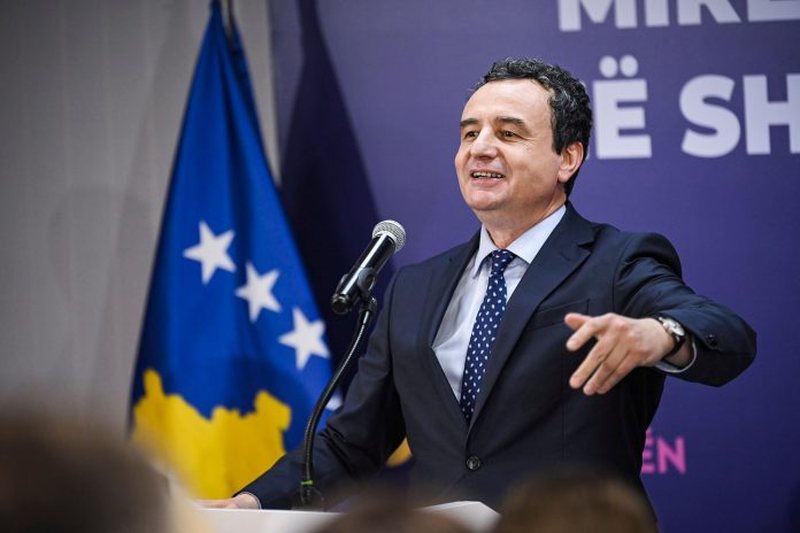
As if a pair of early elections last December, and a full legislative year lost – such as 2025 – were not enough – political parties in Kosovo risk starting an election campaign again within a few weeks, as they are unable to find consensus on a name for the country's president.
There are only five days left until the deadline when the Kosovo Assembly must vote to elect a new president, otherwise, according to the Constitution, it will be dissolved and new elections will be called.
The current president, Vjosa Osmani, expires her five-year term on April 4, but the Assembly must vote for the president for a new term by March 4 at the latest.
The President has announced her intention to seek an additional term, but it appears she does not have the necessary votes.
She won her first term on the proposal of the Vetevendosje Movement (LVV), but the party no longer mentions her name. Opposition parties have criticized her on occasion for being biased in favor of LVV and do not seem to be in the mood to vote for her for another term.
But these parties are not even mentioning other potential names for the position of president.
So far, it is known that Kosovo's Prime Minister, Albin Kurti, leader of the ruling party, the Vetevendosje Movement (LVV), has met separately with the leaders of the main opposition parties: Bedri Hamza of the Democratic Party of Kosovo (PDK) and Lumir Abdixhiku of the Democratic League of Kosovo (LDK).
There was no progress after the meetings.
Analyst Rrahman Paçarizi, a professor at the Department of Journalism at the University of Pristina, tells Radio Free Europe (RFE/RL) that the lack of transparency calls into question the seriousness of political parties to elect a new president on time.
"Perhaps there is a hidden will among political parties, including the largest party, the Vetëvendosje Movement, for the country to go to elections again," says Paçarizi.
No party mentions names, although PDK said a few days ago that it has one, but did not identify it by name.
Kurti claimed days ago that he is making "every effort" to avoid early elections, but did not indicate who his candidate would be or whether he would support President Osmani.
Who was mentioned for this position?
For days, there was talk of the possibility of a member of the family of the hero Adem Jashari being at the head of state, including Deputy Prime Minister Glauk Konjufca himself.
However, members of this family have made it clear to the media that they have no ambitions for this position.
Unlike them, former Minister of Public Administration and Education, Arsim Bajrami, has expressed his willingness to become president.
Similarly, the leader of the Alliance for the Future of Kosovo (AAK), Ramush Haradinaj, expressed his willingness weeks ago, but other parties have not given him support.
To propose a candidate for president, 30 signatures of MPs must be obtained, while LVV alone has 57 of them.
To elect a candidate, at least 80 votes are needed in one of the first two rounds, or 61 in the third, out of 120 votes in total.
What are the chances of an agreement?
There are reports that Kurti may meet Hamza and Abdixhiku again on Friday, in an attempt to reach an agreement.
According to Paçariz, the chances of an agreement do not look that good.
"It is likely that they will agree, but as long as we have not had public meetings between the leaders of the opposition parties to coordinate or agree on a name that they would bring to Mr. Kurti's table... it does not seem that there can be an agreement today."
However, he does not rule out that Friday's possible meeting could produce "movement forward, agreement on principles at a time when the Jashars have refused and at a time when we do not know Kurti's approach to President Osmani."
According to him, more than anything, the issue is complicated by the lack of coordination among opposition parties on a name they could present to Prime Minister Kurti.
"I am afraid that coordination between PDK and LDK on the candidate is more difficult than Kurti accepting a consensual candidate that the opposition parties would agree on. I see the problem more with the opposition parties than with the relationship with Kurti in this sense," he adds.
Thus, Kosovo risks facing elections, less than a month after a new government was formed.
This would be another blow to the country, as these would be the second early elections in months.
Civil society organizations have called for such a process to be avoided, demanding that civic interests be placed before party interests./ REL
Happening now...






Denouncing Berishism is a prerequisite for denouncing the government
Nga Blendi Kajsiu
ideas

American Libra!
Nga Arian Galdini


The Hungarian lecture and 4 messages for the political establishment in Albania
Nga Kreshnik Spahiu
top



Alfa recipes







services
- POLICE129
- STREET POLICE126
- AMBULANCE112
- FIREFIGHTER128