


Lajme flash
It will happen overnight, here's everything you need to know about the blue moon phenomenon

2026-05-31 16:03:13 / MISTERE&KURIOZITETE
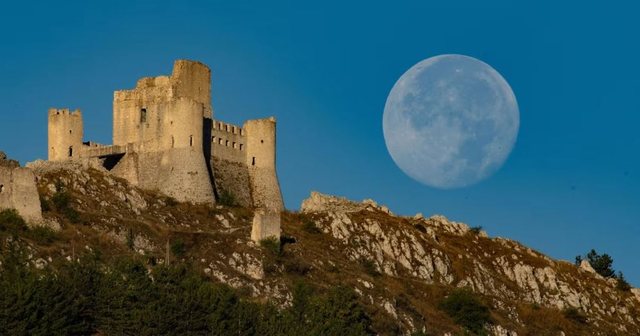
You've probably heard the expression "once in a blue moon." You've probably also used it to describe a rare event in your life, for example, how often you buy a new cell phone.
But this weekend will bring a true blue moon: the second full moon to appear in the sky within the same month.
This celestial event occurs about seven times every 19 years, or roughly every two to three years.
What is a blue moon?
The lunar cycle has eight phases and lasts about 29.5 days, slightly less than the typical length of a month. As a result of this discrepancy, sometimes a month can have two full moons. The second of these is called a “blue moon,” or more accurately, a calendar blue moon.
Sometimes even a single year can have two blue moons. In 2018, January and March each had two full moons, while February had none. The next time this phenomenon is expected to occur is in 2037.
Another kind of blue moon
There is also a seasonal blue moon. This occurs when four full moons, instead of the usual three, appear within a quarter-year period. In this case, the third full moon is considered a blue moon. The next seasonal blue moon is expected on May 20, 2027.
Is the moon really blue?
Despite its name, Earth's natural satellite will appear in its usual color: silvery white or golden.
The phrase "blue moon" dates back to the 1500s and was originally used to describe something that was considered impossible. Later, the term evolved to refer to the astronomical phenomenon we know today.
However, on rare occasions, the moon can appear blue when the atmosphere contains smoke or dust particles of specific sizes. One such case was reported after the eruption of the Krakatoa volcano in 1883.
How to see the blue moon
May's blue moon will peak at 4:45 a.m. Eastern Time, before sunrise. The event will also include a micromoon, meaning the moon will be near its farthest point from Earth.
Because the Moon's orbit is not a perfect circle, its distance from Earth varies. The closest point is called perigee, while the farthest is called apogee. When a full moon occurs near apogee, it is called a micromoon.
This weekend's moon will be about 406,093 kilometers away from Earth, compared to the average distance of about 384,400 kilometers. However, this difference will not be easily visible to the naked eye.
For America, Africa and Europe, the Moon will appear fullest on the night of May 30, while Australia, New Zealand and Asia will see it brightest on the night of May 31.
For best photos, the ideal moment is shortly after moonrise, when the sky still retains the colors of twilight and the visual contrast is strongest.
Po ndodh...


The "small flower" and the big problem of Rama and Berisha!
Nga Ermal Peçi
ide

It's not the Cauliflower Trust, it's the Aruba Cartel!
Nga Gjergj Erebara

Tri krizat dhe tri zgjidhjet
Nga Përparim Gjeka

Innocence for the liberators, so that history is not judged!
Nga Azgan Haklaj
top


TRENDING 


shërbime
- POLICIA129
- POLICIA RRUGORE126
- URGJENCA112
- ZJARRFIKESJA128