


Lajme flash
NASA reveals plan for a permanent base on the Moon, US wants to return astronauts before 2029

2026-05-27 09:49:23 / MISTERE&KURIOZITETE
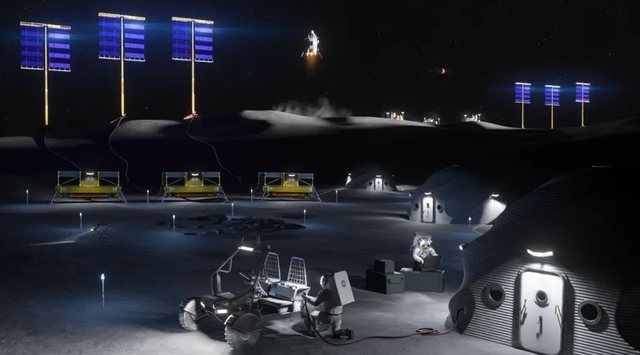
NASA has released new details on its ambitious program to return humans to the Moon and build a permanent lunar base, including robotic landers, exploration drones and astronaut transport vehicles.
Amazon founder Jeff Bezos' space company Blue Origin is one of several companies selected to build the vehicles. The US aims to land American astronauts on the moon again before President Donald Trump leaves office in 2029, the BBC reports.
However, NASA is facing a fierce competition with China to return humans to the lunar surface, which is increasing pressure on the US agency to show progress in the "new space race."
China is moving forward with its plans to send astronauts to the Moon by 2030. In March, it launched the Shenzhou-23 spacecraft, sending a crew of astronauts to the Tiangong space station.
In March, NASA announced a $20 billion program to build a permanent base on the moon's south pole by 2032, which would run on nuclear and solar power.
NASA Administrator Jared Isaacman said Tuesday that these plans mean the US "will never give up on the Moon again."
Such a base would allow the US to conduct scientific experiments, potentially tap into valuable resources, and more easily prepare missions to Mars. However, most experts believe NASA's timelines are optimistic rather than realistic.
Despite the success of the Artemis II mission, during which four astronauts orbited the Moon in April, some scientists believe that China could be the next country to land humans on the lunar surface.
"I would be very surprised if China gets there first," Dr. Simeon Barber, a lunar scientist at the Open University, told BBC News, highlighting NASA's difficulties in securing a reliable lunar landing craft.
Before sending humans, the agency plans to send robotic landers and "jumping" drones to explore and map the difficult lunar terrain. It will also send transport vehicles that will move astronauts to the surface and carry communications equipment and scientific instruments.
NASA has announced that the companies Intuitive Machines and Astrobotic, along with Blue Origin, have been selected to build these vehicles.
NASA aims for Blue Origin's lunar lander, called Endurance, to be capable of precision landings, as well as autonomous navigation and control. Meanwhile, Astrobotic's Griffin-1 lander is expected to touch down in Nobile crater near the moon's south pole.
These vehicles will also carry scientific instruments, including high-resolution cameras and devices that use reflected laser light to help accurately land the ships.
Robotic exploration is expected to last until 2029, with about 25 launches and about 4 tons of cargo sent to the Moon, according to Carlos García-Galán, head of the Moon Base program.
In the second phase, NASA plans to build energy infrastructure on the Moon, including nuclear and solar power plants, as well as small fission reactors. By 2032, the goal is for people to be able to live in “semi-permanent” habitats on the Moon.
Rovers will allow astronauts to travel long distances over the rocky surface. The moon's south pole is particularly attractive because of the possible presence of frozen water, which could be used for drinking water or for oxygen production.
However, these plans depend on the readiness of a spacecraft that can safely transport humans to the Moon.
Elon Musk's SpaceX company has been contracted to build the "Starship Human Landing System" vehicle, but the project has encountered numerous delays and obstacles.
“The main challenge is getting astronauts back to the surface,” explains Dr. Simeon Barber. “It seems like NASA is at a stage where they need to show that they have concrete plans, so there is also a strong political push behind these announcements.”
Po ndodh...


The "small flower" and the big problem of Rama and Berisha!
Nga Ermal Peçi
ide

It's not the Cauliflower Trust, it's the Aruba Cartel!
Nga Gjergj Erebara

Tri krizat dhe tri zgjidhjet
Nga Përparim Gjeka

Innocence for the liberators, so that history is not judged!
Nga Azgan Haklaj
top


TRENDING 


shërbime
- POLICIA129
- POLICIA RRUGORE126
- URGJENCA112
- ZJARRFIKESJA128