


Lajme flash
Horrifying discovery in the Sahara desert, 260 circular tombs found with a frightening hierarchy and 6,000 years old!

2026-06-02 14:53:53 / MISTERE&KURIOZITETE
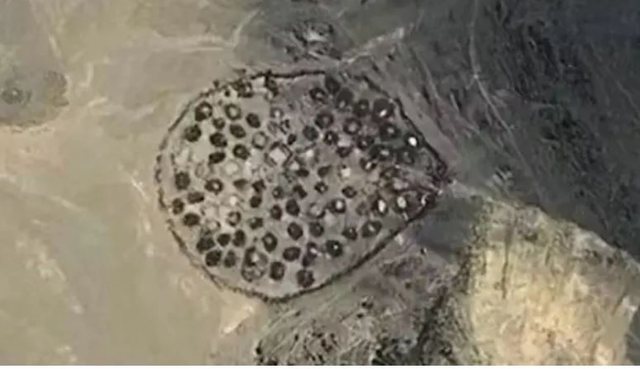
Researchers have discovered 260 previously unknown, 6,000-year-old mass graves scattered across the desert, which hide a strict and frightening social hierarchy.
A team of researchers from Macquarie University, France's HiSoMA research unit and the Polish Academy of Sciences said they have discovered 260 previously unknown mass graves spread over an area of almost 1,000 kilometers in the Atbai Desert, east of the Nile River.
All the tombs share one deeply eerie detail. Each site follows exactly the same pattern: a large circular wall, some up to 80 meters in diameter, containing human and animal bones carefully arranged inside.
However, at the center of each structure lies a single, extremely important person. All other people, as well as animals, are buried around him.
6,000-year-old tombs of desert nomads
The tombs are believed to date back to around 4000-3000 BC, making them around 6,000 years old, predating Pharaonic Egypt. The researchers did not find them by digging, but through satellite imagery, systematically scanning the desert from above.
The absolute consistency of their structure indicates a common nomadic culture that extended across much of the Sahara. Scientists believe that these people were desert nomads, pastoralists who lived with their herds.
Cattle appear to have had great cultural significance, as evidenced by ancient rock paintings from the region. Owning a large herd in such a harsh environment was the ultimate symbol of social status. Thus, when the owner died, the herd followed him to the grave.
The social elite of the desert
The tombs suggest the early emergence of a social elite. The clear hierarchy, with the central “primary” burial surrounded by “secondary” graves, indicates that the chiefs or leaders of the community were honored after death in ways that were not the case for ordinary nomads.
These people were eventually wiped out, not by war, but by climate. As the once-green Sahara began to dry up at the end of the “African Wet Period,” the land could no longer support large herds of cattle.
The nomads either moved south, fled to the Nile, or simply disappeared. Although their tombs survived for millennia, they are now under imminent threat, as unregulated mining activity in the region is destroying many of these monuments.
Po ndodh...


The "small flower" and the big problem of Rama and Berisha!
Nga Ermal Peçi
ide

It's not the Cauliflower Trust, it's the Aruba Cartel!
Nga Gjergj Erebara

Tri krizat dhe tri zgjidhjet
Nga Përparim Gjeka

Innocence for the liberators, so that history is not judged!
Nga Azgan Haklaj
top


TRENDING 


shërbime
- POLICIA129
- POLICIA RRUGORE126
- URGJENCA112
- ZJARRFIKESJA128