


FLASH NEWS
BILD: After Iran and the US, now China is also blocking an important sea route

2026-04-16 12:29:46 / BOTA
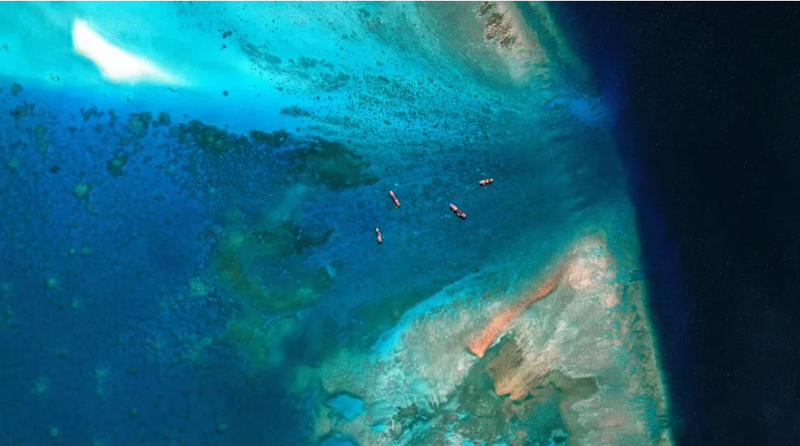
While Iran and the US are de facto blocking the Strait of Hormuz and simultaneously discussing a possible agreement, another maritime crisis is escalating thousands of kilometers away: China appears to be tightening its grip on the Panatag Barrier, a disputed and strategic area in the South China Sea. This risks another blockade!
Satellite images show China is using ships and a floating barrier to block access to the island in the South China Sea. The cause is tensions with the Philippines over the barrier, which is located about 220 km west of the Philippine island of Luzon. Both countries claim the territory, as it is in an important fishing and trading area.
Geopolitics expert Professor Klemens Fischer (61, University of Cologne) warns: “While the world is focused on the Strait of Hormuz and the dual blockade by Iran and the US, China, some 3,700 nautical miles away in the South China Sea, is also starting to build a naval blockade.”
For the Philippines, this is a provocation: according to the Reuters news agency, their ships have been repeatedly chased away by Chinese units, even though they claim the barrier is within their economic zone – something China has ignored for years. This case could serve as a test to see whether China can handle these kinds of blockades, according to Prof. Fischer. The fear is that if Beijing succeeds, it could try to control even more sea lanes, step by step.
China's maneuver has "a completely different dimension" than the current blockade of Hormuz, Fischer points out. He explains: "About a third of the world's maritime trade passes through the South China Sea every year, worth about $3.3 trillion. Seven neighboring countries are competing in nine different areas for exclusive claims, and China is involved in almost every conflict."
Blocking sea routes is becoming a "sport of great powers"
The consequences of a complete blockade would be felt worldwide – including in Europe. Fischer warns: “This uncertainty alone is enough to increase insurance premiums for ships and cargo, thus increasing transport costs, which are then reflected in prices for consumers.”
In other words: many products could become more expensive.
The professor gives a grim conclusion: "If blocking sea routes, which are vital to the world economy, becomes a sport of great powers, Europeans will be the ones paying the price, without being able to intervene."/ BILD
Happening now...















Denouncing Berishism is a prerequisite for denouncing the government
Nga Blendi Kajsiu
ideas

The Hungarian lecture and 4 messages for the political establishment in Albania
Nga Kreshnik Spahiu

Viktor Orban dictator?
Nga Indrit Vokshi

top



Alfa recipes







services
- POLICE129
- STREET POLICE126
- AMBULANCE112
- FIREFIGHTER128