


FLASH NEWS
Lea Ypi and the Albanian media transition

2026-01-07 21:10:34 / IDE
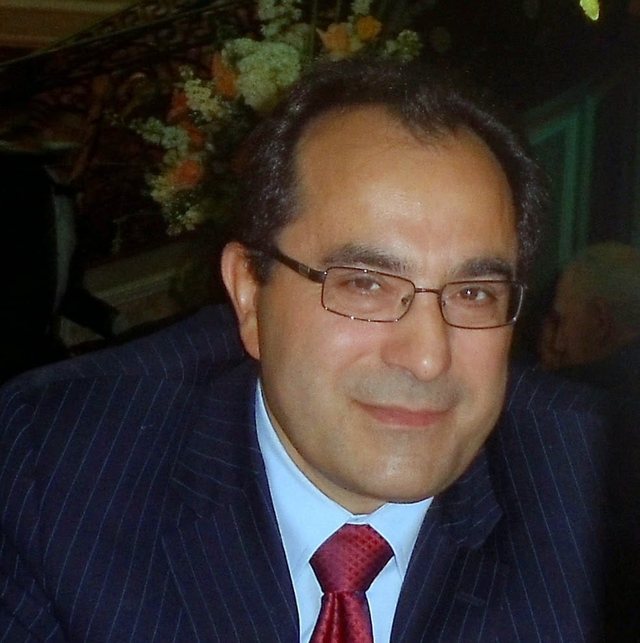
The Intellectual, the Opposition and the Illusion of Salvation
The Albanian transition is not only political and institutional; it is, above all, media and symbolic. It produces not solutions, but figures; not programs, but names; not accountability, but narrative. And it is precisely in this terrain that the latest debate about Lea Ypi arises and is explained.
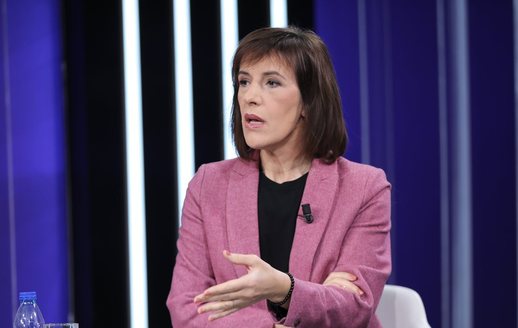
The Ypi case is not simply a debate about an intellectual, an author, or an Albanian academic with an international reputation. It is a pure case study of the Albanian media transition: the way in which a worn-out political system, a powerless opposition and a captive media produce artificial “hope” in order not to face reality.
Lea Ypi entered the Albanian public debate as an idea. As an author. As a reflective voice on freedom, history, communism and personal experience. But the moment when her name began to circulate as “a possibility for a prime minister of a technical government” marks precisely the fatal slide from idea to political image.
From here, Ypi ceases to be simply an intellectual and becomes a symbolic figure of transition: a name that excites the collective desire for “someone different”, for “a clean face”, for “the unconsummated solution”. And this desire is not innocent. It is the product of fatigue, disappointment and the lack of a real alternative.
The opposition without a project and the need for names
An opposition that would have a program, structure and civic trust would not need to flirt with random names. The debate about Ypi, in fact, exposes the deep void of the Albanian opposition: the lack of a political project.
Instead of a platform for the rule of law, for justice, for the economy or for the liberation of institutions, a discussion is produced about “would Lea Ypi accept a leadership role or not”. This is the peak of politics as a reality show: the public is offered an exciting narrative to keep them engaged, while real power remains intact.
Even when the opposition does not directly articulate this offer, it is enough for the topic to circulate to shift the focus from its real failures.
Media as an incubator of illusion
In a functional democracy, the media would ask the intellectual: what do you think about this specific regime? what are the responsibilities? what are the solutions?
In Albania, the media asks: will you accept a position? will you enter politics? are you ready to take over the country?
This is not journalism. It is political casting.
The Albanian media loves Ypi not for its thesis, but for the symbolism it carries: intellectual, successful abroad, articulate, acceptable to the West, untainted by domestic propaganda. In other words, ideal to be sold as a “moral solution”, without the need to touch the real structures of power.
Criticisms from the opposition and its circle: partial, but symptomatic
The criticisms leveled at Lea Ypi by voices linked to the opposition are diverse, but rarely substantive.
Some attack her ideologically, accusing her of relativizing communism. Others see her as a figure who is “being appropriated by the regime.” Some use her family biography to construct tribal narratives.
But most of these criticisms do not aim to discuss her ideas. They aim to position themselves: to justify the opposition’s incompetence, to cover the programmatic gap, or to create symbolic enemies.
In this sense, Lea Ypi becomes a mirror of the crisis of the Albanian political system, not its source.
The Harmless Intellectual in a Captive Society
In captive societies, there is an unwritten rule:
• Intellectuals who demand accountability are marginalized.
• Intellectuals who speak in an abstract manner are promoted.
• Intellectuals who can be instrumentalized are sold as salvation.
Lea Ypi, whether she wants to or not, risks falling into the third category. Not because she is part of the regime, but because her discourse — theoretical, retrospective, universal — does not directly challenge the concrete power that produces injustice today.
And this makes her harmless to existing structures.
The problem is not Lea Ypi.
Let us be clear: the problem is not Lea Ypi as an individual, as an author or as a thinker. The problem is the way in which the Albanian transition produces and consumes intellectuals.
Albanian society does not need “symbolic hopes”, but rather confrontation with reality. It does not need intellectuals who circulate as savior names, but voices that take on costs, that clash with power and that accept the loneliness of truth.
The Lea Ypi case is a symptom, not a cause. A symptom of a society that seeks a way out without changing course. Of an opposition that seeks a figure without a project. Of a media that produces illusions instead of responsibility.
In this sense, the debate about Ypi is not a debate about the intellectual, but evidence of a transition that is not yet over — because it has never seriously begun to close.
And until Albanian politics deals with structures and not names, with programs and not images, cases like this will be repeated. With Ypi today. With another one tomorrow.
Happening now...








The revolution is over, Edi Rama continues calmly
Nga Bato Kosova
ideas


The great loneliness of the West and liberal democracy
Nga The Economist

Corruption money is buying political time.
Nga Taulanda Jupi
top







TRENDING 




services
- POLICE129
- STREET POLICE126
- AMBULANCE112
- FIREFIGHTER128