


Lajme flash
From party-state to party-tribe: Albania's unfinished transition

2026-07-03 17:01:58 / IDE
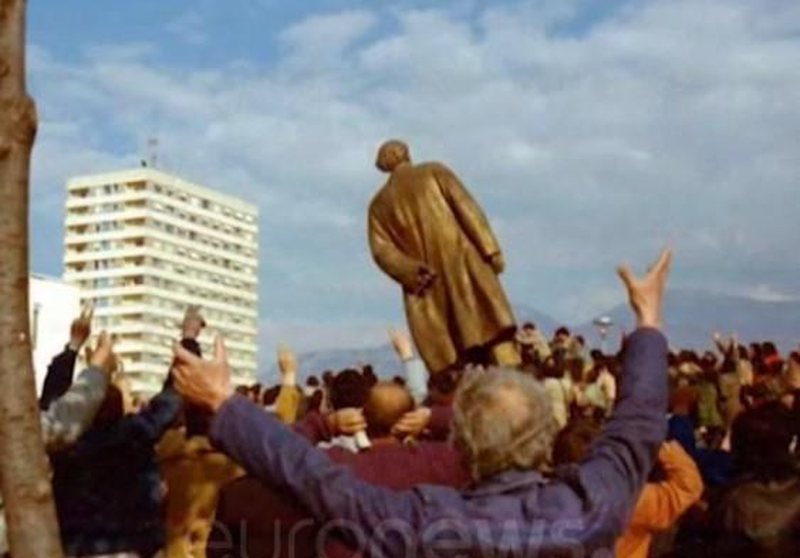
One of the most common claims about Albania is that it transitioned from communism to democracy. This is true on a formal level. A democratic constitution was adopted, a multi-party system was established, pluralistic elections were held, new institutions were built, and the country was oriented towards Euro-Atlantic integration.
But if we look at the transition not only through laws, but also through political culture, the picture becomes more complex.
Albania has not completely transitioned from a party-state to an institutional republic. In many respects, it has transitioned from a party-state to a party-tribe.
This is not an anthropological definition. It is a political metaphor that attempts to explain why, even after more than three decades of pluralism, institutions continue to be weaker than leaders and loyalty to the individual often prevails over loyalty to the law.
In the communist system, there was only one party. It was the state, the law, the economy, justice, and ideology. Loyalty was not required to the Constitution, but to the Party. Career did not depend on merit, but on political credibility. Opposition was not considered debate, but hostility.
The pluralism of 1990 changed the institutional architecture of the state. It could not automatically change the political culture built over nearly five decades.
Thus, many of the mechanisms of persuasion were transferred from the single party to competing parties. Instead of a single center of power, several centers were created.
But the logic often remained similar.
Instead of loyalty to the Party, loyalty to the leader was built. Instead of ideological centralization, personal centralization developed.
Instead of a single party monopoly, small monopolies were created within each party. This is why many Albanian parties function more as communities of loyalty than as modern political organizations.
In a functional democracy, the party is a means of representing citizens.
In a “party-tribe,” the party risks becoming an identity community where the main bond is not the program, but affiliation. In a democratic party, the leader is elected and replaceable.
In a tribal party, the leader becomes the axis of political identity. In a democratic party, criticism is considered a corrective mechanism. In a tribal party, criticism is perceived as an act of disloyalty.
In a democratic party, debate produces better decisions. In a tribal party, unanimity is often valued more than argument. This culture does not remain within the parties alone. It permeates the administration, the parliament, the media, the university, and even social relations.
The citizen is no longer asked: "What do you think about this policy?"
The question is: "Who are you with?"
This is the moment when political identity begins to replace citizenship. Society is divided into camps that each construct their own truth.
Each camp has its own media.
Their own experts.
Their own heroes.
Even its own facts.
In this climate, compromise begins to be seen as weakness, and dialogue as betrayal. This is one of the reasons why political polarization in Albania remains so deep.
The problem is not just competition between parties. Democracy thrives on competition. The problem arises when competition is replaced by tribal logic, where the victory of the other is perceived as an existential loss for the group and not as a normal part of democratic alternation.
The most serious consequence is not political conflict. The most serious consequence is the weakening of the state.
Because the moment citizens trust the leader more than the institution, the republic begins to lose its foundation. Institutions only function when they are respected even by the losers.
The law has authority only when it is applied to the winners. Democracy survives only when no one is above the institutions.
This is precisely where the relevance of Fan Noli lies.
When he spoke of "moral anarchy," he was not describing the absence of laws, but the absence of a political culture where responsibility was stronger than interest.
When he spoke of "patriotic anarchy," he warned of the danger of patriotism being used as a means of legitimization rather than as an obligation for state building.
When he spoke of the "anarchy of ideals," he saw a society that had not yet decided whether to build modern institutions or remain hostage to old customs.
A century later, Albania no longer needs to choose between East and West.
It must choose between two political cultures.
Between the culture of loyalty to the individual and the culture of loyalty to the law.
Between the party as a tribe and the party as a democratic institution.
Between the personalized state and the constitutional republic.
The Albanian transition will not end the day the next government changes.
It will end only when the citizen no longer needs to seek protection from the leader, but finds it in the law; when parties are not built on the cult of the individual, but on the competition of ideas; and when the state is not the property of the winner of the elections, but the common home of all citizens.
Only then will we be able to say that Albania has truly moved from a party-state to a constitutional democracy. Until then, the risk remains that pluralism will produce not a republic of citizens, but a system where parties function, in many respects, like modern political tribes.
Po ndodh...


Rama's government no longer has enough Berisha!
Nga Indrit Gjyzeli
ide


top

Wall Street Journal: Gangsteri që ka futur në telashe dhëndrin e Trump me marrëveshjet në Shqipëri
Eliot Brown, Vladimir Karaj





TRENDING 




shërbime
- POLICIA129
- POLICIA RRUGORE126
- URGJENCA112
- ZJARRFIKESJA128